

The Year and a Day
A Lantern Tale · Original Fiction · Lucas Varro
An original Lantern Tale by Lucas Varro, set among the tidal channels of the Flats, where a saltmaker tends a fire for a year and a day.
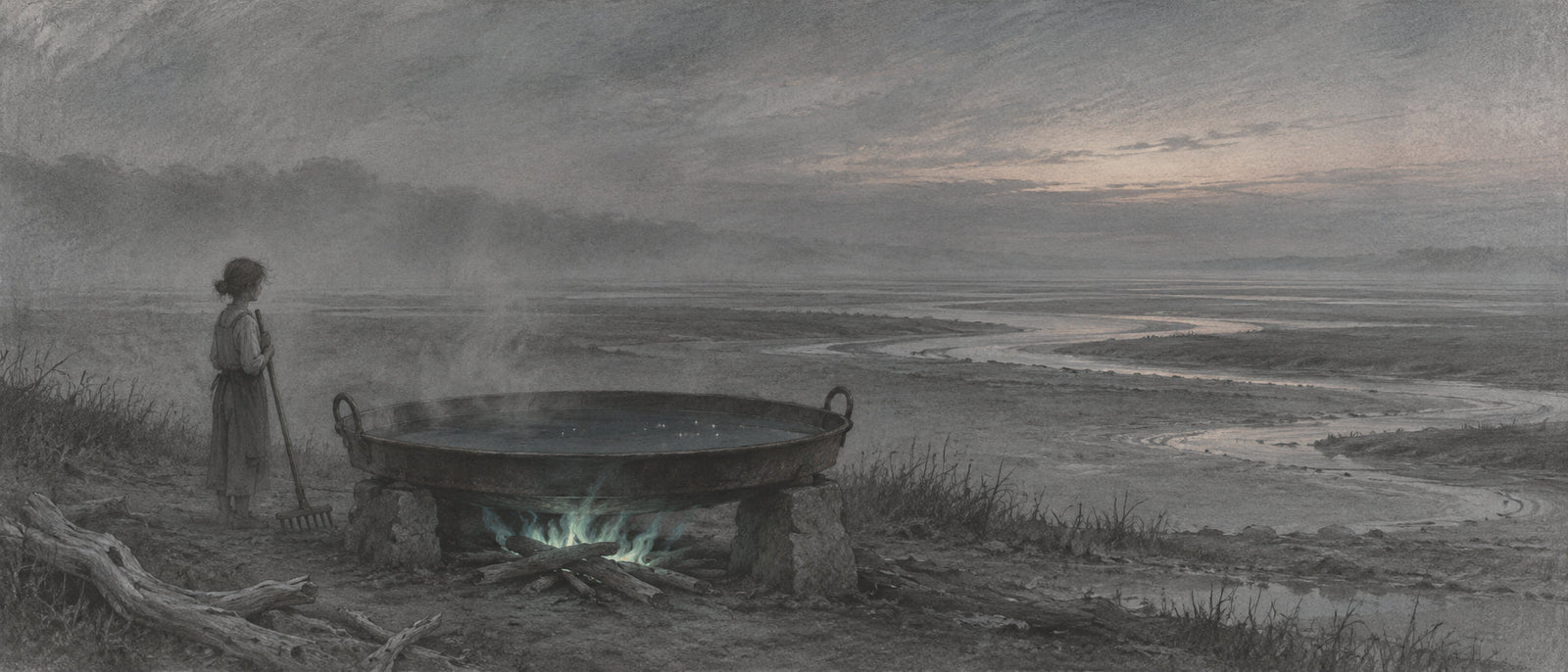
The first night the driftwood burned blue, and the raker thought the sea was burning with it.
He had never seen such a fire. The flames were the colour of the deep water beneath a boat, with little green tongues that ran along the salt in the wood. Yet when he put out his hands, the heat was no different from any other, and the smoke found his eyes as readily as ordinary smoke.
The Saltwife watched him from across the great iron pan.
‘Keep it so,’ she said.
He fed another length of driftwood into the pit.
The pan stood on the lower shoulder of a mound above the Flats, behind a bank of packed mud that kept out the spring tides. It had taken eight men to drag it there. Beneath it a hearth was sunk into the working floor; beyond the drying shelves the ground climbed to a narrow upper bank where even the highest water could not reach. A stone-lined channel ran from the creek through the packed bank, opening beside the hearth and closed at its outer end by a wooden sluice. Twice a day the sea rose and fell beyond the gate. A heavy crossbar held the gate shut against the flood.
Beyond the mound the estuary stretched so far that the opposite shore was seldom seen. Creeks wandered through the mud, dividing and joining again. At low tide there were paths a man might walk. At high tide the same paths lay beneath fathoms of grey water. The people of the Flats knew when to leave them, for they felt the turning of the tide long before the first water moved.
The Saltwife's daughter did not.
The raker had seen this on the morning he came. The other children had been gathering cockles below the bank. All at once they straightened, though nothing in the water had changed, and began climbing towards the houses. The Saltwife's daughter remained kneeling in the mud, arranging small shells in a line.
One of the children called to her. She looked up, saw the others going, and gathered her shells. The raker, who possessed no tide-sense himself, had followed them all.
He was a foundling from the inland road, taken in because his hands were quick and he was willing to work for bread. He knew little of the sea. He had been told that on the Flats a man could drown while standing in the place where he had eaten his breakfast.
The Saltwife gave him an iron rake with a wooden handle worn smooth by other hands. He was to move it through the brine without ceasing, scraping the bottom of the pan before the salt could burn upon it. He was to skim the white crust when it rose, carry it to the drying shelves, fetch fuel from the stacks, and keep the fire alive whenever the Saltwife slept. The work would last a year and a day.
He asked what they were making.
‘Salt,’ she said.
There were already sheds full of salt along the shore, and he looked towards them.
‘Not that salt.’
She looked towards her daughter. ‘When it is ready, she will know when the water turns.’
He did not ask again.
The daughter brought him water and a bowl of barley porridge. She was perhaps a year younger than he was, narrow in the shoulders, with dark hair that would not remain bound and a small scar across one knuckle. Around her wrist she wore a cord with knots tied into it. Some were large enough to find with a cold finger; others were so small that he wondered how they had been made.
She caught him looking.
‘Those are the tides,’ she said.
He counted seventeen knots before the cord disappeared beneath her sleeve.
‘There are more,’ she told him.
That evening she sat beside the sluice with a piece of chalk and an old board, marking the rise of the water against a stake driven into the creek. When the Saltwife called her to supper, she made one more mark before answering.
The raker watched her climb the bank.
He thought she was afraid of being caught by the water.
Continue reading: The Year and a Day in the Saturday Lantern on Substack
More from the Library

The Water Must Be Drawn
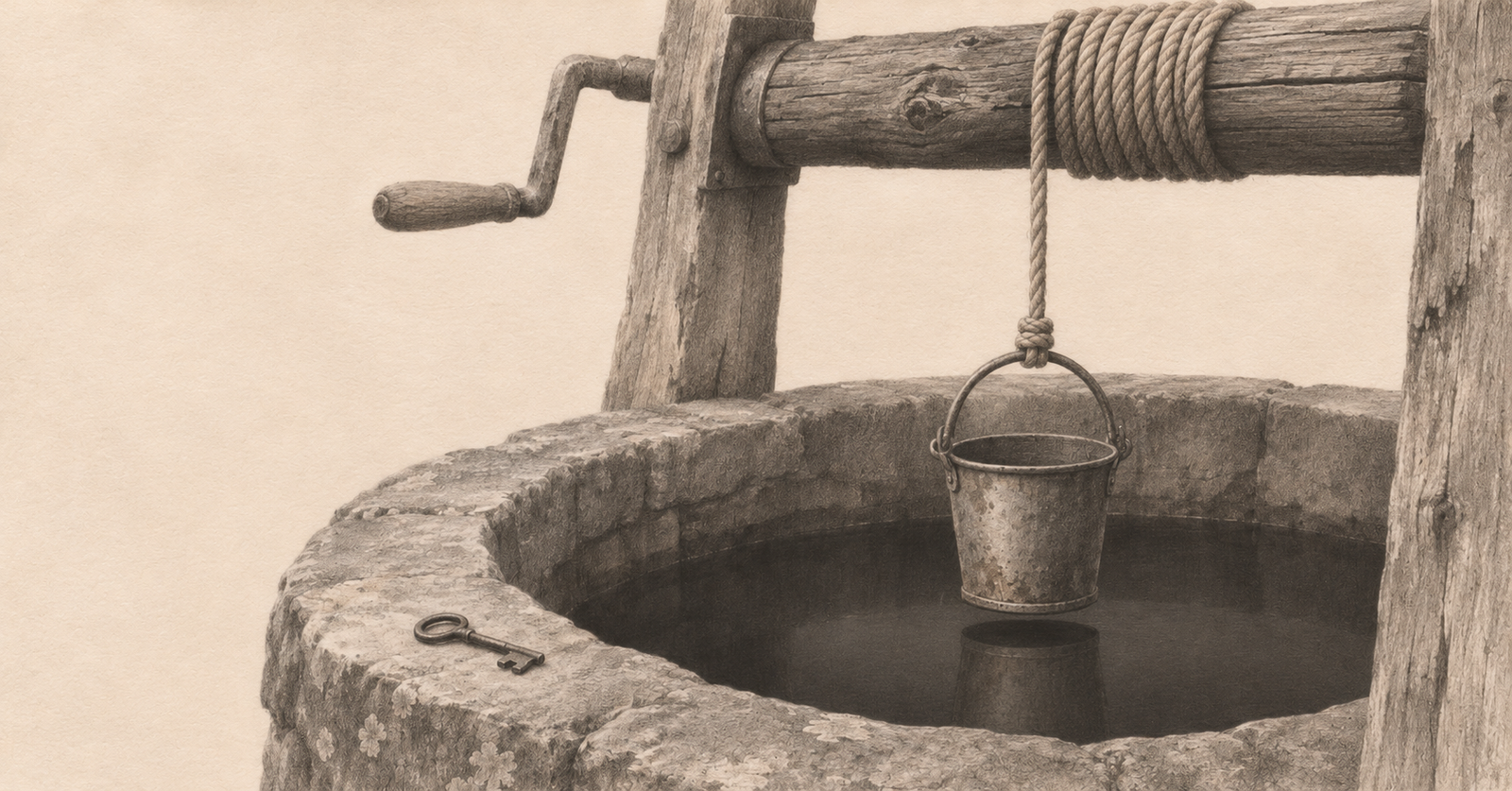
At dusk, Nell hears music rising from the village well. Soon everyone gathers to listen, and a simple decision—to leave the water undisturbed—changes village life. An original fairy tale about a gift no one wants to lose, and the people who must help preserve it.


The Weight of a Lotus
He asked for no more earth than he could cross in three steps. Beneath the foot that has crossed the ocean, Lakshmi holds up a lotus.


The Sky Among the Stones
We look up to find the sky. Among the fallen stones, there is another place to look.