

A Presence Offered, Not Owned
There is a flame that never burns—
only remembers.
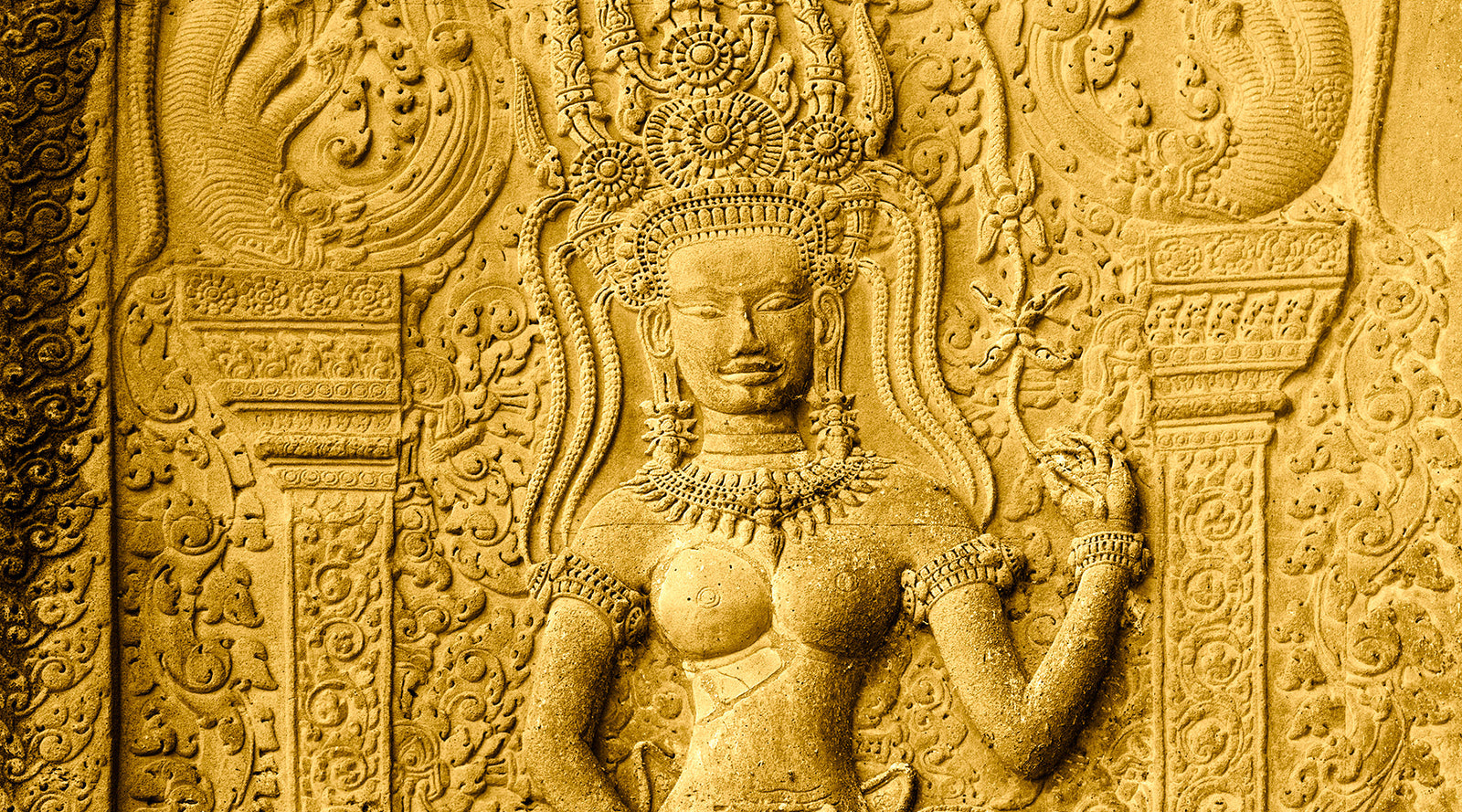
Among the many carved figures of Angkor Wat, this devata stands apart—not for adornment or posture, but for stillness. High on the western gate, she lifts a blossom in a gesture suspended between offering and remembrance. Framed by celestial scrollwork and crowned with seven points, she does not face the world. She faces something older.
Lucas Varro approached her not to capture, but to listen. He stood beneath the gate at day’s end, watching as the light withdrew. The film—large-format black-and-white—was exposed slowly, reverently. The image was later shaped with chiaroscuro, then hand-toned in gold by the artist himself. These gestures, like her own, were not decorative, but devotional.
The Fire That Remains is not an image of a carving. It is a vision of what lingers after fire has passed. The devata does not reflect light—she becomes its echo. Her stillness is not absence. It is presence distilled.
Each print in this limited edition of 25 + 2 Artist’s Proofs is signed, numbered, and hand-finished by the artist. The image is rendered on museum-grade Hahnemühle Bamboo paper. No two impressions are the same. Each one is shaped by silence.
To encounter this work is to cross a threshold—the one where gesture becomes memory, and memory becomes spirit.
More from the Library

See Also
A concise and impartial dictionary of absence, promises, quarrels, ordinary objects, and the troublesome instability of words.

The City of Service
The temple we inherit is a building from which almost all necessity has been removed. Nothing must be brought for it to continue being what we call a temple. The sanctuary asks nothing of us. Stone is good at this kind of independence.
A living temple was otherwise.
Water had to come in. So did grain, cloth, oil, aromatic substances, fuel. The things required for worship arrived because someone carried them across a threshold.

Houses of Wood, Light, and Smoke
Some of Angkor’s most intimate ruins do not rise above the ground at all. They are postholes, low mounds, hearths and ponds: durable traces of a domestic city built largely from things that decay. To restore that city is to see Angkor not only as stone, but as wood, smoke, water, repair, and people living within calling distance.

$895
Angkor Wat Temple, Angkor, Cambodia — 2018
Limited Edition Archival Pigment Print
Edition
Strictly limited to 7 prints + 2 Artist’s Proofs
Edition Number
This listing is for the first numbered print from the Large Collector Edition: 1/7
Medium
Hand-toned black-and-white archival pigment print on Hahnemühle Bamboo — a museum-grade fine art paper chosen for its quiet tactility and reverent depth, echoing the spirit of the temples.
Signature & Numbering
Each print is individually signed and numbered by the artist on the border (recto)
Certificate of Authenticity
Accompanies every print
Image Size
39.6 x 19.8 inches (100.6 x 50.3 cm)
Evening gathers at the western gate of Angkor Wat. The stone no longer reflects the sun—it releases what it remembers. A devata lifts her hand in timeless offering, her gesture poised not in motion, but in presence.
In this contemplative image from the Spirit of Angkor series, Lucas Varro captures one of the temple’s most radiant carvings—her form framed by a palace of flame-leaf scrolls and crowned by a silent kala.
The photograph was exposed on large-format black-and-white negative film beneath the golden hush of day. In the artist’s studio, classical chiaroscuro shaping revealed her presence, and a final hand-toned veil of gold summoned the light she once held.
This strictly limited edition of 25 + 2 Artist’s Proofs is printed on museum-grade Hahnemühle Bamboo paper. Each print is signed, numbered, and individually finished by the artist, making every impression a unique act of reverent craftsmanship.
The blossom she offers is not for the eye, but for the soul.
To step into the moment behind the image, click here to explore the Artist’s Journal.