

A Threshold the Light Remembers
I stepped onto the sandstone causeway while the sky was still veiled in the last notes of night. Each pilgrimage footfall ahead of me sounded less like movement than memory. A monk paused beneath the vaulted arch, lifting a single stick of joss. The ember glimmered—the briefest star—and smoke curled upward, vanishing into the dark rafters.
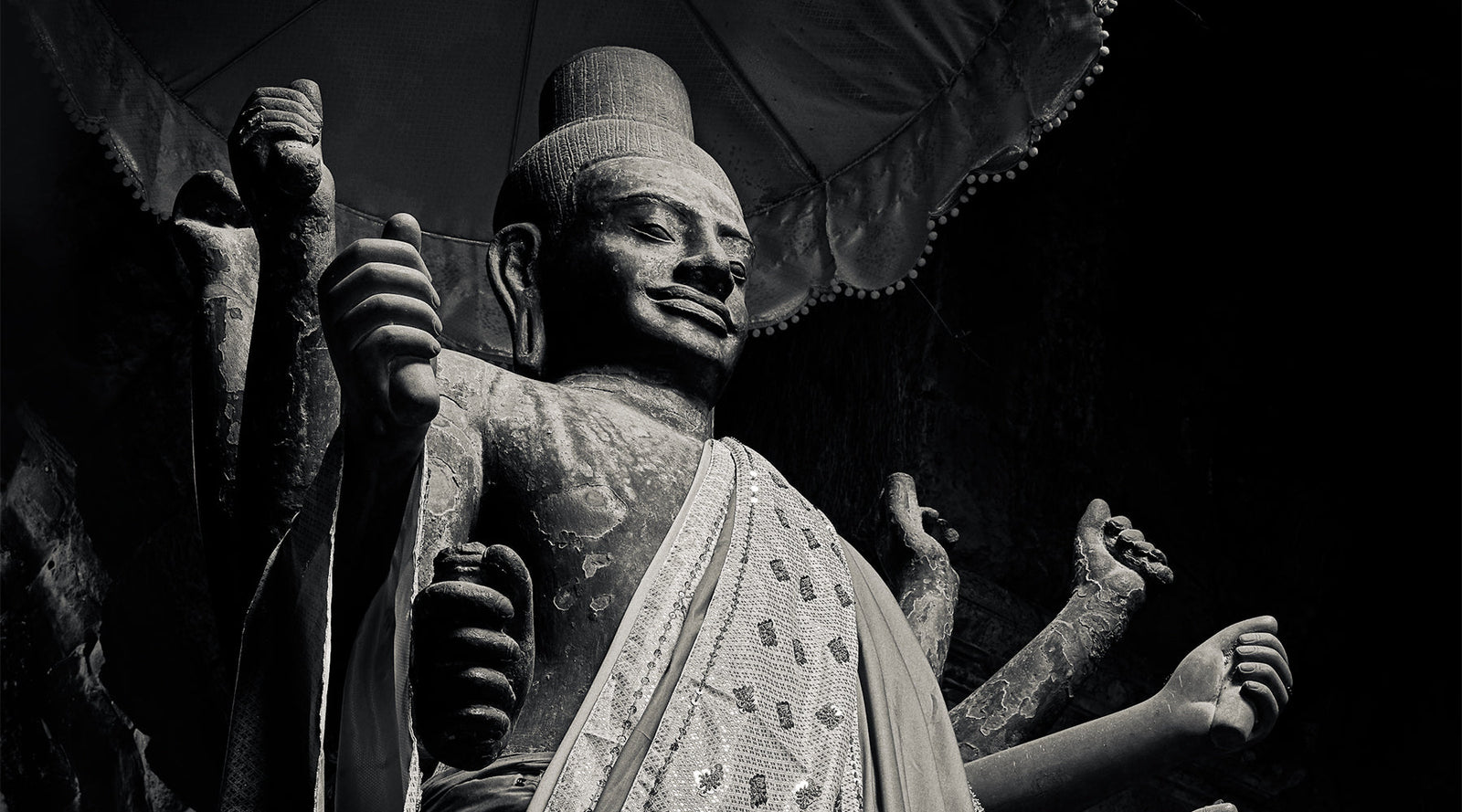
Below that rising thread stood Ta Reach, the eight-armed Vishnu, cloaked in sequined saffron and half-draped shadow. I waited, camera still at my chest, until the air within the gopura settled into the tempo of his granite breath. Light gathered slowly, folding along his shoulders, brushing the curve of a smile too ancient to belong solely to mankind—yet tender enough to remind us the divine has worn our faces before.
Incense finds the dark—
stone exhales what night has kept,
dawn leans into breath.
The shutter opened like an eyelid unclenching a dream. Time slipped: one long exposure that felt shorter than a heartbeat, longer than an age. In that unmeasured interval, the statue seemed to lean forward—not physically, but with presence—affirming every pilgrim’s quiet hope that the sacred is still awake. Later, in the dim red hush of the darkroom, I coaxed that presence back into fibre and tone, letting chiaroscuro recall what the corridor had whispered: creation and dissolution are held gently in the same unseen palm.
Outside, the lilies along the moat caught their first light. Within, a softer brightness remained—hovering in the space my breath had briefly occupied. I left a single jasmine petal at the statue’s base and stepped away, carrying the weight of a gaze that belonged to both past and forever.
More from the Library


See Also
A concise and impartial dictionary of absence, promises, quarrels, ordinary objects, and the troublesome instability of words.

The City of Service
The temple we inherit is a building from which almost all necessity has been removed. Nothing must be brought for it to continue being what we call a temple. The sanctuary asks nothing of us. Stone is good at this kind of independence.
A living temple was otherwise.
Water had to come in. So did grain, cloth, oil, aromatic substances, fuel. The things required for worship arrived because someone carried them across a threshold.

Houses of Wood, Light, and Smoke
Some of Angkor’s most intimate ruins do not rise above the ground at all. They are postholes, low mounds, hearths and ponds: durable traces of a domestic city built largely from things that decay. To restore that city is to see Angkor not only as stone, but as wood, smoke, water, repair, and people living within calling distance.

$895
Angkor Wat Temple, Angkor, Cambodia — 2020
Limited Edition Archival Pigment Print
Edition
Strictly limited to 7 prints + 2 Artist’s Proofs
Edition Number
This listing is for the first numbered print from the Large Collector Edition: 1/7
Medium
Hand-toned black-and-white archival pigment print on Hahnemühle Bamboo — a museum-grade fine art paper chosen for its quiet tactility and reverent depth, echoing the spirit of the temples.
Signature & Numbering
Each print is individually signed and numbered by the artist on the border (recto)
Certificate of Authenticity
Accompanies every print
Image Size
28 x 28 inches (71.1 x 71.1 cm)
Morning gathers in the western gate of Angkor Wat, where a single thread of incense rises toward a darkened ceiling, and the eight-armed Vishnu—Ta Reach—emerges from shadow into a slant of newborn light. Sequined saffron cloth, garlands, and weathered sandstone combine not into sculpture, but into presence.
Pilgrims pass barefoot across the worn stone floor. A monk lights a stick of joss and bows beneath the vaulted hush. Here, the gods do not sleep—they listen. The artist lingers in silence, waiting not for a perfect frame, but for communion. When the shutter opens, it is in reverence.
Captured on medium-format black-and-white film, the image was shaped in the studio through classical chiaroscuro techniques and hours of patient hand-toning. Each gesture on the print speaks with its own voice—depths of shadow, glints of light, a carved smile that contains both creation and dissolution.
Printed as a hand-toned archival pigment work on Hahnemühle Bamboo paper, the result is a tactile hymn—each piece signed, numbered, and offered in a strictly limited edition of 25 with 2 Artist’s Proofs.
Let this silent guardian keep watch within your calmest room.
Previously titled ‘Ta Reach Vishnu, Study I, Angkor Wat Temple, Cambodia. 2020,’ this photograph has been renamed to better reflect its place in the series and its spiritual tone. The edition, provenance, and authenticity remain unchanged.