
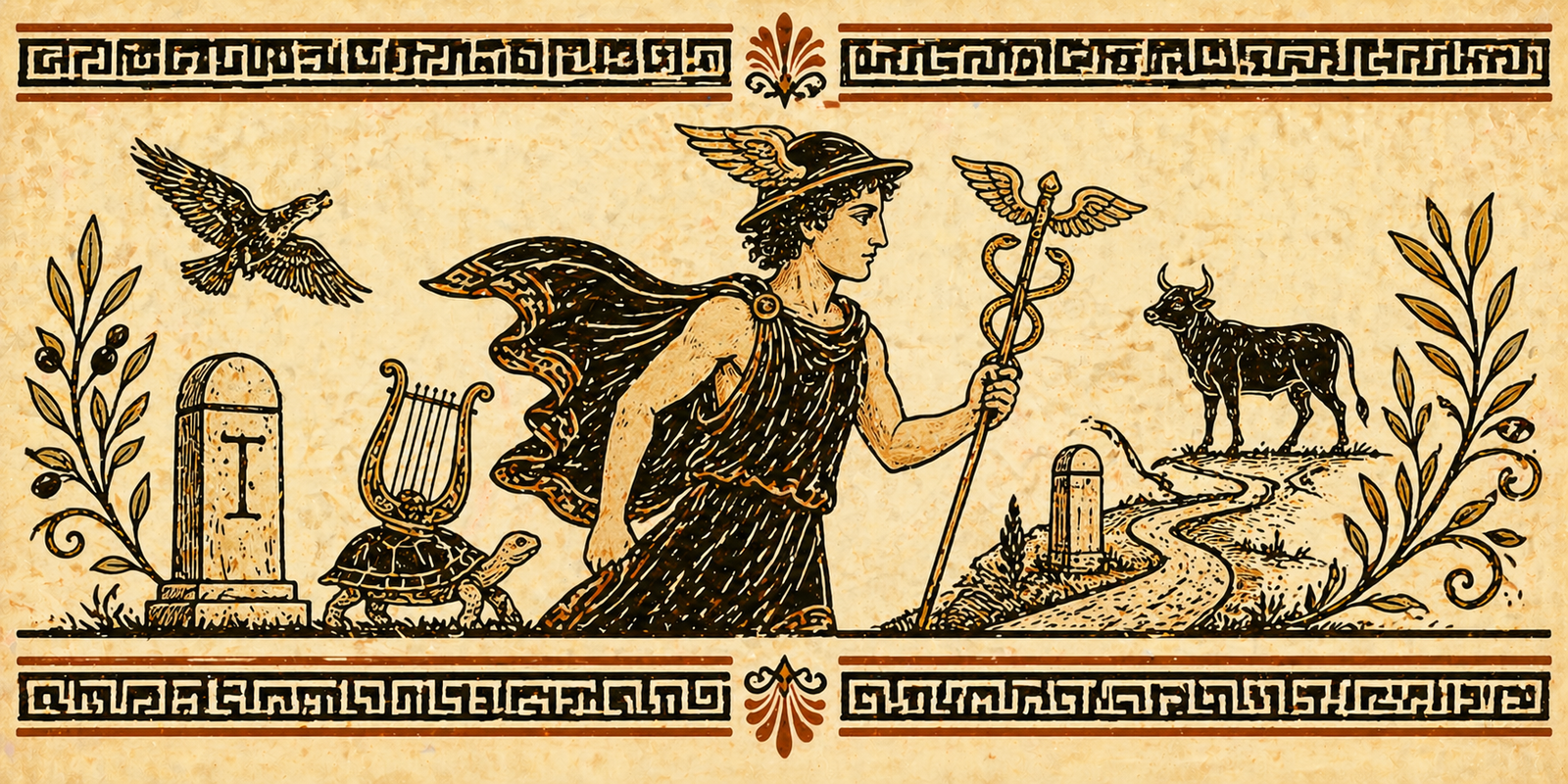

Hermes: The Road, the Message, and the Trick
The quick-footed god of roads, messages, thieves, travellers, tricks, and sudden escapes.
Before a hero reaches the monster, someone usually has to show the way.
Before a message crosses the sea, someone must carry it.
Before a locked place is opened, someone must know the trick of the door.
That is where Hermes belongs.
Hermes is one of the busiest gods in Greek myth. He moves between places that do not usually touch: Olympus and earth, city and wilderness, the living and the dead, the safe road and the dangerous one. He is the god of travellers, messengers, merchants, shepherds, thieves, roads, clever words, lucky escapes, and sudden changes of plan.
This is quite a lot of work for one god, but Hermes seems to enjoy being busy.
He is quick, sharp, charming, and not always entirely trustworthy. That does not mean he is wicked. It means that when Hermes arrives, something is probably about to move.
The Short Answer
Hermes is the messenger of the gods.
He is the son of Zeus and Maia, and he belongs especially to roads, thresholds, journeys, bargains, tricks, and messages. He can cross boundaries other gods do not always cross. He can carry a command from Olympus, guide a traveller through danger, or lead a soul down to the Underworld.
He is also a thief.
This is not a rumour started by his enemies. One of the oldest stories about Hermes says that when he was still a baby, he stole the cattle of Apollo, hid them very cleverly, and then behaved as if he had no idea what anyone was talking about.
Apollo was not amused.
Hermes, however, was already so clever that even his trouble became useful. In that same story, he made the first lyre from a tortoise shell, and Apollo loved the instrument so much that the quarrel turned into an exchange. Hermes gave Apollo the lyre. Apollo let Hermes keep some of the honour that belonged to herds, music, and clever dealing.
This is very Hermes.
He causes trouble. Then he turns the trouble into a bargain.
What You Need to Know
Hermes is not the strongest of the gods. He is not the king. He is not the thunderer, the sea-shaker, or the great archer.
His power is movement.
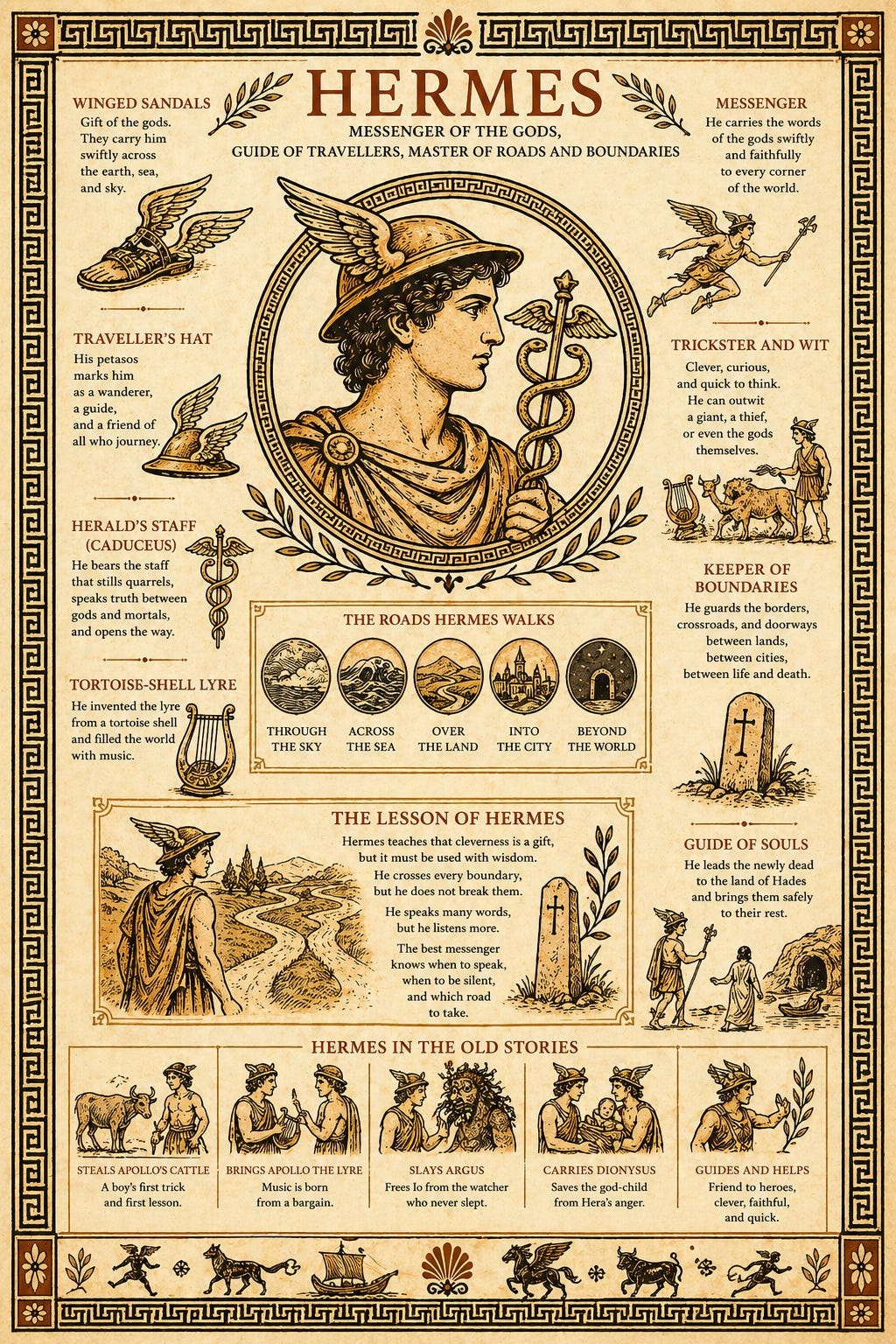
He goes where others cannot go easily. He slips through the spaces between things. He appears on roads, at doorways, at crossroads, in dreams, beside travellers, and at the edges of danger. He is often shown with winged sandals, a traveller’s hat, and a herald’s staff.
A herald is someone who carries messages. In the ancient world, that mattered. Messages could begin wars, end quarrels, summon heroes, warn kings, or send someone on a terrible journey. A good messenger needed speed, memory, courage, and a certain amount of nerve.
Hermes has all of these.
He is also a guide. In some myths, Hermes leads the souls of the dead down to the Underworld. This may sound frightening, but it is also strangely gentle. Hermes does not only stand at the beginning of journeys. He stands at the last road too.
The Story Shape
Hermes usually appears when a story needs a crossing.
A hero must get from one place to another.
A message must travel quickly.
A command from Zeus must reach a mortal.
A lost person must be guided.
A dangerous object must be delivered.
A trick must be played, or discovered, or survived.
Hermes is especially useful in stories where courage alone is not enough. He brings speed, information, tools, warnings, disguises, and the kind of cleverness that does not wait politely for danger to finish speaking.
This makes him different from Athena.
Athena gives strategy, discipline, judgement, and difficult good sense. Hermes gives motion, cunning, luck, and the ability to get through a tight place before it closes.
A hero would be wise to accept help from either of them.
A hero helped by both should still be careful.
Important Stories
Hermes appears in many Greek myths. Here are some of the most important.
He steals Apollo’s cattle when he is still an infant, then invents the lyre and turns the quarrel into an exchange.
He serves as messenger for Zeus, carrying divine commands to gods and mortals.
He helps Perseus in some tellings of the Gorgon story, often by guiding him or providing gifts needed for the dangerous task.
He leads souls to the Underworld, which is why he is sometimes called a guide of the dead.
He appears in the stories of Odysseus, especially when cunning, warning, and survival are needed.
He is connected with roads, boundary stones, travellers, merchants, shepherds, thieves, luck, and clever speech.
This does not mean every story about Hermes is cheerful. A road can lead to safety, but it can also lead into danger. A message can bring help, but it can also bring terrible news. A trick can save someone, or ruin them.
Hermes knows this.
He walks the road anyway.
Family and Connections
Hermes is the son of Zeus and Maia.
Zeus, as usual, is connected to a large amount of trouble. Maia is one of the Pleiades, a group of seven sisters connected with the stars. Hermes is therefore a child of Olympus and of something older, quieter, and more hidden.
His half-brothers and half-sisters include many famous gods and heroes: Athena, Apollo, Artemis, Dionysus, Heracles, Perseus, and others.
He often works for Zeus as a messenger. He quarrels with Apollo early in life, but their quarrel becomes a kind of friendship through music, exchange, and divine negotiation.
He is also friendly to mortals more often than some gods are. This does not mean he is safe. It means he understands human difficulty. Travellers, traders, shepherds, wanderers, and people who must think quickly all belong somewhere near his care.
Thieves also belong to him.
The Greeks were honest enough to notice that cleverness does not always behave itself.
Signs and Symbols
Hermes is usually recognised by the things that help him move between worlds.
Winged Sandals
Hermes is fast.
He can cross the sky, the road, and the distance between gods and mortals.
Traveller’s Hat
Hermes belongs on the road.
He is the god of journeys, strangers, wanderers, and sudden departures.
Herald’s Staff
Hermes carries messages for the gods.
His staff shows that he comes with authority, not merely with news.
Roads and Crossroads
Hermes appears where choices have to be made.
A road may lead to safety, danger, trade, exile, or home.
Boundary Stones
The Greeks placed stones at borders and crossings.
Hermes belongs at these edges: between fields, houses, cities, and worlds.
Tortoise-Shell Lyre
As a baby, Hermes made the first lyre from a tortoise shell.
This shows his gift for turning mischief into invention.
Cattle
Hermes stole Apollo’s cattle when he was still an infant.
The theft became one of the first signs of his cleverness.
Purse or Merchant’s Bag
Hermes watches over trade, bargains, and exchange.
He understands profit, risk, and the quickness of a good deal.
Doorways and Thresholds
Hermes belongs wherever one place becomes another.
He stands at entrances, exits, crossings, and the last road to the Underworld.
His staff is often called a caduceus. It is sometimes shown with two snakes winding around it. Today, people may think of medicine when they see it, but in Greek myth Hermes’ staff belongs first to heralds, messages, crossings, and divine authority.
The winged sandals are easier to understand.
Hermes is fast.
Why This Matters in the Tales
Hermes matters because Greek heroes rarely succeed by strength alone.
Perseus needs more than bravery. Theseus needs more than a sword. Odysseus survives because he can think as quickly as danger changes shape. Again and again, Greek myth asks whether a hero can listen, notice, move, bargain, hide, endure, and choose the right moment.
Hermes belongs to those moments.
He is not the god of standing still and looking noble.
He is the god of the road, the message, the trick, the lucky arrival, the narrow escape, and the door that opens just before the monster reaches it.
One Thing to Remember
Hermes belongs wherever a road begins, a message must be carried, or someone clever is trying to get away with something.
—
Receive the next work
Subscribe free to receive new work from the The Alexander Series Library by email.
More from the Library


See Also
A concise and impartial dictionary of absence, promises, quarrels, ordinary objects, and the troublesome instability of words.

The City of Service
The temple we inherit is a building from which almost all necessity has been removed. Nothing must be brought for it to continue being what we call a temple. The sanctuary asks nothing of us. Stone is good at this kind of independence.
A living temple was otherwise.
Water had to come in. So did grain, cloth, oil, aromatic substances, fuel. The things required for worship arrived because someone carried them across a threshold.


Houses of Wood, Light, and Smoke
Some of Angkor’s most intimate ruins do not rise above the ground at all. They are postholes, low mounds, hearths and ponds: durable traces of a domestic city built largely from things that decay. To restore that city is to see Angkor not only as stone, but as wood, smoke, water, repair, and people living within calling distance.