
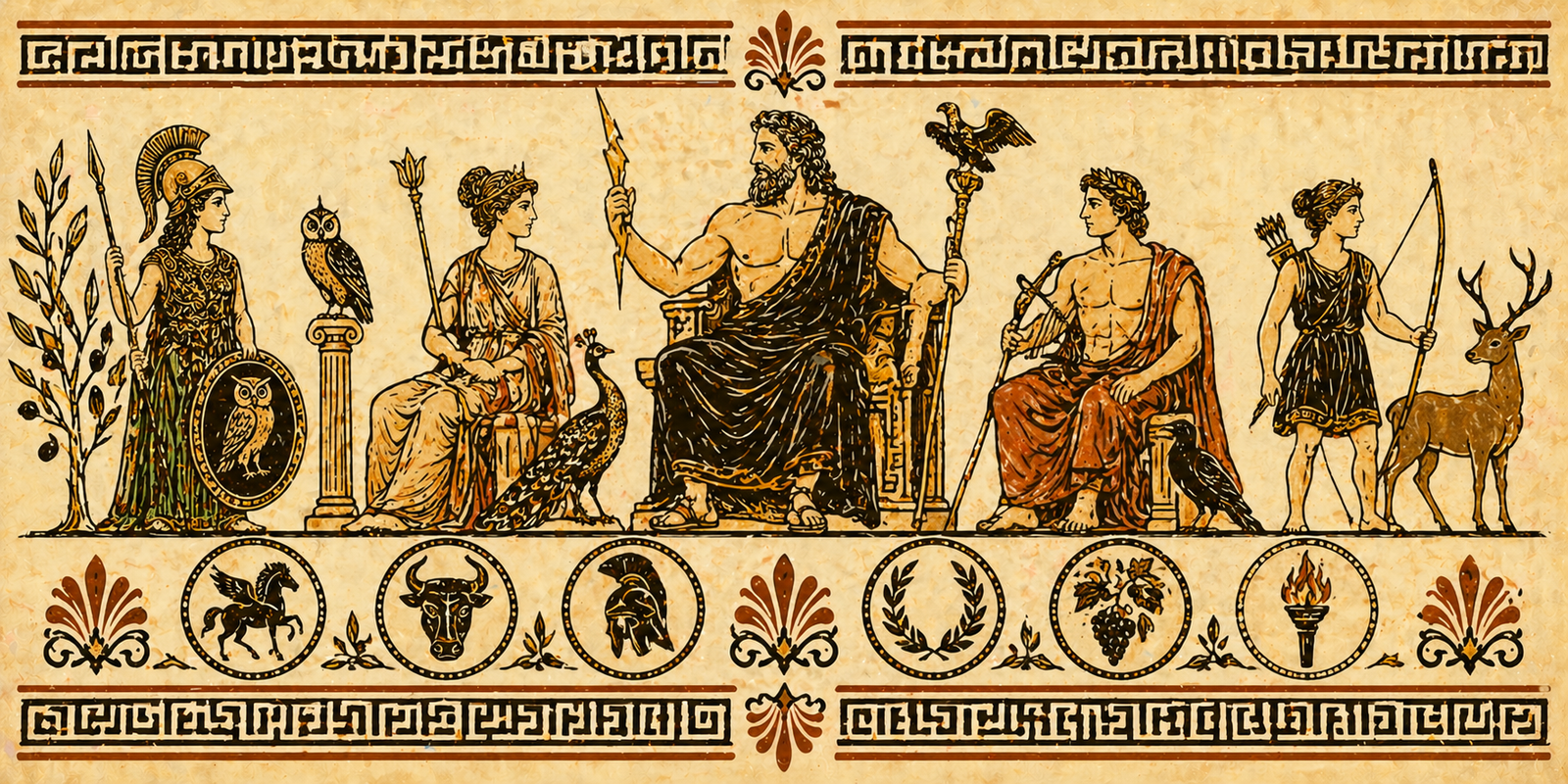

Zeus and His Children: The Stormy Family Tree of Greek Myth
In Greek myth, being a child of Zeus can mean glory, danger, trouble, or all three.
In Greek myth, being Zeus’s child is rarely simple.
It may mean glory.
It may mean danger.
Usually, it means both.
Zeus is king of the Olympian gods. He rules the sky, sends thunder and lightning, keeps order among gods and mortals, and sits at the centre of many Greek stories. He is powerful, commanding, and impossible to ignore.
He is also the father of a great many gods, heroes, kings, queens, monsters, and complicated people.
This is one reason Greek myth can feel like a family tree struck by lightning.
A child of Zeus may grow up to become a god of wisdom, music, hunting, wine, roads, or war. A child of Zeus may become a hero who fights monsters. A child of Zeus may become a queen whose beauty begins a war. A child of Zeus may inherit honour, danger, jealousy, divine attention, impossible tasks, and enemies they did not personally choose.
In ordinary life, it might sound lucky to have the king of the gods as your father.
In Greek myth, it is not so simple.
The Short Answer
Zeus has many children.
Some are immortal gods, such as Athena, Apollo, Artemis, Hermes, Dionysus, Ares, Hebe, and Hephaestus in many tellings.
Some are mortal heroes or famous figures, such as Perseus, Heracles, Helen, Minos, and others.
The Greeks did not always agree about every family line. Greek myth is old, branching, and full of different tellings. But one thing stays clear: Zeus stands behind many of the most important divine and heroic families.
This makes him more than a king sitting on a throne.
He is a storm at the centre of the family.
What You Need to Know
Zeus’s children do not all have the same kind of life.
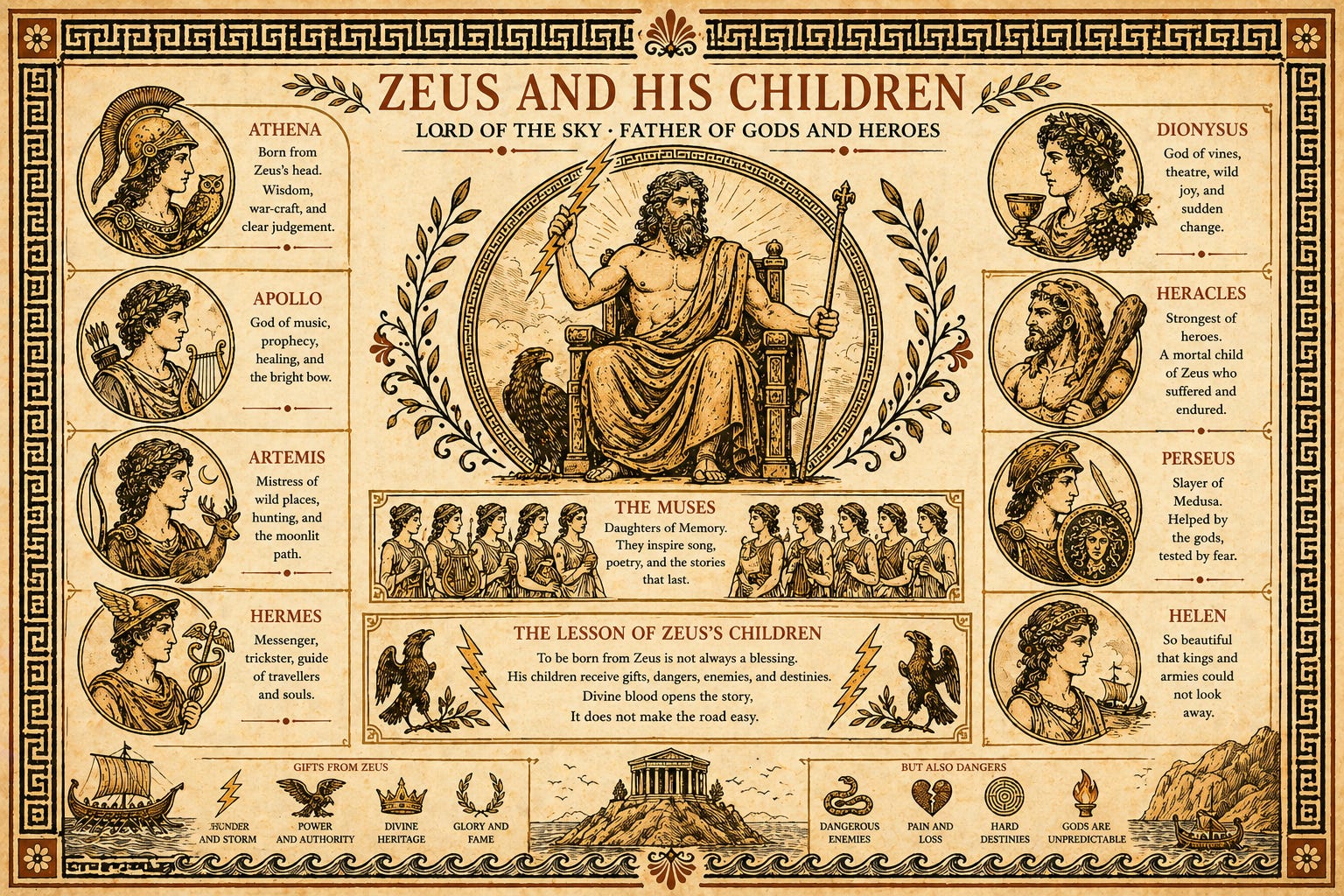
Some are born among the gods and become Olympians themselves. Athena, for example, is one of the greatest Olympians. Apollo and Artemis are mighty divine twins. Hermes becomes the messenger of the gods. Dionysus becomes the strange and powerful god of wine, ecstasy, theatre, and wild joy.
Others are born to mortal mothers. These children may have divine blood, but they still live in the mortal world. That can make them extraordinary, but it does not make them safe.
Perseus is a son of Zeus. So is Heracles. Both become famous monster-slayers. Both must endure danger before glory arrives. Neither has an easy childhood.
Helen, whose beauty becomes one of the causes of the Trojan War, is also called a child of Zeus in many stories. Minos, the king connected with Crete, the Labyrinth, and the Minotaur, is another famous son.
To be descended from Zeus is to be drawn into large stories.
Large stories are not always kind.
The Story Shape
Zeus’s children often carry a mark of greatness before they understand what it means.
Sometimes that greatness appears as strength.
Sometimes as beauty.
Sometimes as wisdom, skill, speed, courage, music, command, or strangeness.
But Greek myth rarely gives greatness without cost. A child of Zeus may be watched by gods, hunted by enemies, tested by monsters, or hated by Hera.
Hera is Zeus’s wife and queen of the gods. She is majestic, proud, and not easily fooled. Since Zeus often causes trouble by loving others, Hera often notices. This is frequently unfortunate for everyone else.
The children are not always to blame for the quarrels around them, but they often suffer because of them.
This is one of the hard rules of Greek myth: divine families do not keep their trouble to themselves.
When the gods quarrel, mortals may feel it.
When Zeus loves someone, a child may be born into danger.
When a child of Zeus grows strong, the world may have to make room.
Some Famous Children of Zeus
Athena is the daughter of Zeus and the goddess of wisdom, war-craft, weaving, cities, shields, and difficult good sense. In a very strange story, she springs from Zeus’s head fully armed. This is not how most children are born, but Athena is not most children.
Apollo is the god of music, prophecy, archery, healing, plague, and bright distance. He is one of the most important Olympians.
Artemis is Apollo’s twin sister. She is the goddess of hunting, wild places, young creatures, and fierce independence. She does not like being insulted.
Hermes is the quick-footed messenger of the gods: clever, slippery, useful, and not always entirely honest.
Dionysus is the god of wine, theatre, wild joy, masks, madness, and release. His stories can be beautiful, strange, and dangerous.
Ares is the god of war’s violence and battle-rage. He is a son of Zeus and Hera, and he is not usually admired for his judgement.
Hebe is the goddess of youth, and in some stories she serves nectar to the gods.
Hephaestus is connected with fire, metalwork, craft, and divine making. The myths do not always agree about his parentage, but he belongs to the Olympian family and to the great divine household.
Perseus is a mortal son of Zeus and Danae. He grows into the hero who faces Medusa with help from the gods and courage sharpened by love.
Heracles is another mortal son of Zeus, famous for strength, suffering, monsters, labours, and a life that never becomes easy for very long.
Helen is one of the most beautiful figures in Greek myth. Her story leads toward Troy, war, longing, blame, and sorrow.
Minos becomes a king of Crete. His family leads us toward the Minotaur, the Labyrinth, Ariadne, and Theseus.
There are many others.
Zeus’s family is not a small household. It is almost a weather system.
Family and Connections
Zeus is the son of Cronus and Rhea. He belongs to the generation of gods who overthrew the Titans and became the Olympians.
His brothers include Poseidon and Hades. His sisters include Hera, Demeter, and Hestia.
Hera is his wife and queen. Their marriage is one of the great unsettled facts of Olympus: royal, powerful, and often stormy.
Many of Zeus’s children become connected to one another through later stories. Perseus becomes an ancestor of Heracles. Minos belongs to the Cretan stories that lead toward Theseus. Helen belongs to the world of the Trojan War. Apollo and Artemis appear again and again wherever prophecy, hunting, plague, music, punishment, or sudden divine judgement enters the story.
This is why Zeus’s family matters.
It is not only a list of names.
It is a network of roads leading into nearly every great part of Greek myth.
Signs and Symbols
Zeus is usually recognised by signs of height, storm, power, and command.
Thunderbolt
Zeus’s most famous sign.
It shows his power to strike from the sky.
Eagle
The eagle belongs to high places.
It is a royal bird, watching from above.
Oak Tree
The oak is strong, old, and difficult to move.
At Dodona, one of Zeus’s ancient sanctuaries, people listened for divine signs in the rustling of oak leaves.
Sky and Storm-Clouds
Zeus rules the bright sky, but also the storm.
His power can appear as clear order or sudden danger.
Throne and Sceptre
Zeus is king of the Olympian gods.
The throne and sceptre show rule, judgement, and command.
High Mountains
Zeus belongs to the heights.
Mount Olympus is the home of the gods, and mountains bring him close to the sky.
His children have their own signs.
Athena
Owl, shield, spear, olive tree.
Wisdom, war-craft, cities, and clear judgement.
Apollo
Lyre, bow, laurel, sun-like brightness.
Music, prophecy, healing, plague, and distance.
Artemis
Bow, deer, moon, wild places.
Hunting, independence, young creatures, and the untamed world.
Hermes
Winged sandals, herald’s staff, traveller’s hat.
Messages, roads, crossings, tricks, and sudden escapes.
Dionysus
Vine, cup, leopard, mask.
Wine, theatre, wild joy, danger, and change.
Ares
Spear, helmet, shield, battlefield.
War’s violence, rage, and terrible noise.
Perseus
Polished shield, winged sandals, Gorgon’s head.
A hero who survives by courage, help, and indirect sight.
Heracles
Club and lion skin.
Strength, suffering, monsters, and impossible labours.
Helen
Swan, egg, beauty, Troy.
A child of Zeus whose story leads toward desire, blame, war, and sorrow.
Minos
Bull, throne, Crete, Labyrinth.
Kingship, judgement, pride, and the dark house of the Minotaur.
A family tree of Zeus would not look neat for long.
It would need branches, storms, warnings, jealous gods, heroic children, and probably several monsters waiting near the edges.
Why This Matters in the Tales
The Alexander Series begins with Perseus, who is one of Zeus’s mortal sons.
That matters, but it does not solve the story for him. Perseus still begins in danger. He still has to love his mother, leave home, listen to the gods, face the Gorgon, and learn how to survive a fear he cannot look at directly.
Being Zeus’s child does not make Perseus safe.
It makes his life larger.
The same will be true again and again in Greek myth. Divine parentage may give a hero a strange beginning, a hidden strength, or a place in a great family. But it also brings attention. It brings expectation. It brings old quarrels down onto young shoulders.
For a child reader, this is one of the useful things to understand early.
Greek heroes are not simply lucky people with famous parents.
They are often children born too close to the gods.
One Thing to Remember
In Greek myth, being Zeus’s child is never merely lucky.
—
Receive the next work
Subscribe free to receive new work from the The Alexander Series Library by email.
More from the Library


See Also
A concise and impartial dictionary of absence, promises, quarrels, ordinary objects, and the troublesome instability of words.

The City of Service
The temple we inherit is a building from which almost all necessity has been removed. Nothing must be brought for it to continue being what we call a temple. The sanctuary asks nothing of us. Stone is good at this kind of independence.
A living temple was otherwise.
Water had to come in. So did grain, cloth, oil, aromatic substances, fuel. The things required for worship arrived because someone carried them across a threshold.

Houses of Wood, Light, and Smoke
Some of Angkor’s most intimate ruins do not rise above the ground at all. They are postholes, low mounds, hearths and ponds: durable traces of a domestic city built largely from things that decay. To restore that city is to see Angkor not only as stone, but as wood, smoke, water, repair, and people living within calling distance.