
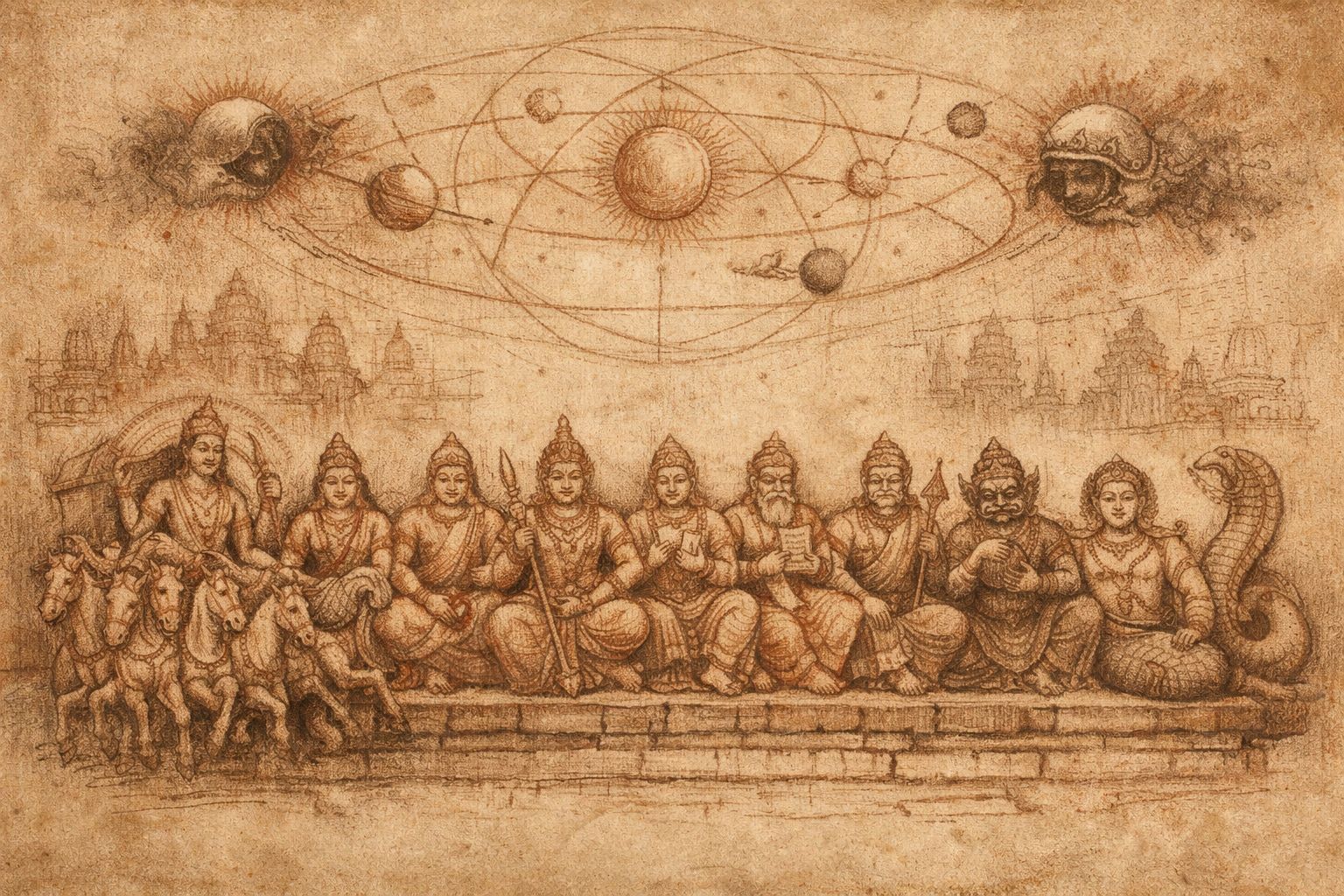

Navagraha
The Navagraha do not announce themselves as gods in the familiar sense. They do not dwell in stories alone, nor do they remain fixed in place. They move. They seize. They govern not belief, but timing. In the ancient Khmer world, this distinction mattered. To act without regard for the heavens was not impious—it was ineffective.
Navagraha means the nine celestial bodies that grasp the universe. Sun and moon. Five visible planets. Two shadows without substance, yet immense in consequence. Together they form a living calculus by which the world is tuned. Not fate as destiny, but fate as condition: the precise arrangement under which something may properly begin.
At the head stand Surya and Chandra, regulators of day and night, heat and cool, insistence and return. Around them move Mangala, Budha, Brihaspati, Shukra, and Shani, each carrying a distinct pressure—urgency, intelligence, expansion, attraction, delay. Then come Rahu and Ketu, the severed nodes of the moon, bodiless yet feared, whose brief victories over sun or moon announce eclipses and rupture the ordinary flow of time. They are reminders that disorder is not an error in the system, but part of it.
In Khmer temples, the Navagraha are often carved together on a single horizontal stone. They face outward, directly toward the viewer. There is no procession here, no hierarchy of scale. The message is clear: these forces operate together or not at all. The stone does not narrate their myths. It presents their presence. One does not read a Navagraha slab; one acknowledges it.
These slabs are frequently found in the so-called libraries—small, restrained buildings whose purpose has long resisted certainty. Their association with the Navagraha suggests not storage of texts, but calibration of moments. Fire rites, consecrations, inscriptions, foundations: all required the correct alignment. Time itself was the offering. Stone merely recorded that the moment had been seized correctly.
This cosmology reaches outward into architecture. Fixed stars establish the frame. Towers, enclosures, and causeways hold their places like anchors. Against this stillness, the Navagraha move. At sites such as Phnom Bakheng, number, orientation, and repetition suggest a world measured by lunar cycles and solar passages. The temple does not imitate the heavens. It cooperates with them.
Rahu and Ketu ensure that this cooperation is never complacent. Their eclipses interrupt certainty. Light disappears. Order is swallowed. Then it returns. In this rhythm, the Khmer understood something essential: harmony is not stasis. It is adjustment. The Navagraha do not guarantee success; they allow possibility.
Seen this way, the Navagraha are less a pantheon than a discipline. They teach attentiveness to sequence, patience with delay, respect for constraint. They insist that no act—royal, ritual, or architectural—exists outside time’s conditions.
To stand before a Navagraha stone is to stand before a reminder that the universe is not persuaded by intention alone. It must be met correctly. The heavens must be listened to. Only then does the moment open, briefly, and allow the world to move forward without resistance.
—
Receive the next work
Subscribe free to receive new work from the Lucas Varro Library by email.
More from the Library


See Also
A concise and impartial dictionary of absence, promises, quarrels, ordinary objects, and the troublesome instability of words.

The City of Service
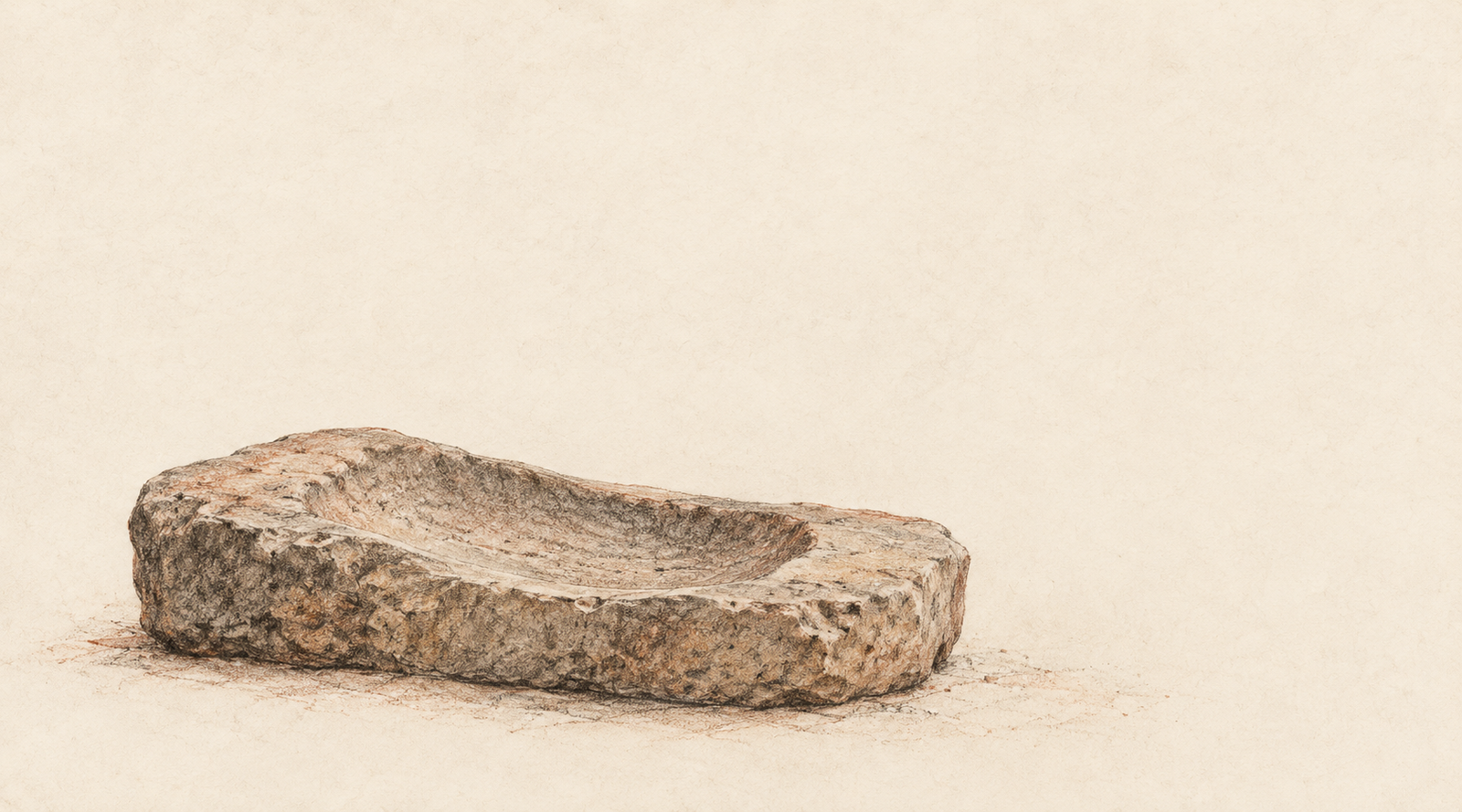
The temple we inherit is a building from which almost all necessity has been removed. Nothing must be brought for it to continue being what we call a temple. The sanctuary asks nothing of us. Stone is good at this kind of independence.
A living temple was otherwise.
Water had to come in. So did grain, cloth, oil, aromatic substances, fuel. The things required for worship arrived because someone carried them across a threshold.


Houses of Wood, Light, and Smoke
Some of Angkor’s most intimate ruins do not rise above the ground at all. They are postholes, low mounds, hearths and ponds: durable traces of a domestic city built largely from things that decay. To restore that city is to see Angkor not only as stone, but as wood, smoke, water, repair, and people living within calling distance.