
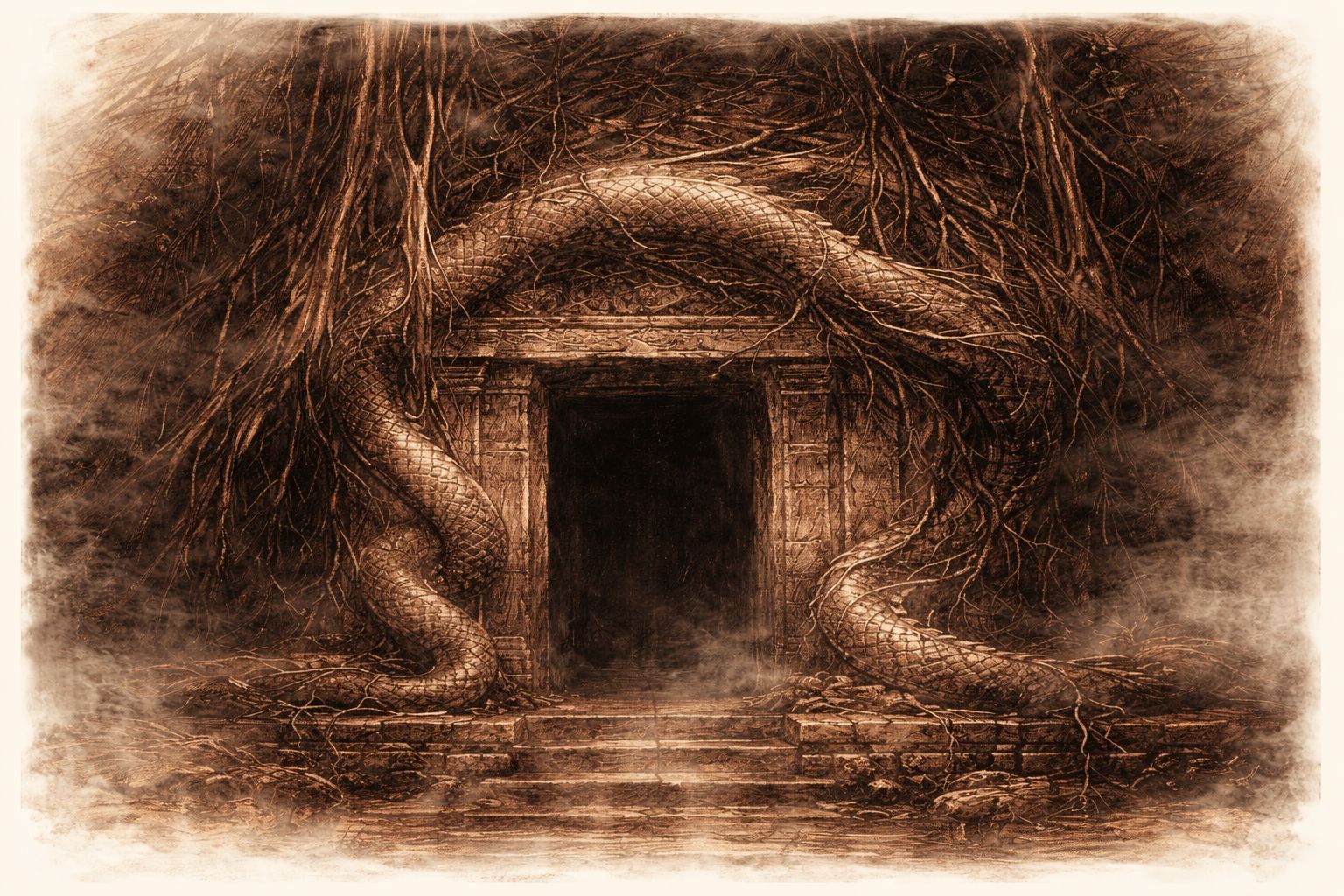

Naga Vow
A Love Poem of Sacred Hunger in a Lost Jungle Temple
Some places do not permit innocence.
They do not accept the polite modern fiction that the sacred is always gentle, always consoling, always clean. In the jungle’s lost cities, devotion is carved in thresholds and teeth: guardianship and hunger intertwined, protection indistinguishable from possession.
This poem is a vow spoken in that older grammar. It does not praise romance. It does not negotiate. It follows the serpent-law of temple myth — the binding force that circles, closes, keeps. Desire here is not entertainment or softness, but a rite: the moment the body admits what it already knows.
What we call love, in such places, is sometimes a sacred danger.
Naga Vow
I did not choose you.
I was chosen.
Not by thought.
By thirst.
By heat.
By the old law in the blood.
A lost city sleeps in the jungle—
stone corridors breathing moss,
blind doors slick with rain,
gods worn soft
until they almost resemble flesh.
Roots in the walls.
Roots in the ribs of the ruin.
Not to hold it up—
to take it.
To teach stone
what possession means.
Serpents on the thresholds.
Coils cut into the causeways.
Not ornament.
Not myth.
Instruction.
This is how the sacred keeps
what it claims.
This is how my wanting moves.
It does not speak.
It circles.
It finds your throat.
It finds your wrist.
It finds the hollow under your ribs
where breath turns.
It reads you
without permission.
It knows the place
before the name.
No romance.
No gentleness.
No safe story.
Only the fact:
when you come near
something in me lifts its head
and tastes the air.
Come closer.
Not for tenderness.
For truth.
I want you
with the certainty of roots.
I want you
with the patience of constriction.
I want you
like floodwater wants the lowest place—
finding it, filling it,
refusing to lift.
Let the jungle listen.
Let the carved gods
pretend they have not seen this before—
the vow made without language,
the mouth’s religion,
the body’s unargued law.
I will not love you safely.
I will not love you
as proof of control.
I will love you
like the serpent loves:
as guardian,
as captor,
as gate.
The gate that closes.
The gate that becomes
the only way through.
Come closer.
Let me wrap you
until breath forgets its bargaining.
Until fear goes quiet
from exhaustion.
Until the body stops pretending
it is not made for this.
You will tremble.
Not from harm.
From recognition.
Because this is the truth
no wisdom corrects:
to be chosen
is to be taken.
Come closer.
Let me learn you
by touch,
by pressure,
by the slow accuracy of hunger.
Let my mouth find your pulse—
not metaphor,
not beauty—
heat.
Let our names fall away.
Let them fall.
Let them drown.
Offerings dropped
on wet stone:
unrecoverable,
already received.
I do not want love
that behaves.
I want love
that admits what it is.
A vow that is also an animal.
A vow that is also a god.
I want you
completely.
Not as possession—
as sacred.
Come closer—
close enough
that fear becomes useless.
Let me take the last distance from you.
Let me take even the word enough.
Let my mouth find your pulse
and make it gospel—
salt on my tongue,
your skin answering like rain.
Let your breath break
into my breath
until there is only one animal left
to do the wanting.
I will guard you
the only way I know:
by consuming you.
—
Receive the next work
Subscribe free to receive new work from the Lucas Varro Library by email.
More from the Library


See Also
A concise and impartial dictionary of absence, promises, quarrels, ordinary objects, and the troublesome instability of words.

The City of Service
The temple we inherit is a building from which almost all necessity has been removed. Nothing must be brought for it to continue being what we call a temple. The sanctuary asks nothing of us. Stone is good at this kind of independence.
A living temple was otherwise.
Water had to come in. So did grain, cloth, oil, aromatic substances, fuel. The things required for worship arrived because someone carried them across a threshold.

Houses of Wood, Light, and Smoke
Some of Angkor’s most intimate ruins do not rise above the ground at all. They are postholes, low mounds, hearths and ponds: durable traces of a domestic city built largely from things that decay. To restore that city is to see Angkor not only as stone, but as wood, smoke, water, repair, and people living within calling distance.