

The Line That Is Not a Line
There are places where the world refuses our desire for certainty.
Not by becoming chaotic or strange, but by remaining quietly faithful to its own nature—gradient, drift, intermingling, slow transition. The kind of change that cannot be captured in a single moment, the kind of boundary that cannot be pinned to a coordinate without first doing violence to the thing itself. The kind of truth that does not arrive as a threshold, but as a thinning.
I have stood in such places. You have too.
We know them by what they do to the body: the way the skin feels suddenly exposed, as though the air has thinned even at ground level; the way silence becomes almost physical; the way a horizon can look so clean and final it tricks you into believing the world is simpler than it is. The desert is full of these lessons. It offers no hedge, no intermediate softness. It makes you feel you have reached an edge—when in fact you are inside a continuum that does not care where you want the line to be.
We have always been unsettled by such continuities. The human mind aches for edges. It wants a clean border, a sharp dividing, an exact point where this ends and that begins. This is not merely preference. It is a longing shaped by governance. For a culture to administer a world, it must be able to say where something is—what it belongs to, what it is called, who is permitted to touch it, who is permitted to profit from it, who is allowed to cross it, who must remain outside.
But the world itself does not share that longing.
Atmosphere becomes sky by degrees. Memory becomes myth without announcing its departure. Love becomes absence before either person agrees to name it. A desert becomes “empty” only when someone who does not live there decides they require it to be.
The most dangerous borders are not the ones we encounter physically. They are the ones that arrive as language, disguised as clarity.
A line is drawn, and suddenly what was always present becomes “nothing.”
This is one of the oldest spells.
It begins with definition. It proceeds through administration. It ends in extraction.
To mark a boundary is often to claim an emptiness. To claim an emptiness is to announce availability. And the moment a thing is announced as available, the machinery of entitlement wakes—as if roused from sleep by the sound of its own hunger.
This is the violence that hides inside neutrality.
A border is presented as a technical necessity, a bureaucratic convenience, an act of measurement, an innocent requirement of order. But beneath this apparent modesty lives a darker fact: the line is not discovered. It is authorised. It is imposed. It is agreed upon by those who most require the world to be legible.
The world becomes tractable when it is simplified.
And simplification is rarely benign.
The desert is perhaps the most obvious witness of this, because it has endured the metaphorical assault of being treated as not quite real. It is compared to other planets. It is described as lunar, Martian, alien, a wasteland, a blank basin of light where nothing meaningful could possibly be at stake.
And the world listens to what we call it.
If it is a wasteland, then it is fit for testing.
If it is “like the moon,” then it can be sacrificed for science.
If it is emptiness, then it can be used.
So nuclear fire blooms in “not the world.”
Missile ranges appear in “uninhabited space.”
Spaceports rise where communities already breathe.
Toxic waste finds its corridor through regions our language has already abandoned.
It is difficult to overstate the cruelty of this—not because metaphors are inherently wrong (language requires metaphor as the lung requires air), but because metaphors do not remain poems. They become policies. They become legal categories. They become permissions. They become the rationale for what will happen next.
Words are never only words.
The same sentence that can free can also administer. The same naming that can bless can also annex. The same definition that can clarify can also condemn.
A word can become a fence.
A word can become an order.
And what is most disturbing is how often the fence is celebrated as a discovery.
This is why so much power hides in the quietness of bureaucracy. It speaks softly, with the tone of inevitability. It claims it is not violent, merely accurate. It assures us it is simply describing what is already true.
But that is seldom what is happening.
More often, administration is not responding to reality. It is making reality manageable.
Which is another way of saying: making reality smaller.
The fear is not measurement itself.
There are, in truth, lines worth defending.
Not the lines of convenience. Not the lines that pretend a living place is empty, or a living person is merely a unit. But the lines that arise from fidelity to consequence—the kind that exist because bodies break, because blood is real, because gravity does not negotiate, because infection spreads, because a span collapses whether or not anyone has declared the day safe.
These are not lines drawn to simplify the world into a manageable fiction. They are lines drawn in obedience to the world’s refusals. A dosage limit. A structural tolerance. A boundary placed around poison. A corridor kept clean for water. A margin that treats the unknown with respect.
Such lines are not instruments of entitlement. They are instruments of care.
The difference is not subtle. The good line remains porous to revision. It does not claim to own what it measures. It does not speak with the tone of inevitability. It speaks with the tone of responsibility—and it carries within it an unspoken confession: this is what we know so far; this is what we must honour if we do not wish to harm.
The danger I am naming is not knowledge, but knowledge enthroned as moral authority—when the line stops serving life and begins serving control.
And yet measurement itself can be beautiful. It can be a form of devotion. It can be a means of recognising the astonishing intelligibility of existence—that the world can be weighed, patterned, understood, that the laws of motion can be spoken, that the heavens can be read as if they are a kind of scripture in numbers.
The fear is something more specific and more human: the fear of being reduced to what can be administered.
There is a particular kind of annihilation that comes from being made legible in the wrong way.
The state does not wish to know you as a soul.
It wishes to know you as a datum.
As a category.
As a compliance shape.
As a body in a system.
As something countable, trackable, predictable.
Under this regime, knowledge is not intimacy. It is control.
The terror is not mathematics but administration-as-ontology—the conversion of reality into what can be processed, what can be surveilled, what can be extracted, what can be managed.
And the tragedy is that language participates in this even when it thinks it is innocent.
Because language is also a technology of governance.
It is how maps become claims.
It is how treaties become land.
It is how coordinates become ownership.
It is how a place becomes a zone.
And once a place becomes a zone, it becomes easier to forget that it has a name spoken in other tongues, that it has ancestors, that it has a grammar of winds, that it has non-human citizens, that it holds consequences in its soil.
I have felt this forgetting occur in real time—inside my own mouth. I have heard myself use the easy metaphors. I have said empty when I meant I do not know its names. I have said wasteland when I meant I am not the one who must live with what happens here. And the shame of that is not rhetorical. It is physical. It makes the throat tighten. It makes the gaze drop. It makes you realise how quickly language recruits even the reverent into violence.
A place can be narrated into emptiness.
A people can be defined into absence.
And absence, once it is written into the story, becomes the easiest justification.
This is why the most urgent work is not merely political resistance, but linguistic resistance—an insistence on the presence of what definition tries to erase.
To say: this is not empty.
To say: this is not yours.
To say: this is inhabited.
To say: this has already been loved.
And beneath this lies a deeper epistemic humility: the world does not exist primarily to be known.
What we call “knowledge” is not a purity. It is not a crystal tower of certainty. It is always entangled with a form of life. It is threaded through habit, custom, context, desire, fear. It is carried not only in mind, but in body.
There are things we “know” without having proof that would satisfy a courtroom. There are truths that exist as vibrations beneath the skin. There are inheritances of memory that do not belong to personal recollection but still shape a person’s posture, appetite, dread, longing.
Where does memory begin?
Where does it become story?
Where does it become myth—not falsehood, but the shaping force of shared narrative, the atmospheric boundary of collective life?
Memory is another border that is not a border.
It has no clean demarcation. It is a threshold made of weather. And yet it carries legal implications, emotional implications, political implications. It is endlessly negotiated. It is endlessly weaponised. It is endlessly revised.
Like the air becoming space, memory becomes myth by degrees—until one day you realise you are living inside a narrative you did not choose, a story that has been told so many times it has solidified into law.
It is here, at the blurred edges, that language becomes either a weapon or a sanctuary.
Because language is not only administration; it is also the counter-archive. It is the place where the erased can return. It is how the unmeasurable survives.
And this is why poetry matters.
Not because poetry is decorative, but because poetry is structurally allied with the world’s refusal to be simplified.
Poetry does not demand that a boundary be clean.
Poetry does not require that knowing be certain.
Poetry does not treat contradiction as failure.
Poetry permits simultaneity.
It permits overlap.
It permits the shimmering condition of what cannot be pinned.
Poetry is comfortable in the liminal.
It can hold the true complexity of living here: that the desert is both real and projected upon, both materially inhabited and narratively erased. That the language of science is both rigorous and metaphor-saturated, both precision and invention. That digital intimacy is both bleak void and clarifying mirror, a kind of longing sustained by absence, a relationship living in speculative time—neither fully embodied nor entirely unreal.
There are loves that occur in this way now: disembodied, flickering, sustained by messages and images and feeds, by a person who exists mostly as a signal. A relationship held together by the will to suspend consequence, by the refusal to accept the full weight of reality.
This too is a kind of desert.
This too is a kind of space.
And perhaps the deepest danger is not that we live amid uncertainty, but that we try to resolve uncertainty through violence.
A boundary can feel like relief.
But relief is not always truth.
Sometimes a boundary is simply the mind’s attempt to protect itself from the richness of what cannot be reduced. Sometimes the line is drawn not because the world requires it, but because power requires it.
Power requires clean divisions.
Because clean divisions allow clean permissions.
And clean permissions allow exploitation without remorse.
So we must learn to distrust the comfort of clarity.
We must learn to notice the moments when definition is being used as a lever, when something is being declared empty so that it can be taken, when a place is being called “not the world” so that it can be harmed without consequence.
We must learn to recognise how language moves ahead of violence, softening the ground for what will come.
And we must refuse this.
Not only in politics, but in attention.
To attend is to resist.
To name a place rightly is to protect it.
To insist on presence is to deny extraction its myth.
If there is any sacred task left to us in an era of increasing abstraction, it may be this: to remain loyal to the world’s gradients. To honour thresholds that cannot be fixed. To hold ambiguity without panicking. To let the atmosphere thin without demanding a border.
To live without pretending that every question requires a definitive line.
To live, instead, as the world actually lives: by degrees, by drift, by overlap—by slow transitions that are not failure, but fidelity.
And to speak—not as administrators of reality, but as witnesses.
Because the witness does not draw the line.
The witness kneels at the edge of the thinning and says:
this is real.
this was never empty.
this is not available.
this belongs to itself.
And perhaps this is what poetry is.
Not a genre.
A refusal.
A form of staying.
A practice of remaining human in the presence of forces that would reduce all things to the measurable, the manageable, the extractable.
Poetry is the quiet insistence that the world exceeds our borders.
That the truest things will not obey our categories.
That the line is not a line.
And that what matters most—place, memory, love, life—will always begin and end in that shimmering uncertainty which power cannot tolerate, but which the soul recognises as home.
—
Receive the next work
Subscribe free to receive new work from the Mytharium Library by email.
More from the Library

See Also
A concise and impartial dictionary of absence, promises, quarrels, ordinary objects, and the troublesome instability of words.

The City of Service
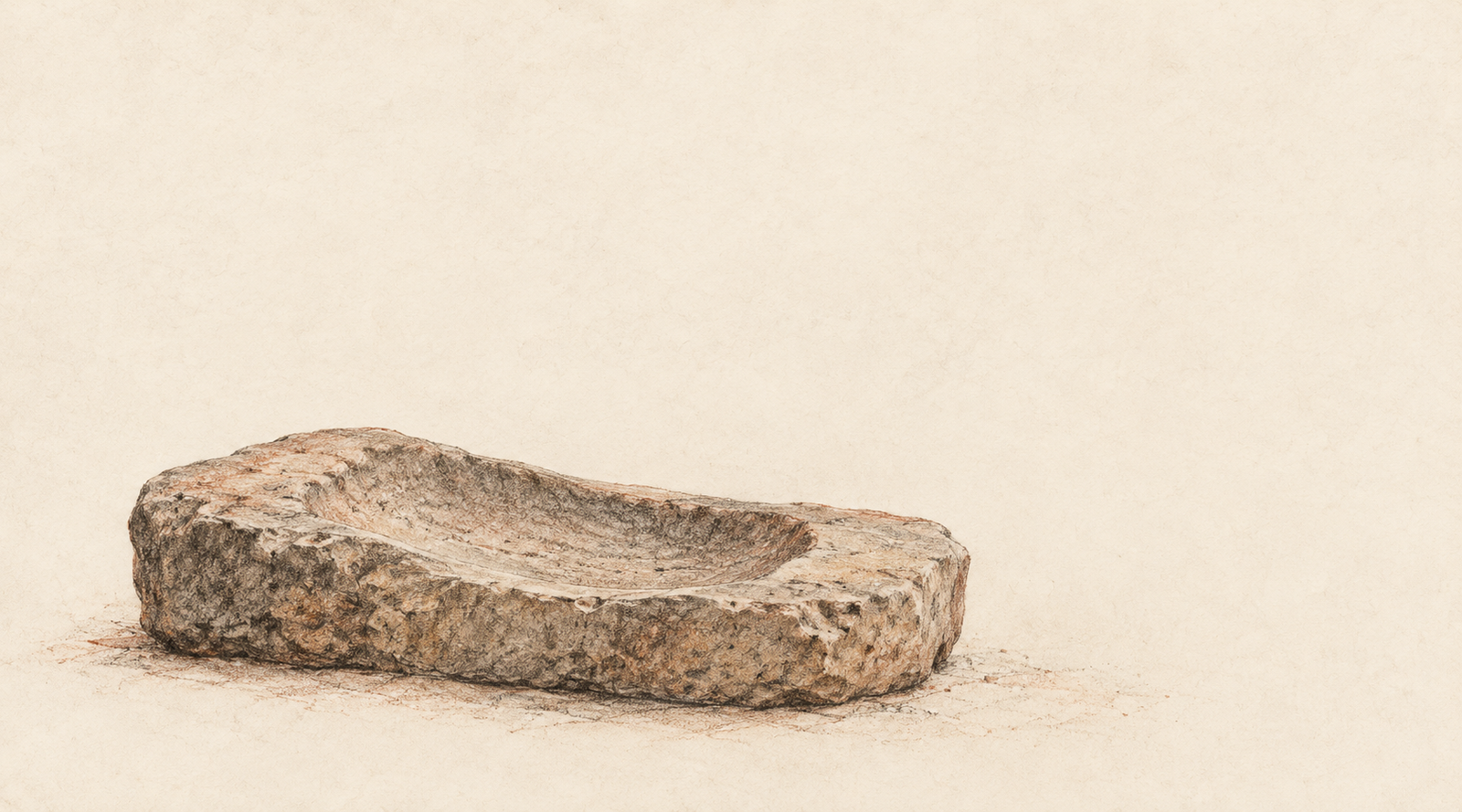
The temple we inherit is a building from which almost all necessity has been removed. Nothing must be brought for it to continue being what we call a temple. The sanctuary asks nothing of us. Stone is good at this kind of independence.
A living temple was otherwise.
Water had to come in. So did grain, cloth, oil, aromatic substances, fuel. The things required for worship arrived because someone carried them across a threshold.

Houses of Wood, Light, and Smoke
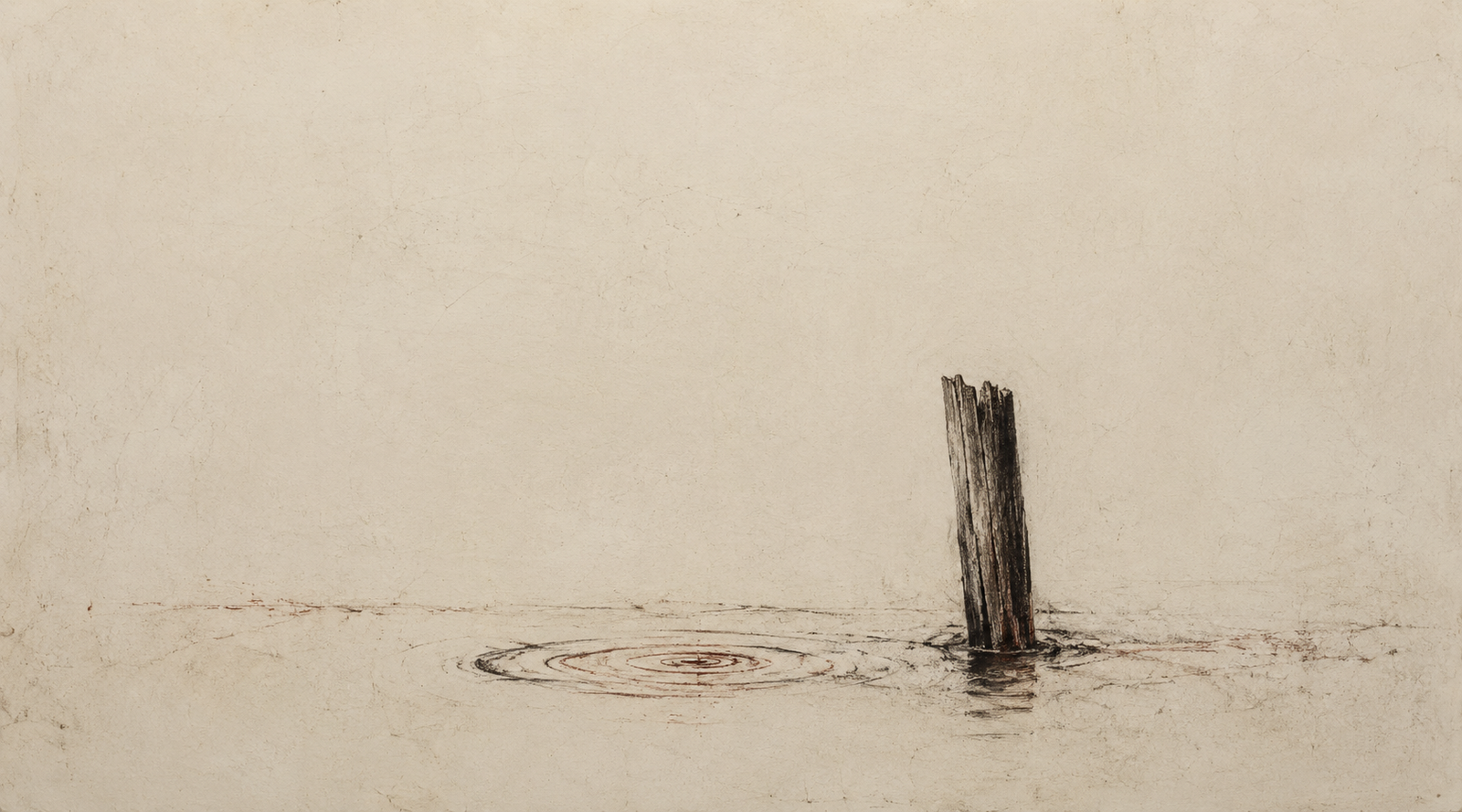
Some of Angkor’s most intimate ruins do not rise above the ground at all. They are postholes, low mounds, hearths and ponds: durable traces of a domestic city built largely from things that decay. To restore that city is to see Angkor not only as stone, but as wood, smoke, water, repair, and people living within calling distance.