
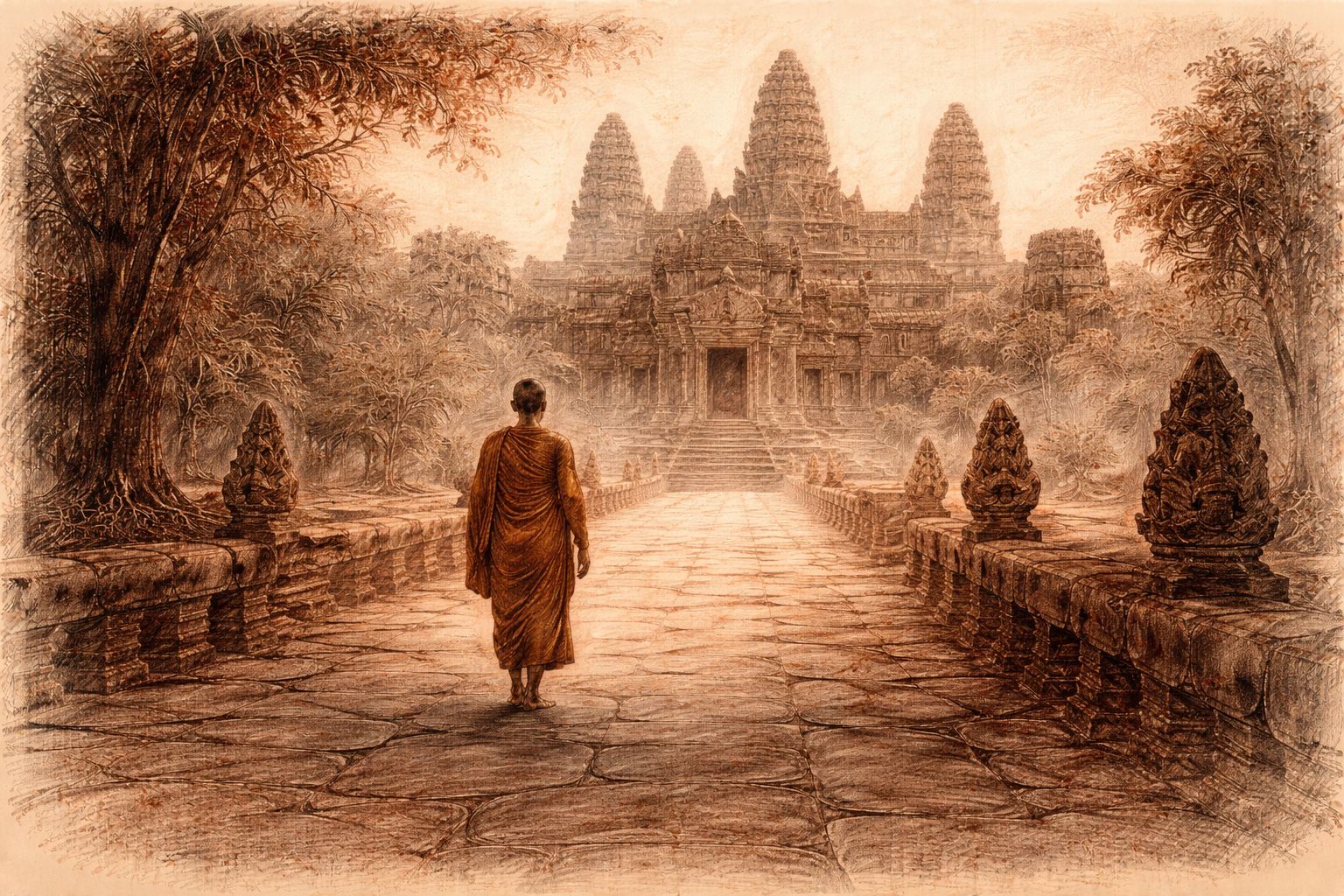

From Mountain to Monastery
Angkor Wat was conceived as a summit. Its causeways advance with deliberation, its galleries rise by measured degrees, and its central towers hold the logic of ascent. The body is drawn inward and upward, trained to feel distance from the ordinary ground. This was a place designed to separate—to lift the king, the god, and the ritual act above the common field of life.
The temple-mountain organised belief vertically. Meaning was concentrated at the centre, guarded by scale and repetition. To approach the heart was to move through narrowing thresholds, to leave behind multiplicity and arrive at singularity. The stone insisted on hierarchy. It taught devotion through effort.
Yet the structure did not remain closed. Over time, its centre softened. The cardinal openings of the sanctuary were walled, not to exclude, but to still the flow. Images of the Buddha appeared where presence had once been imagined as vast and distant. The summit ceased to function as a point of cosmic command and began to behave like a reliquary—contained, inward, receptive.
This was not a rupture but a reorientation. The mountain did not collapse; it learned to pause. Where ascent had been the lesson, return became possible. The galleries, once processional, accommodated lingering. The upper levels no longer marked an ending but a dwelling.
As Theravada practice took root, Angkor Wat adjusted its scale of meaning. Belief moved from monument to routine, from once-in-a-lifetime ritual to daily observance. The teaching did not require the full drama of ascent; it required proximity. A robe folded, a bowl carried, a chant repeated. The dharma survived not by being monumentalised, but by being inhabited.
The second level filled gradually with offerings—small images placed without instruction or plan. Wood, lacquer, gilding: materials that age, crack, and disappear. This accumulation did not compete with stone; it leaned against it. The temple became porous to time. Devotion arrived in fragments and remained unfinished.
What allowed Angkor Wat to endure was not its original intention, but its capacity to be repurposed without being erased. While other monuments were abandoned to forest and forgetting, this one stayed in use. The stone was maintained because the practice continued. The practice continued because it no longer depended on stone.
The transformation from temple-mountain to monastery is not a story of decline. It is a story of accommodation. The building ceased to insist on transcendence and began to host continuity. It accepted voices, repairs, imperfections. It learned how to be ordinary without losing gravity.
Angkor Wat stands today not as a frozen cosmology, but as a record of adjustment. Its towers still rise. Its galleries still instruct the body. But its deepest lesson is quieter: that endurance belongs not to what stands highest, but to what can be lived with.
—
Receive the next work
Subscribe free to receive new work from the Lucas Varro Library by email.
More from the Library

The Leaf and the Pencil
A leaf holds my attention. Then I remember that I can draw. The pencil reveals things I had never noticed, but introduces its own demands: proportion, shading, the desire to make something beautiful. When I try to describe the encounter, language presents another difficulty. An essay about the uncertain distance between looking at something, understanding it, and being present with it.

The Work We Return To
We have become very good at measuring persistence, and less good at asking what deserves it.
A musician begins the same passage again. A writer returns to an unfinished sentence. Someone stands before a familiar face carved in stone, with nothing new to photograph.
What brings us back when enthusiasm has gone? And how do we distinguish devotion from the demands that quietly consume the rest of our lives?

Under the Gallery
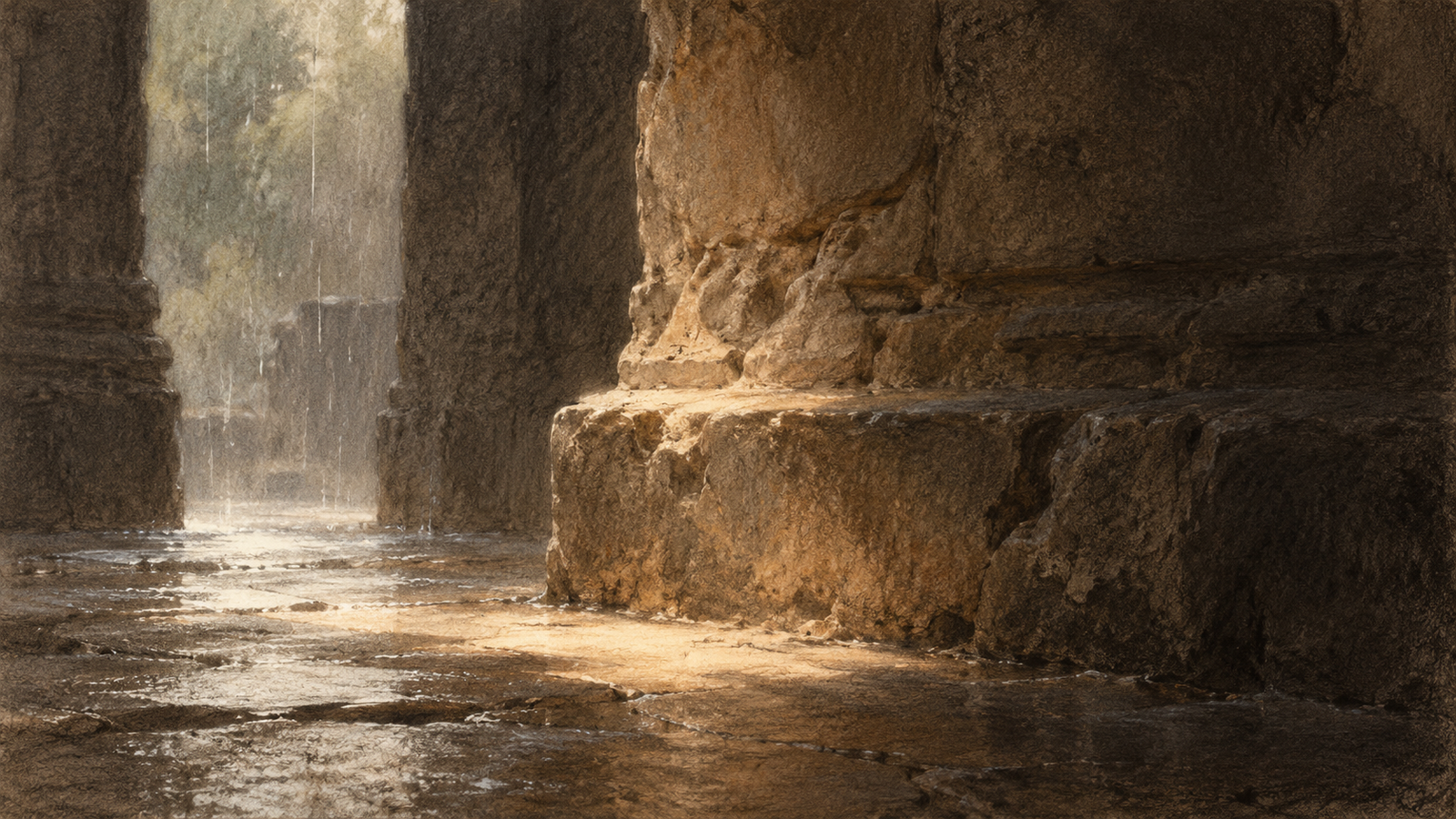
Rain, a carved hand, and the small movements of lives separated by centuries. A new literary piece from The Vow.