
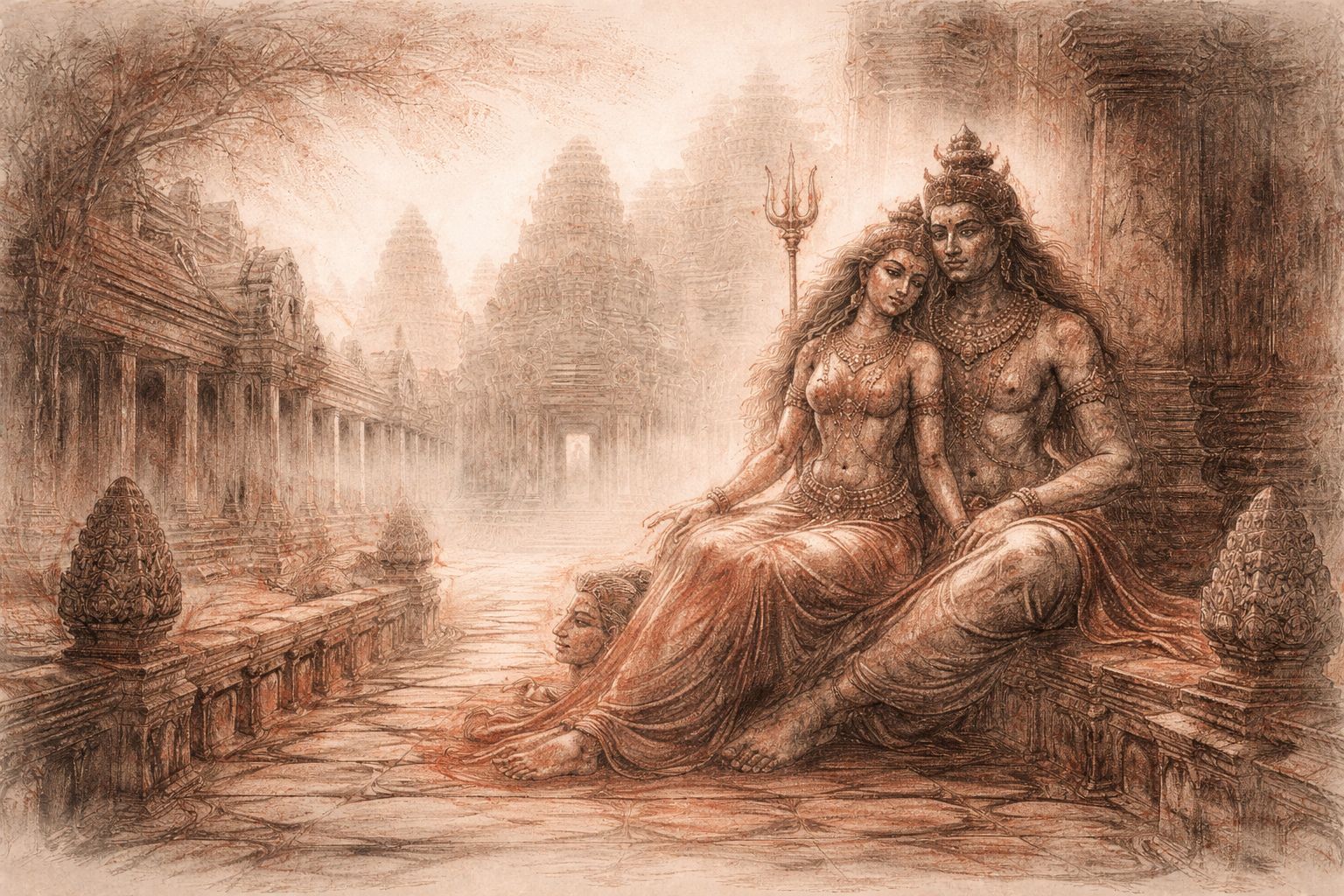

Parvati in Angkor: Presence, Continuity, and Held Power
The One Who Returns Him to the World
Parvati is not a presence that interrupts. She gathers. In Angkor, she is felt less as an arrival than as a gradual easing—an almost imperceptible softening of severity, like stone warmed by long, indirect light. Where Shiva withdraws, she remains. Where he refuses, she waits. Her power is not in overcoming resistance, but in making endurance possible.
She is known as daughter of the mountain, yet she does not dominate height. Her strength is learned through nearness: the patience of staying, the discipline of attention, the courage of sustained devotion. In the myths she approaches Shiva not with command, but with penance—years of listening rather than speaking, of shaping herself to the rhythm of what already is. This is not submission. It is alignment.
In Angkorian form, Parvati does not stand apart. She is seated, inclined, balanced against another body. The stone renders her with restraint: rounded but contained, present but never excessive. Even when placed upon Shiva’s thigh, she is not decorative. She is structural. The composition depends upon her weight. Without her, the figure would collapse inward.
She carries shakti not as force released, but as force sustained. Energy held close, measured, intimate. This is the power that allows ascetic withdrawal to return to the world without dissolving into it. In this sense, Parvati is neither the opposite of Shiva nor his complement. She is the condition under which his stillness can act.
The stories speak of danger requiring intervention: of Taraka, of the gods’ anxiety, of desire summoned to disturb meditation. Yet what emerges is not urgency, but sequence. Parvati does not hurry the world into balance. She makes balance possible by re-entering it. The birth of Skanda is not conquest, but consequence—the natural outcome of relation restored.
Her gentler names speak of brightness, of nourishment, of the maternal field that holds without enclosing. But even here there is firmness. Parvati does not dissolve boundaries. She teaches their use. Her care is exacting. What she nurtures, she also disciplines. What she brings into being, she expects to endure.
In Angkor, her presence is quieter than her fiercer forms, yet no less decisive. She inhabits thresholds where intensity must be tempered to remain coherent. She belongs to the space between retreat and return, where renunciation learns how to touch ground again.
Parvati does not correct through force. She corrects through continuity. She is the reminder that withdrawal, left alone, becomes sterile; that power, without relation, becomes inert. She does not speak this truth. She sits with it. And by sitting, she makes it real.
—
Receive the next work
Subscribe free to receive new work from the Lucas Varro Library by email.
More from the Library


See Also
A concise and impartial dictionary of absence, promises, quarrels, ordinary objects, and the troublesome instability of words.

The City of Service
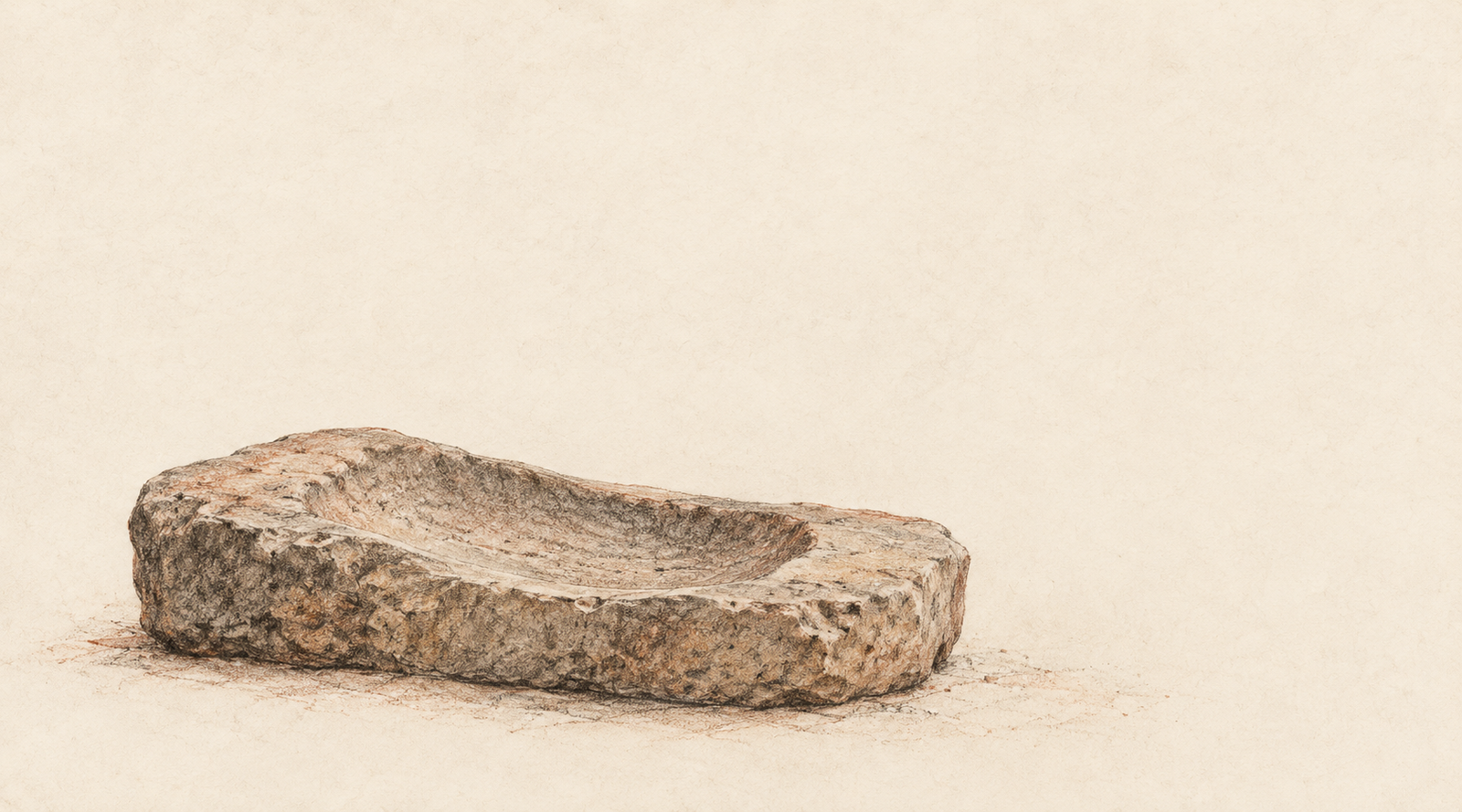
The temple we inherit is a building from which almost all necessity has been removed. Nothing must be brought for it to continue being what we call a temple. The sanctuary asks nothing of us. Stone is good at this kind of independence.
A living temple was otherwise.
Water had to come in. So did grain, cloth, oil, aromatic substances, fuel. The things required for worship arrived because someone carried them across a threshold.


Houses of Wood, Light, and Smoke
Some of Angkor’s most intimate ruins do not rise above the ground at all. They are postholes, low mounds, hearths and ponds: durable traces of a domestic city built largely from things that decay. To restore that city is to see Angkor not only as stone, but as wood, smoke, water, repair, and people living within calling distance.