
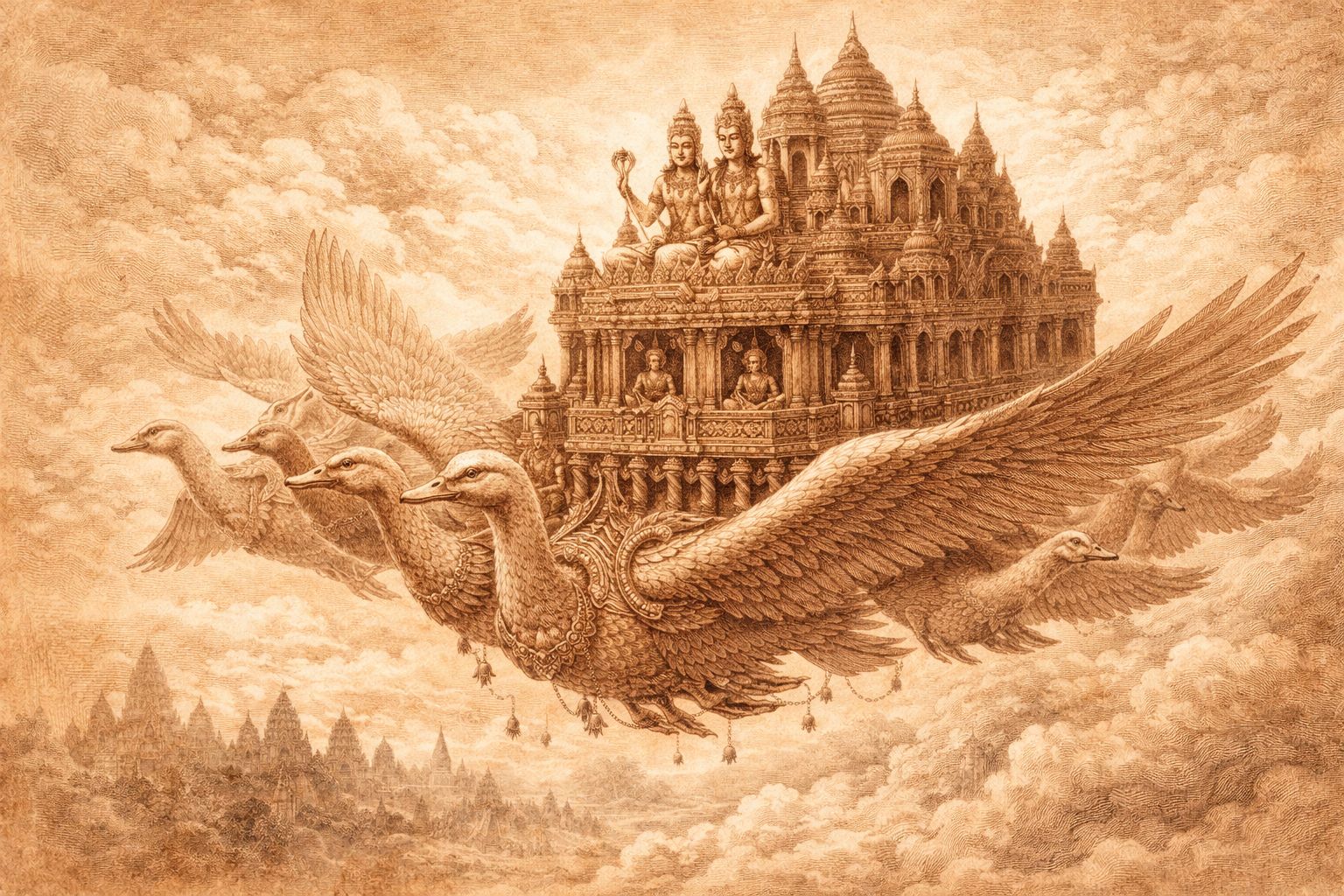

Pushpaka — The Palace That Learned to Fly
Among the flying things of sacred imagination, there are birds, there are gods, and then there are palaces that loosen their roots and rise. The Pushpaka belongs to this rare third order. It is not merely a vehicle but an idea made mobile: architecture released from ground, sovereignty freed from geography, justice given wings.
In the Ramayana, Pushpaka appears as a celestial chariot of incomparable splendour—an aerial palace described as indestructible, obedient only to the will of its rightful bearer. Gilded in gold, inlaid with jewels, hung with bells that sounded as it moved, it was said to resemble the summit of Mount Meru itself. It was not built for haste alone. It was built to arrive.
Its origin is telling. Pushpaka was fashioned by Brahma and first granted to Kubera, lord of wealth and measure. It belonged, therefore, to an ordered cosmos where abundance was balanced by restraint. That this palace could be stolen—and was—marks the moral tension at the heart of the epic. When Ravana seized Pushpaka and used it to carry Sita to Lanka, the chariot did not change form, but it changed meaning. Architecture remained radiant; ethics collapsed.
After the long violence of the war, it is Pushpaka’s final journey that reveals its deeper purpose. Once Ravana is defeated, the chariot is offered by Vibhishana to Rama. Reunited with Sita, Rama ascends the same palace that once bore injustice—and transforms it. The return flight to Ayodhya is not conquest but restoration. The palace flies not to escape the world, but to return rightly to it.
This is why Pushpaka matters so profoundly in the Khmer imagination. In temple reliefs, it is often rendered not as a foreign marvel but as a Khmer sanctuary in flight: tiered, symmetrical, disciplined. Supported by hamsas—sacred geese who glide between water and sky—the chariot becomes a lesson in governance. Power must move, but it must move cleanly. It must be elevated without becoming detached.
At Preah Khan, Pushpaka appears borne by multiple hamsas, their wings straining yet calm, carrying Rama, Sita, and Lakshmana within a pavilion that looks unmistakably like a temple. At Angkor Wat, the return to Ayodhya is carved into stone with a quiet inevitability: the palace does not rush; it proceeds. Elsewhere—at The Bayon, Preah Vihear, and Phnom Rung—the same logic repeats. Pushpaka is always supported, never thrust forward by force.
What the chariot ultimately teaches is subtle. Architecture, like power, can be seized or inherited. What determines its meaning is direction. Pushpaka in the hands of Ravana is brilliance without conscience. Pushpaka in the hands of Rama becomes restoration in motion—a reminder that the highest structures are not those that rise farthest from the earth, but those that know when and how to return.
In Angkor, stone remembers this. The flying palace is carved not to glorify speed, but to honour rightful arrival. Pushpaka is not an escape from gravity; it is gravity obeyed by the heavens themselves.
—
Receive the next work
Subscribe free to receive new work from the Lucas Varro Library by email.
More from the Library


See Also
A concise and impartial dictionary of absence, promises, quarrels, ordinary objects, and the troublesome instability of words.

The City of Service
The temple we inherit is a building from which almost all necessity has been removed. Nothing must be brought for it to continue being what we call a temple. The sanctuary asks nothing of us. Stone is good at this kind of independence.
A living temple was otherwise.
Water had to come in. So did grain, cloth, oil, aromatic substances, fuel. The things required for worship arrived because someone carried them across a threshold.

Houses of Wood, Light, and Smoke
Some of Angkor’s most intimate ruins do not rise above the ground at all. They are postholes, low mounds, hearths and ponds: durable traces of a domestic city built largely from things that decay. To restore that city is to see Angkor not only as stone, but as wood, smoke, water, repair, and people living within calling distance.