
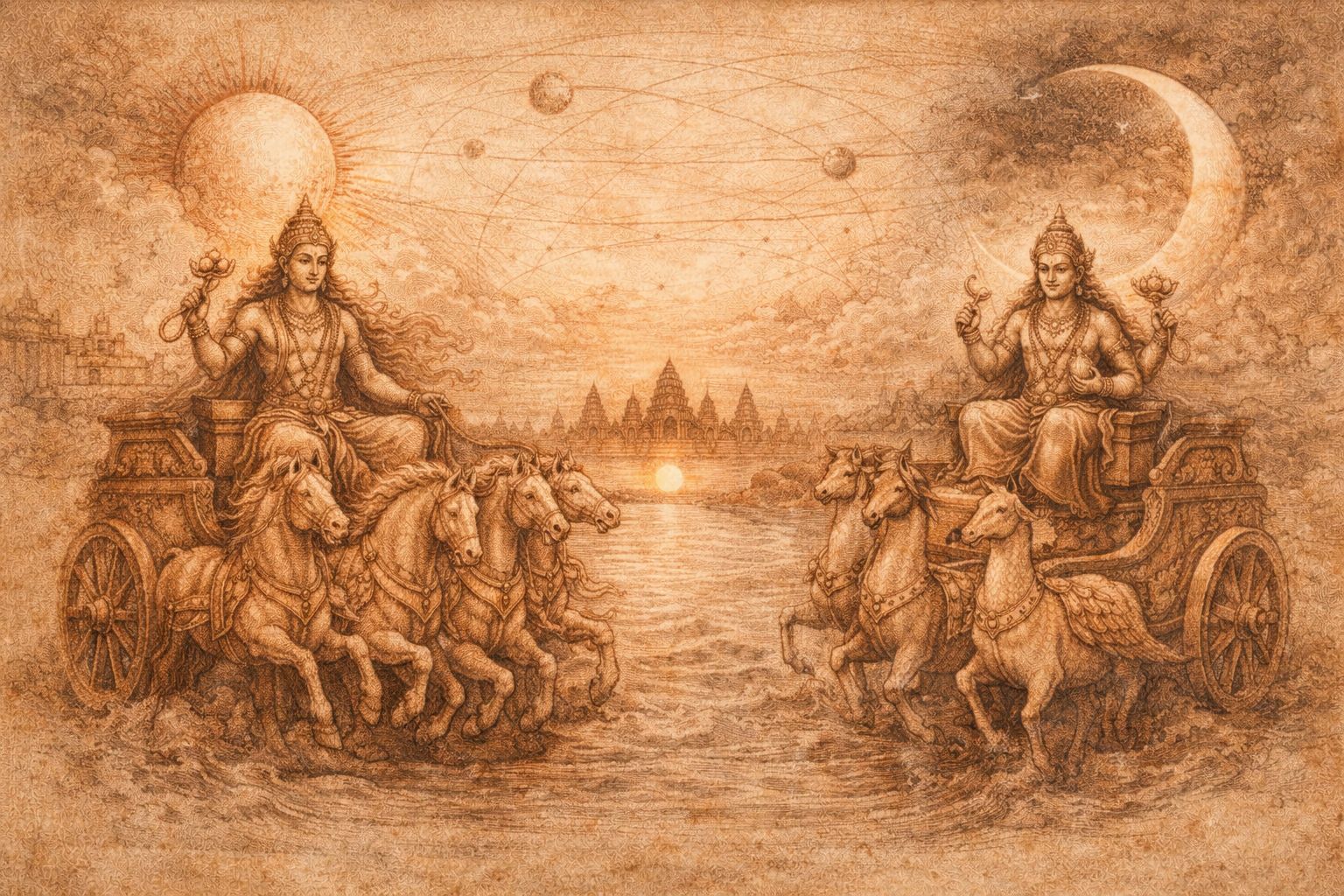

Surya and Chandra
Surya and Chandra do not arrive as opposites. They arrive as measures.
Before they are gods, before they are names or images carved in stone, they are the two great regulators by which the world learns to breathe. One governs the length of the day, the other the softness of the night. One insists. The other restores. Together, they teach time how to move without tearing the fabric of life.
In the Vedic imagination, Surya is not simply the sun as seen, but the sun as order made visible. He is the eye of the world, the witness who cannot be deceived. His daily passage establishes rhythm, obligation, sequence. To rise is to begin; to cast shadow is to measure; to set is to conclude. Kings took their authority from him, calendars from his motion, temples from his path. Even his chariot—drawn by seven horses—does not suggest speed so much as completeness: seven days, seven colours, seven divisions of light unfolded into time.
Chandra moves differently. Where Surya defines, Chandra dissolves. He waxes and wanes, refusing fixity. Known also as Soma—the elixir, the bright drop, the drink of immortality—he gathers what Surya has spent. His light does not conquer darkness; it inhabits it. Dew forms under his watch. Sap rises. Rest becomes possible. If Surya is the law that binds, Chandra is the mercy that allows life to endure within it.
The two belong together not because they are equal, but because neither can stand alone. A world of only Surya would burn itself into clarity and ash. A world of only Chandra would drift, fertile but unmoored. The ancient cosmologies understood this balance instinctively. That is why Surya and Chandra stand at the head of the Navagraha—the nine celestial forces that seize, shape, and steer existence. They are not decorative gods. They are instruments.
In myth, their roles are made explicit during the Churning of the Ocean of Milk, when gods and demons cooperate—briefly—to extract immortality from chaos. When the demon Rahu attempts to steal the elixir, it is Surya and Chandra who see the deception and speak. Vision and reflection together expose imbalance. Rahu is severed, but not destroyed. From then on, eclipses become the consequence of unresolved tension: the moments when order is briefly swallowed, when time falters and must be re-established.
At Angkor Wat, this cosmology is not explained. It is enacted. The temple itself is a solar instrument—its orientation, proportions, and alignments disciplined to Surya’s path. Yet within its galleries, Surya and Chandra appear not as abstractions but as riders in motion, each in a chariot, each drawn by horses, each fully embodied. They move across stone as they move across the sky: endlessly, without fatigue, carrying time forward.
And yet, in one of the temple’s most famous relief cycles—the Churning itself—they are absent. Their omission is not an error. It is a reminder. Even the regulators of time step back at moments of cosmic upheaval. There are thresholds where order must be renegotiated, not enforced. The sun and the moon wait until balance can be restored.
This is the deeper lesson Surya and Chandra offer. Not dominance, but calibration. Not brilliance alone, nor softness alone, but the continual adjustment between the two. Khmer builders understood this when they carved celestial discs, when they aligned causeways, when they chose when to begin a consecration. Time was not an abstraction. It was a material to be handled with care.
To walk a temple aligned to Surya by day and to leave it under Chandra by night is to feel this instruction in the body. The heat clarifies. The cool gathers. Attention sharpens, then loosens. One learns, slowly, that sacred architecture does not merely house gods—it trains the human sense of measure.
Surya and Chandra remain overhead, unhurried. They do not argue their importance. They rise, they set, they return. And in their unbroken exchange, the world is given just enough light to continue.
—
Receive the next work
Subscribe free to receive new work from the Lucas Varro Library by email.
More from the Library

See Also
A concise and impartial dictionary of absence, promises, quarrels, ordinary objects, and the troublesome instability of words.
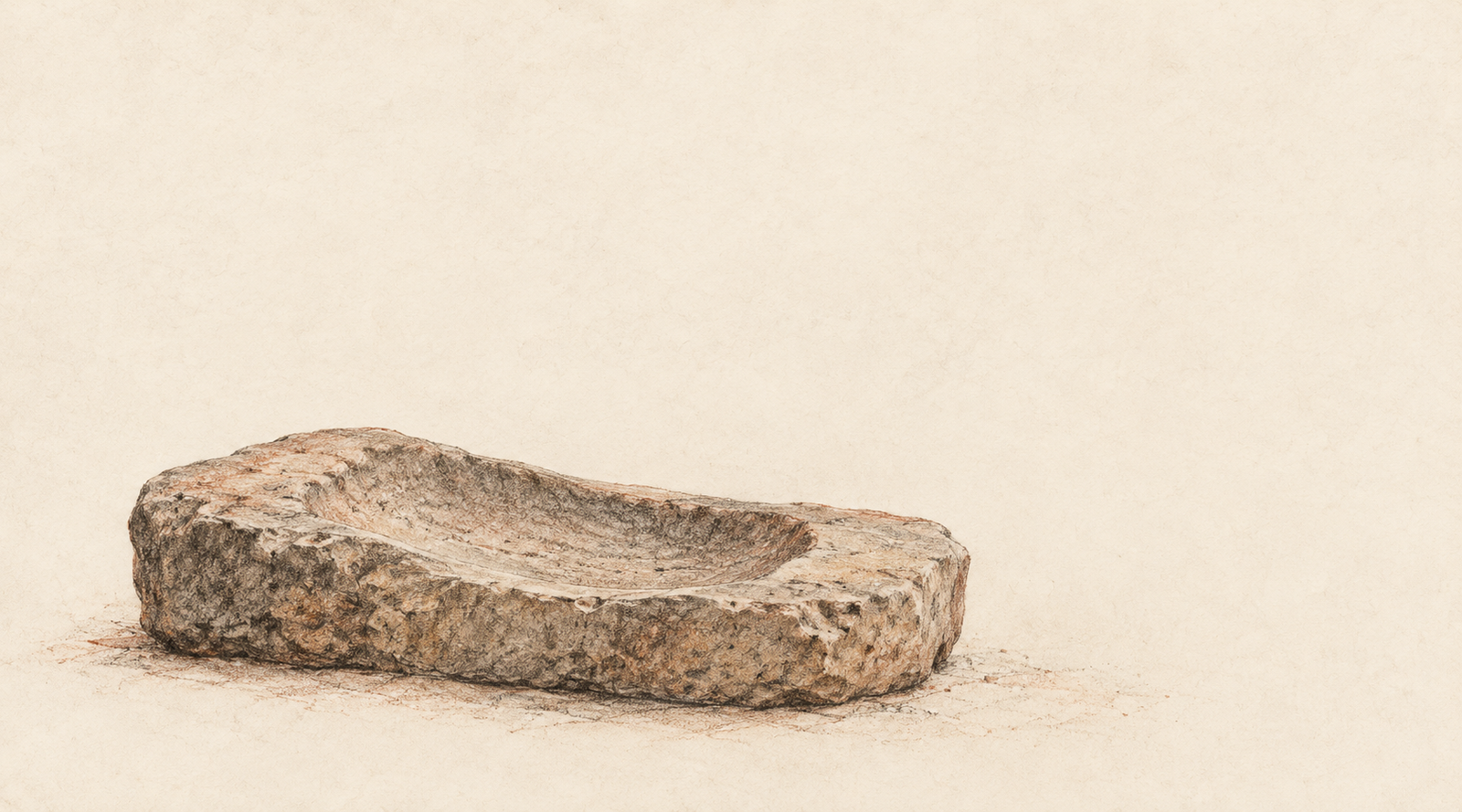

The City of Service
The temple we inherit is a building from which almost all necessity has been removed. Nothing must be brought for it to continue being what we call a temple. The sanctuary asks nothing of us. Stone is good at this kind of independence.
A living temple was otherwise.
Water had to come in. So did grain, cloth, oil, aromatic substances, fuel. The things required for worship arrived because someone carried them across a threshold.
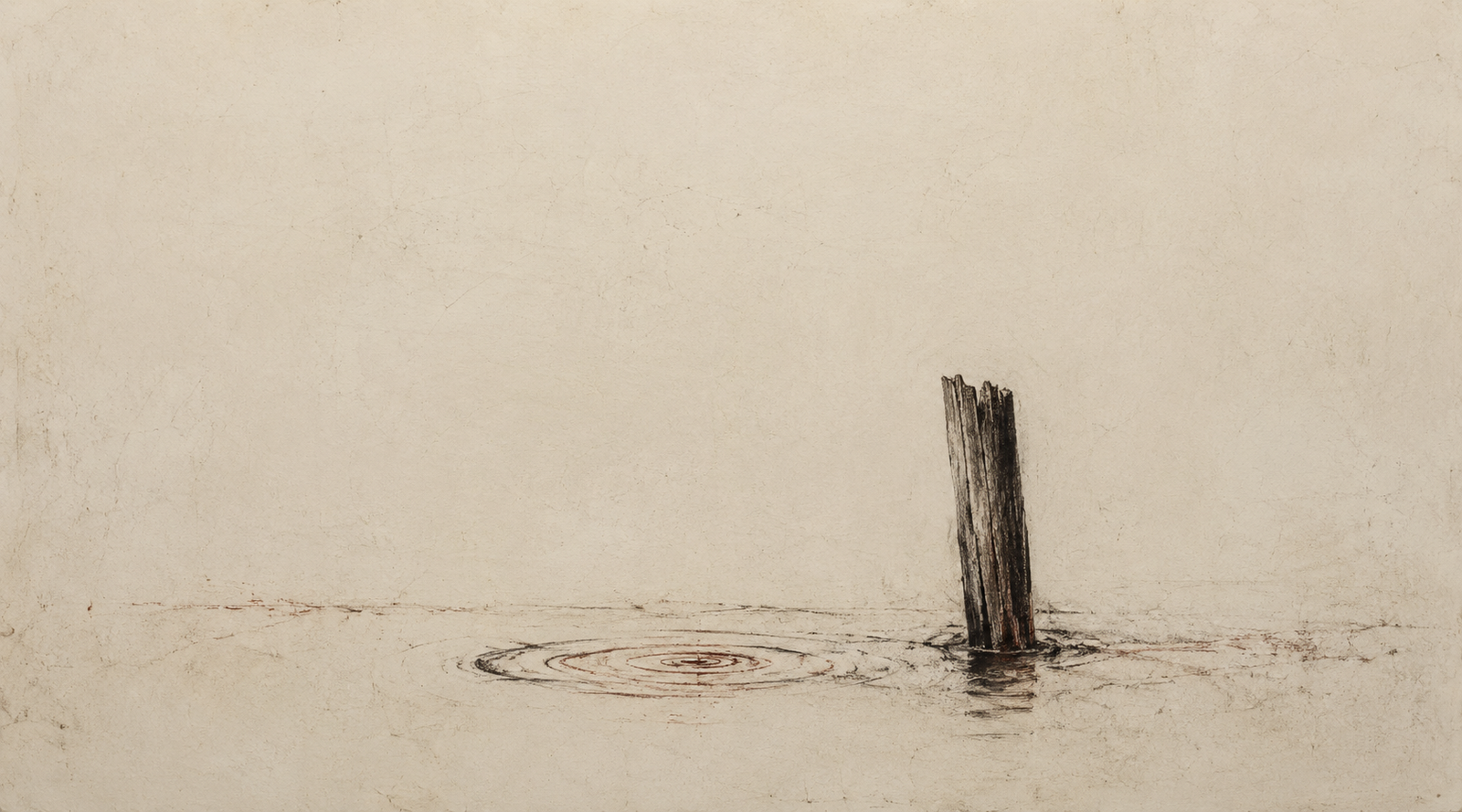

Houses of Wood, Light, and Smoke
Some of Angkor’s most intimate ruins do not rise above the ground at all. They are postholes, low mounds, hearths and ponds: durable traces of a domestic city built largely from things that decay. To restore that city is to see Angkor not only as stone, but as wood, smoke, water, repair, and people living within calling distance.

$895
Angkor Wat Temple, Cambodia. 2020
Limited Edition Archival Pigment Print
Edition
Strictly limited to 7 prints + 2 Artist’s Proofs
Edition Number
This listing is for the first numbered print from the Large Collector Edition: 1/7
Medium
Hand-toned black-and-white archival pigment print on Hahnemühle Bamboo — a museum-grade fine art paper chosen for its quiet tactility and reverent depth, echoing the spirit of the temples.
Signature & Numbering
Each print is individually signed and numbered by the artist on the border (recto)
Certificate of Authenticity
Accompanies every print
Image Size
30.1 x 26.1 inches (76.5 x 66.3 cm)
Mediocre pictures may follow a formula, good ones seldom do:
When the visual tools are used just right, the design, lighting, mood, and emotion come together to just the right point,
and that point hits you and you know what the photographer meant
– that’s a good picture.