

The City Behind the Temples
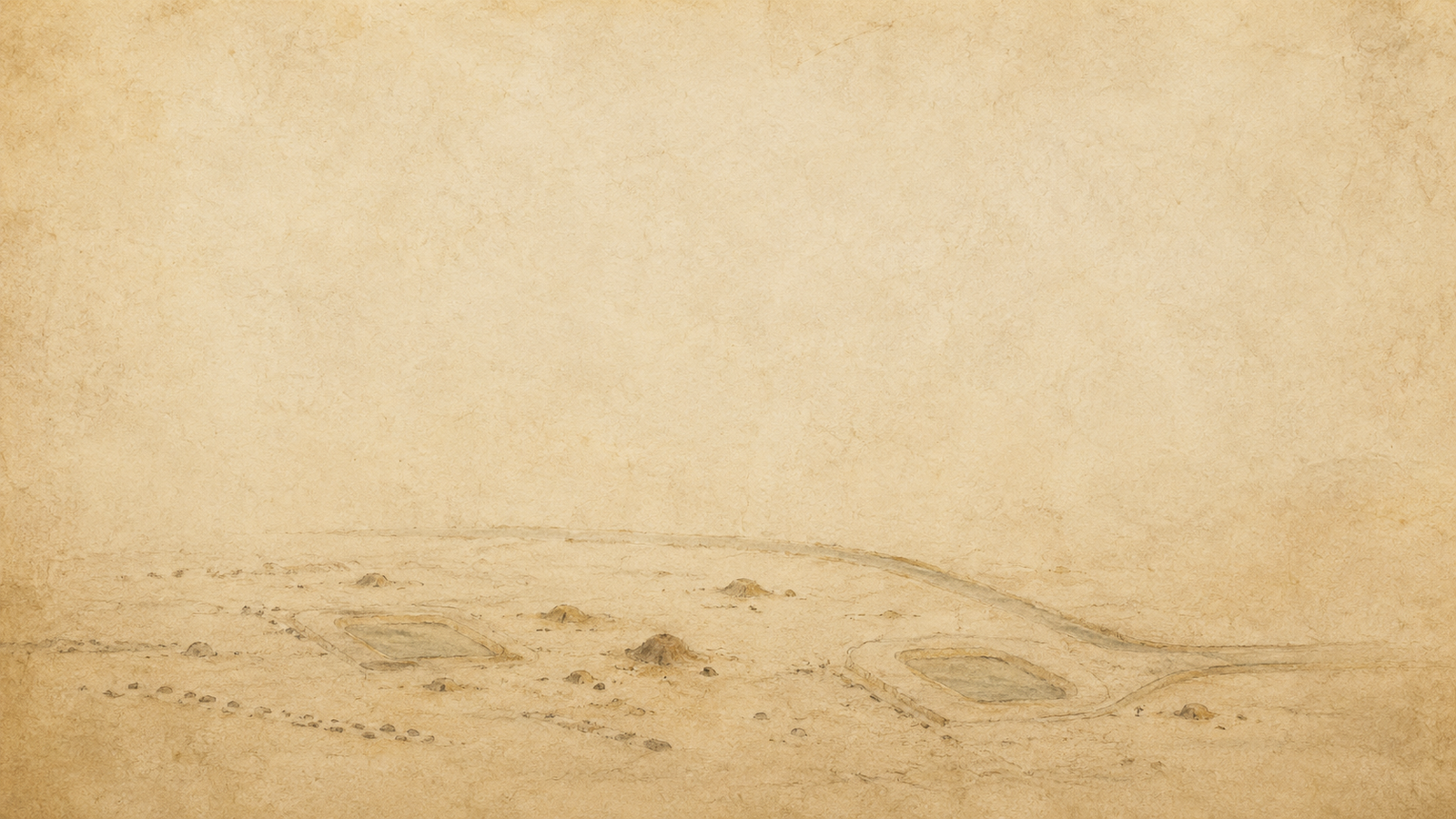
When the empty ground around Angkor begins to reveal mounds, ponds, roads, fields, and the vanished shape of a living city.
After publishing The Stone Is Not the World, this felt like the necessary next step.
If the previous essay asked us not to mistake surviving stone for the whole civilisation, this one asks us not to mistake the spaces around the temples for emptiness. Angkor was not a scattering of sacred monuments in a void. It was a vast, inhabited, low-density city whose most human materials have largely vanished, but whose ground still carries the pattern.
—
Walk away from the tower.
Leave the carved lintel, the devata, the gallery, the stair. Step beyond the place where the guidebook usually stops speaking. Let the temple fall behind you, not because it has ceased to matter, but because its power has become too obvious to be the whole truth.
There is ground ahead.
Grass. Earth. Trees. A shallow hollow. A raised line hardly high enough to deserve attention. A pond holding a piece of sky. A mound that looks like accident. A path that appears to be only the way people pass through because people have always needed a way through.
To the hurried eye, this is interval.
The monument is over there. The next monument is somewhere else. Between them lies the practical emptiness of tourism: road, verge, field, shade, ditch, water, waiting space. The temple is the event. The ground is the pause.
But at Angkor, the pause is often the thing we have failed to read.
Stone trains the eye to obey it. Stone rises, endures, concentrates attention. It offers towers, doorways, sanctuaries, faces, lintels, inscriptions, apsaras, gods, kings, battles, serpents, thresholds. It carries the authority of survival. It seems to say: I am what remains; therefore I am what mattered.
But this is only half true.
Stone is what survived most visibly.
It is not the whole world.
The great temples of Angkor were never isolated objects standing in sacred emptiness. They were the durable points of a much wider city: a city of earth, water, timber, thatch, bamboo, smoke, carts, ponds, embankments, gardens, rice fields, markets, workshops, shrines, roads, canals, processions, neighbourhoods, and ordinary human need.
Much of that city did not vanish because it was imaginary.
It vanished because it was mortal.
The gods received stone.
Human beings lived in what time could eat.
This is why the modern visitor so easily mis-sees Angkor. We stand before stone and think we are standing before the city. But what remains in stone is closer to a skeleton than a body. The sacred architecture is real, immense, and indispensable; yet it is not the full organism. Around it lay the perishable city, the living city, the city that cooked and traded and slept and fetched water and repaired tools and planted rice and walked in shade.
The temples did not rise from nowhere.
They rose from a world.
To see that world, one must lower the eyes.
Not to the carvings. Not to the towers. Not even to the formal axial causeways by which sacred order declares itself. Lower still: to the modest irregularities of the ground.
A low mound may not be merely a mound.
A rectangular pond may not be merely a pond.
A faint embankment may not be only old earth.
A line across the landscape may not be accident, drainage, erosion, or convenience.
When the ground is read carefully, the empty spaces begin to organise themselves. What seemed scattered becomes patterned. What seemed natural becomes engineered. What seemed incidental becomes inhabited.
The city returns first as a grammar of small signs.
Across the Angkorian landscape, archaeologists have identified thousands of mounds and ponds. These are not theatrical survivals. They do not announce themselves like towers. They ask for another kind of attention. A raised patch of ground may have supported wooden houses. A nearby trapeang, a small pond dug into the earth, may have supplied water for a household or a cluster of households. Around a local shrine there may have been a small community: dwelling mounds, ponds, gardens, paths, trees, cultivated fields, and the rhythms of ordinary life.
It is easy to pass such things without reverence, because they do not look like relics.
They look like ground.
Yet this is the point. Angkor’s vanished city is not hidden only beneath the ground. In many places it is hidden as ground. It survives as level, depression, rise, straightness, dampness, spacing, alignment. It is not a lost splendour waiting to be painted back into the imagination. It is a patterned surface waiting to be recognised.
A mound is a syllable.
A pond is a mark of punctuation.
An embankment is a sentence the earth has not quite forgotten.
The temples have made us good at looking upward. The city behind the temples requires us to become literate in the horizontal.
This city was not dense in the way many modern readers expect a city to be dense. It was not a compact mass of masonry streets, stone houses, crowded squares, permanent facades, and vertical accumulation. Angkor was urban in another way: dispersed, hydraulic, agrarian, sacred, practical. It spread through water and rice. It ran along roads, canals, embankments, and causeways. It gathered around shrines and ponds. It formed patches, grids, alignments, enclosures, orchards, gardens, fields.
It was not less a city because trees grew through it.
It was not less a city because rice fields belonged to its logic.
It was not less a city because its houses were built from materials that did not intend to defy centuries.
This is one of the great corrections Angkor asks of the modern imagination. We have inherited too narrow an idea of what a city must be. We expect stone density, permanent streets, domestic architecture that survives long enough to be admired. Angkor refuses that expectation. Its urban life was spread through a landscape where sacred architecture, water management, agriculture, habitation, and movement were woven together.
The city did not end where the temple wall ended.
Sometimes the wall was only one line within a much larger design.
Consider the ground around Angkor Wat. The eye goes first to the towers, then to the moat, then to the long causeway, then to the galleries. The monument commands this sequence. But look to either side of the approach and the ordinary grass is no longer innocent. Traces of an internal grid have been identified there: former streets, patterns of ponds and mounds, signs of occupation within the great enclosure. What now looks like open space was once organised space. The temple precinct was not an empty ceremonial diagram. It contained life.
At Ta Prohm, too, the imagination tends to cling to roots and stone. The temple has become famous as an image of nature reclaiming architecture. But this romantic opposition between forest and ruin can obscure the older reality. Around and within such enclosures were patterns of habitation, work, movement, water use, and maintenance. Excavations have found traces that belong not to royal spectacle but to ordinary occupation: post-holes, floors, hearths, ceramics, botanical remains, signs of cooking, processing, and household activity. These are quieter than a tower strangled by a tree.
They are also more intimate.
The city behind the temples is not only a matter of royal planning.
It is the trace of people making life possible.
There were houses where no houses now stand. There were posts sunk into earth. Roofs of thatch, tile, or other perishable material. Raised floors. Verandas. Cooking spaces. Storage. Children. Animals. Water jars. Smoke. Tools. Mats. Palms. Fruit trees. Cloth. Rice. Fish. Voices at dawn. Voices at evening. Voices interrupted by rain.
The stone tells us what Angkor consecrated.
The ground tells us what Angkor required.
Between those two forms of evidence, the civilisation becomes more human, not less sacred.
The vastness of this world matters. Greater Angkor is now understood not as a handful of temples scattered through forest, but as an immense low-density urban complex extending across roads, canals, embankments, reservoirs, fields, shrines, mounds, and ponds. The exact figures, like all reconstructions of ancient population and settlement, require caution. But caution does not restore emptiness. The evidence is too abundant for that. The city may not have looked like our idea of a city, but it was no mere ceremonial park.
It was a civilisation spread flat.
It was a city made of interval.
And this interval was not blank. It was connective.
Roads and embankments joined the dispersed world. Some roads were raised well above flood-prone land. Some served as dikes. Some carried people, goods, processions, officials, pilgrims, stone, rice, command, obligation, news. Bridges crossed rivers and streams. Causeways made formal approaches to sanctuaries. Canals carried water, drained land, shaped movement, and tied the sacred landscape to the agricultural one.
A city is not only where people sleep.
A city is where movement becomes organised.
At Angkor, movement passed through water as well as dust. Moats were not merely picturesque frames for reflection. Barays were not merely impressive expanses on a map. Canals were not merely lines of engineering. These features belonged to a world in which water shaped settlement, agriculture, transport, ritual, and power.
Scholars may continue to debate the exact function of particular hydraulic works: irrigation, drainage, flood control, symbolic oceans, royal display, practical management, cosmological statement, or some changing mixture of these across time. But the debate over function should not blind us to the fact of transformation. The plain was engineered. The ground was worked. The city was made through water.
This is why the familiar phrase “temple complex” feels too small.
It is not wrong, exactly. Angkor does contain temple complexes. But the phrase can shrink the imagination. It encourages the eye to move from monument to monument, as though each were a sacred island surrounded by neutral absence.
Angkor was not a necklace of isolated stones.
It was a landscape of relationships.
Temple to pond.
Pond to mound.
Mound to path.
Path to embankment.
Embankment to canal.
Canal to field.
Field to shrine.
Shrine to road.
Road to gate.
Gate to city.
City to water.
Water to rice.
Rice to labour.
Labour to offering.
Offering to god.
Once this chain is seen, the temple no longer stands alone. It becomes the luminous concentration of a much larger order.
This does not diminish the temples. It rescues them from isolation.
A temple without its city is too easily misunderstood as an object of wonder. A temple within its city becomes stranger and deeper: not only a masterpiece, but a node in a living field of obligation, devotion, labour, ecology, hierarchy, craft, agriculture, and time.
The great monuments were not surrounded by emptiness.
They were surrounded by consequence.
Part of that consequence is invisible because the social world of Angkor was not preserved equally. Kings speak more loudly than blacksmiths. Inscriptions remember foundations, endowments, gods, officials, villages, rice, personnel, ritual obligations. They do not always pause for the woman setting out goods on a mat, the man repairing a cart, the child carrying water, the worker firing ceramics, the person cutting thatch, the cook grinding spice, the hand twisting cotton, the household sweeping a raised floor after rain.
But absence from inscription is not absence from life.
The output remains where names do not. Iron, ceramics, plant remains, post-holes, hearths, occupation layers, roof tiles, pillar sockets, road lines, ponds, embankments: these are the humbler archives of the city. They do not praise themselves. They do not declare piety. They do not name patrons. They simply persist as consequences of having been used.
This is one of archaeology’s moral gifts. It restores, imperfectly but powerfully, the world beneath official memory.
The city behind the temples is not only a spatial correction. It is an ethical correction. It asks us to widen reverence beyond what was designed to survive. It asks us to honour not only the sanctuary, but the conditions that made sanctuary possible. The temple was not built by stone alone. It was built by food, water, roads, labour, settlement, craft, management, transport, ritual service, household life, and a thousand acts too ordinary to enter the heroic imagination.
The sacred depended on the practical.
The visible depended on the perishable.
The immortal house of the god depended on a mortal city.
This is why LiDAR, for all its importance, must remain a supporting character in this story. It has helped researchers see subtle topographic traces beneath vegetation and map the extent and density of ancient networks with extraordinary precision. It has clarified patterns that the eye alone could not hold. It has filled gaps. It has made certain forms of blindness harder to maintain.
But the city was not created by a laser.
Nor was the wider Angkorian landscape first imagined only when aircraft carried new instruments over the forest. Long before recent remote sensing, aerial photography, ground surveys, inscriptions, excavations, historical accounts, and the patient work of earlier scholars had already begun to challenge the monument-centred view. Roads had been traced. Reservoirs measured. Enclosures mapped. Occupation evidence found. The perishable city had been inferred from what survived and from what did not.
LiDAR matters because it sharpened the reading.
It did not make the ground meaningful.
The danger of the “lost city discovered” story is that it flatters the instrument and diminishes the landscape. It suggests that Angkor was absent until modern technology found it. But Angkor was not absent. It was misread. Or read incompletely. Or read through a habit of attention trained too strongly on stone.
The real revelation is not technological.
The real revelation is perceptual.
A forested enclosure becomes a neighbourhood.
A hollow becomes a pond.
A slight rise becomes a house mound.
A straight line becomes a street.
A sequence of ponds becomes planning.
A field becomes part of the city.
The ground, which had seemed silent, begins to remember aloud.
There is humility required for this kind of seeing. Monumental art rewards admiration quickly. A tower can seize the eye at once. A great face at the Bayon needs no explanation in order to possess presence. Angkor Wat at dawn does not have to argue for itself. But a mound asks for patience. A pond asks for context. A faint embankment asks the viewer to admit that not all significance is dramatic.
The city behind the temples is therefore a lesson in attention.
It teaches that absence is sometimes only a failure of scale. That emptiness may be a form of erasure. That survival is not the same as importance. That a civilisation may remain most visibly where it was least human, and disappear most completely where it was most lived.
This does not mean we should invent what is gone. The vanished city must not become fantasy. We should distinguish carefully between what is directly evidenced, what is inferred, and what remains debated. A post-hole is not a whole house. A mound is not a biography. A pond does not tell us every use to which it was put. A canal does not always declare whether it served irrigation, drainage, ritual symbolism, transport, flood control, or several purposes at different moments.
But caution is not emptiness.
Enough remains to change how we walk.
Once we have learned even a little of this grammar, the landscape alters. The famous road from one monument to another ceases to be a route through blankness. The forest beside the South Gate of Angkor Thom is no longer simply picturesque shade before the Bayon. The space around Angkor Wat is no longer ceremonial vacancy. The ground near Ta Prohm is no longer only the theatre of ruin and root. The barays are no longer just vast rectangles of water or absence. The small ponds no longer sit at the edge of attention. The low rise under grass is no longer nothing.
A whole discipline of looking begins.
The visitor who has learned to see this way does not see less mystery.
He sees more.
The mystery shifts. It is no longer only the mystery of how such temples were built, or why such gods were honoured, or how such kings imagined themselves. It becomes also the mystery of how a city can disappear without ceasing to pattern the earth. How ordinary life can rot away and still leave marks. How water, rice, timber, and earth can form an urban world without leaving a skyline. How the most modest features may hold the greatest correction.
Angkor is not smaller when the city returns.
It is larger.
Not merely larger in kilometres, though it is that. Larger in meaning. Larger in human range. Larger in the number of lives implied. Larger in the kinds of attention it demands. The stone temples remain sublime, but they now stand within a recovered field of dependence. Behind the god was the village. Behind the tower was the road. Behind the moat was the management of water. Behind the carving was the hand that ate, slept, carried, repaired, cooked, planted, ferried, traded, swept, dug, and remembered.
The city behind the temples is not behind them in the sense of being secondary.
It is behind them as the body is behind the face.
Without it, the face still astonishes.
With it, the face belongs to life.
So walk again.
Walk away from the tower. Leave the gallery, the stair, the devata, the god. Step into what you once called empty. Let the grass remain grass. Let the pond remain pond. Let the trees keep their shade. Nothing spectacular has to be added. No reconstructed houses need to rise before you. No imagined crowd needs to fill the path. No vanished market needs to be painted over the silence.
Only look more carefully.
There, perhaps, is a mound.
There, a pond.
There, a line.
There, the faint discipline of an old road.
There, water remembered by shape.
There, the interval that was never empty.
The temples still rise from the plain.
But after the ground has once become legible, they no longer rise alone.
—
Workroom Note
For paid subscribers, I have added a Workroom note on the making of this piece: Author’s Note: The City Behind the Temples.
It follows the difficulty of seeing the ground truthfully, the danger of turning the essay into a LiDAR story, and the choices behind the final form.
—
Receive the next work
Subscribe free to receive new work from the Lucas Varro Library by email.
More from the Library


See Also
A concise and impartial dictionary of absence, promises, quarrels, ordinary objects, and the troublesome instability of words.

The City of Service
The temple we inherit is a building from which almost all necessity has been removed. Nothing must be brought for it to continue being what we call a temple. The sanctuary asks nothing of us. Stone is good at this kind of independence.
A living temple was otherwise.
Water had to come in. So did grain, cloth, oil, aromatic substances, fuel. The things required for worship arrived because someone carried them across a threshold.


Houses of Wood, Light, and Smoke
Some of Angkor’s most intimate ruins do not rise above the ground at all. They are postholes, low mounds, hearths and ponds: durable traces of a domestic city built largely from things that decay. To restore that city is to see Angkor not only as stone, but as wood, smoke, water, repair, and people living within calling distance.