
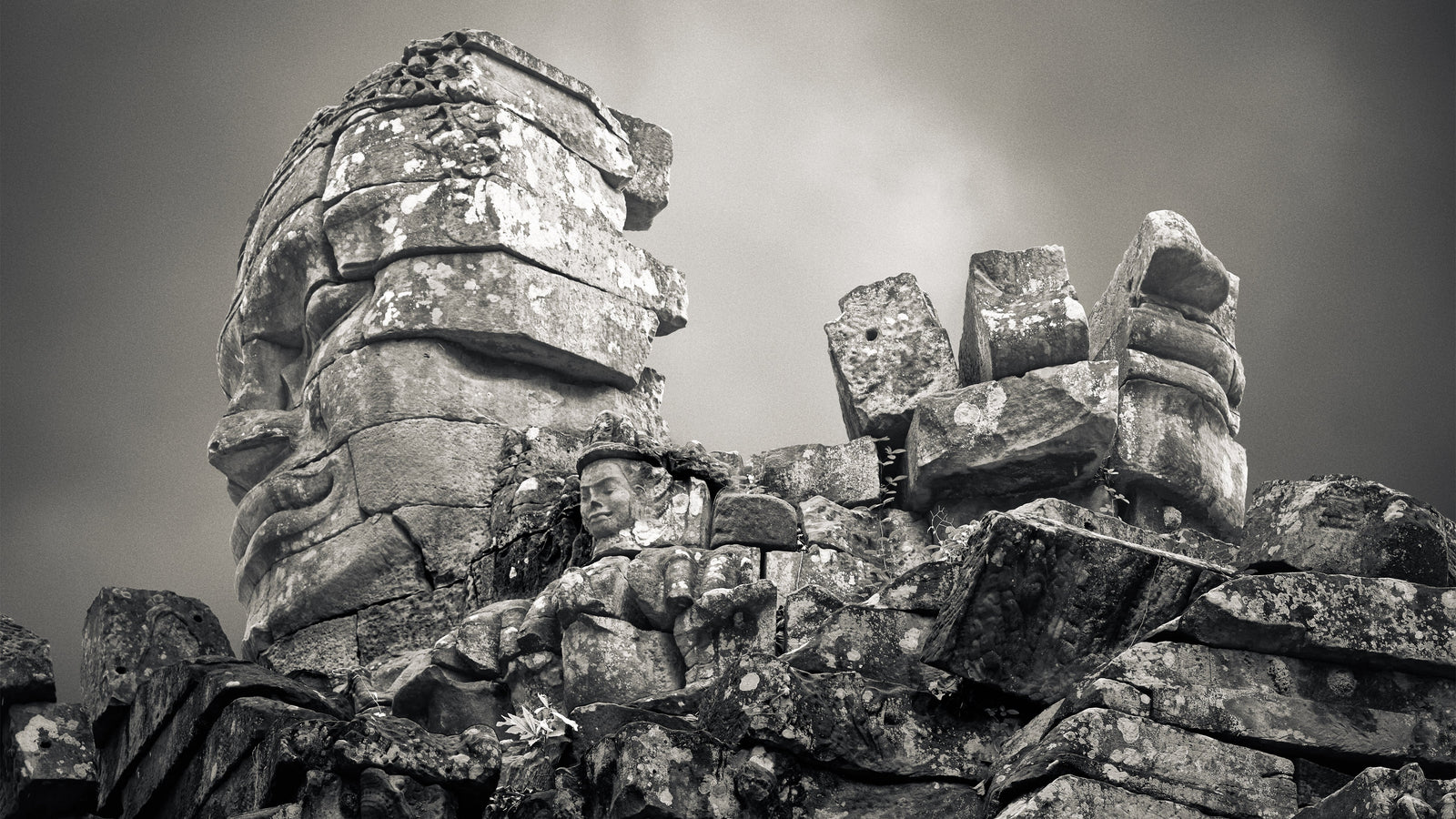

The Face the Rain Did Not Erase
The vine moved first—barely. Its green curl trembled against the cheek of the ruined guardian. Not wind, not gesture, but something more ancient. The kind of movement that belongs to silence, to roots, to breath drawn below speech.
I lowered my voice within. Even the click of the tripod felt like intrusion. Across the tower’s fractured geometry, dawn spilled unevenly, filling cracks like water searching for its own depth. The face turned slightly away—not from me, but from the need to be seen.
In that moment, the rain began again.
Captured on medium-format black-and-white film, the exposure lasted just long enough to let the mist enter the frame—not as subject, but as presence.
The rain has forgotten
its own falling.
Stone remembers for it—
each drop a slow syllable
in a prayer older than language.A face, half-broken, half-becoming,
lifts into stormlight
like a mountain listening.
I stand below,
heartbeat loosened
into the hush between breaths.What guards such silence?
Only the gaze
that has already seen us depart,
and still keeps watch
for the quiet we might leave behind.
More from the Library


See Also
A concise and impartial dictionary of absence, promises, quarrels, ordinary objects, and the troublesome instability of words.

The City of Service
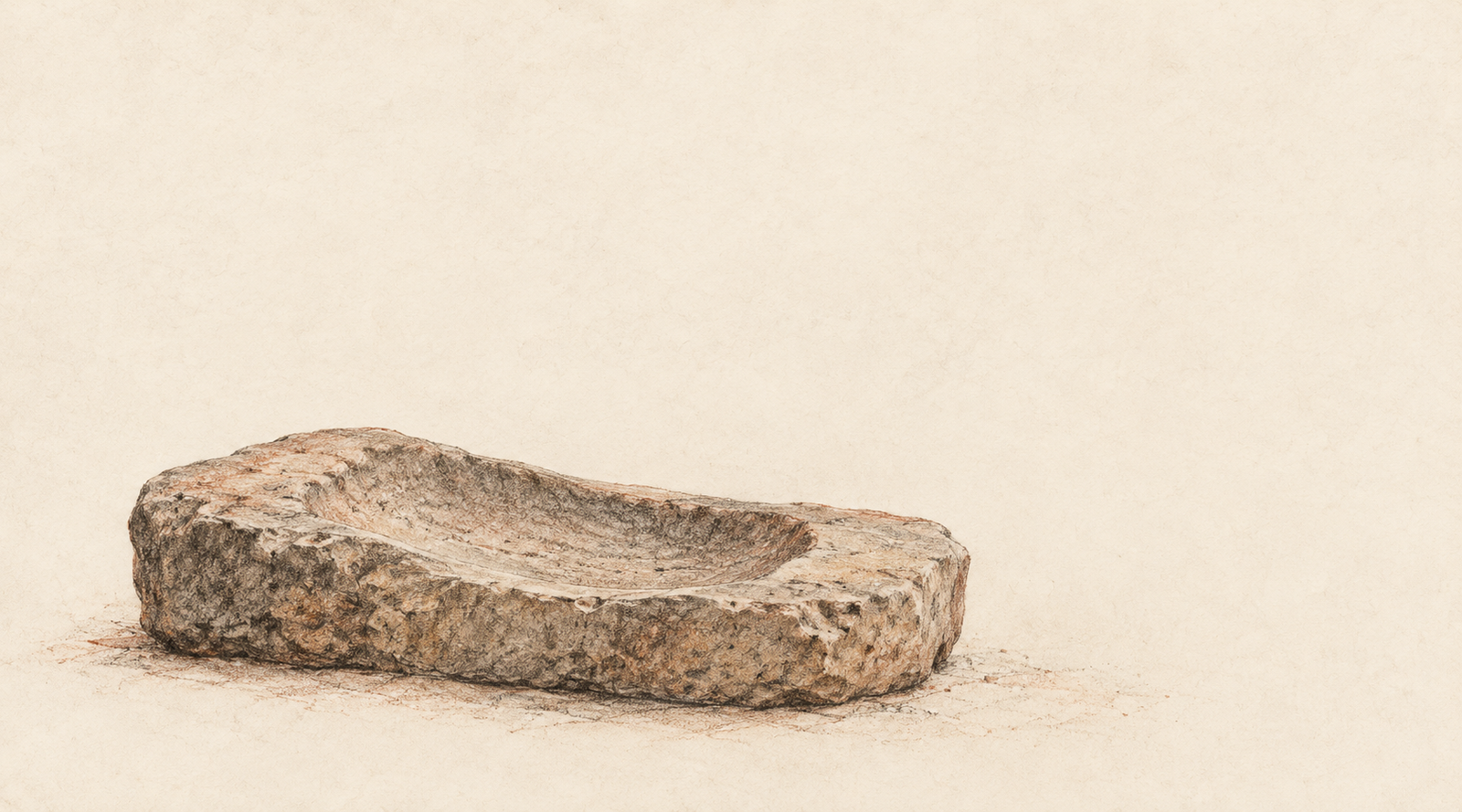
The temple we inherit is a building from which almost all necessity has been removed. Nothing must be brought for it to continue being what we call a temple. The sanctuary asks nothing of us. Stone is good at this kind of independence.
A living temple was otherwise.
Water had to come in. So did grain, cloth, oil, aromatic substances, fuel. The things required for worship arrived because someone carried them across a threshold.

Houses of Wood, Light, and Smoke
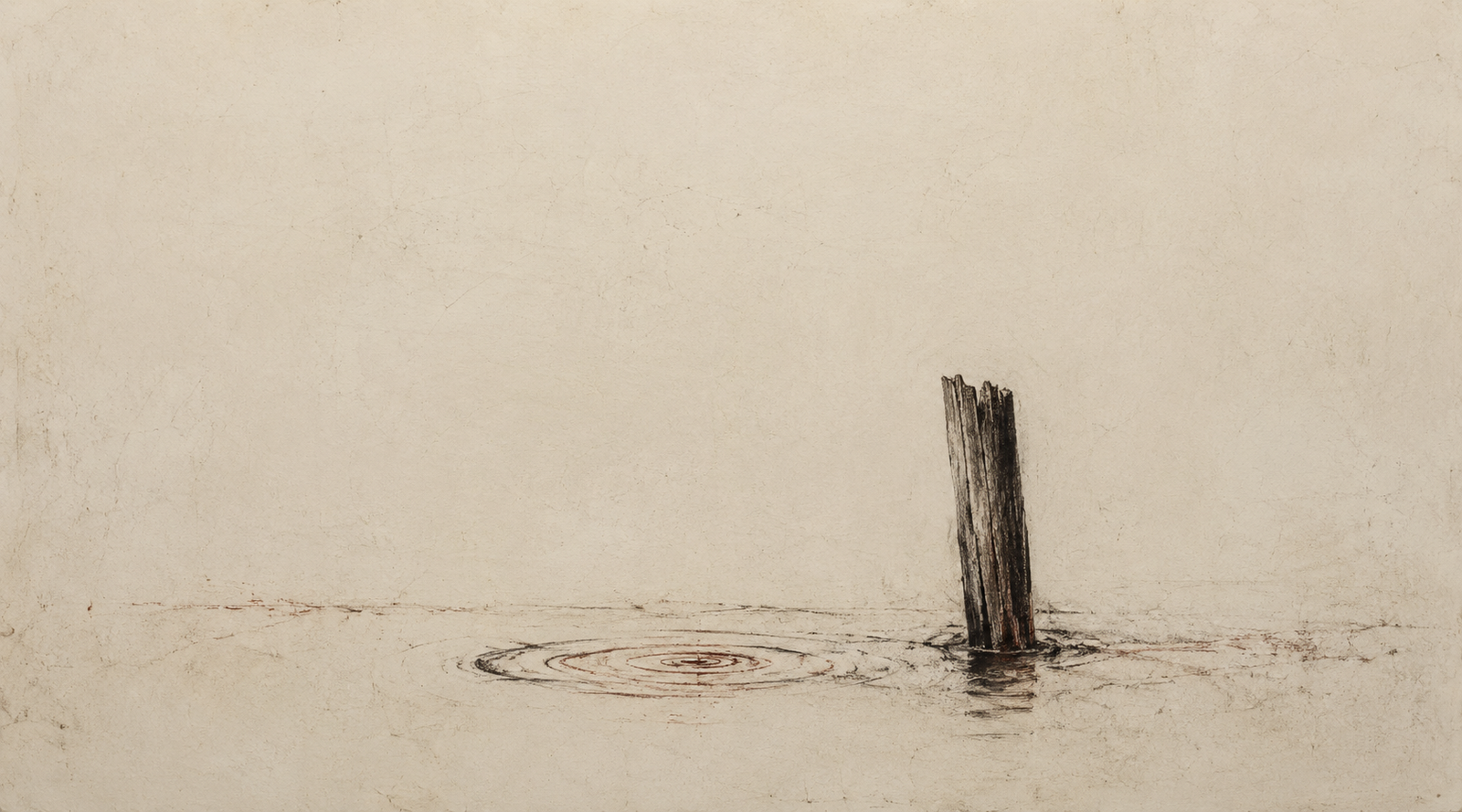
Some of Angkor’s most intimate ruins do not rise above the ground at all. They are postholes, low mounds, hearths and ponds: durable traces of a domestic city built largely from things that decay. To restore that city is to see Angkor not only as stone, but as wood, smoke, water, repair, and people living within calling distance.

$895
Banteay Kdei Temple, Angkor, Cambodia — 2020
Limited Edition Archival Pigment Print
Edition
Strictly limited to 7 prints + 2 Artist’s Proofs
Edition Number
This listing is for the first numbered print from the Large Collector Edition: 1/7
Medium
Hand-toned black-and-white archival pigment print on Hahnemühle Bamboo — a museum-grade fine art paper chosen for its quiet tactility and reverent depth, echoing the spirit of the temples.
Signature & Numbering
Each print is individually signed and numbered by the artist on the border (recto)
Certificate of Authenticity
Accompanies every print
Image Size
28 x 28 inches (71.1 x 71.1 cm)
Storm-heavy dawn cloaks the western gate of Banteay Kdei, where a fractured guardian face rises from a broken tower—its gaze turned not outward, but inward. Light moves across the ruin like breath through a reed, quiet and shaping. Moss clings to cracked lips. Vines trace their own soft sutras.
The silence is not absence—it is memory. A stillness that bears witness to centuries of devotion and decay. In this hush, the ruin becomes a kind of offering, neither whole nor lost, but entirely present.
I stood before it with the lens steady and my breath slower than the wind. The shutter opened long enough for storm and mist to thread their weight into the emulsion. Later, in the studio, I shaped the image with chiaroscuro, deepening shadows to reveal light’s edge. Each print is hand-toned—its warmth born not of color, but of reverence.
This limited edition of twenty-five archival pigment prints (with two Artist’s Proofs) is printed on museum-grade Hahnemühle Bamboo paper. The tactile quiet of the paper holds the image like an echo holds sound. Each print is signed and numbered on the border recto, accompanied by a Certificate of Authenticity.
Let this sentinel find its stillness within your own sacred threshold.
Previously titled ‘Face-Tower Ruin, Banteay Kdei Temple, Angkor, Cambodia. 2020,’ this photograph has been renamed to better reflect its place in the series and its spiritual tone. The edition, provenance, and authenticity remain unchanged.