

The Frog and the Bell
a tale told beneath the temple eaves
There was once a frog who lived in the dust-shadowed halls of an ancient forest temple.
He was not a very large frog. In truth, he was quite small. His skin bore the colour of wet moss, and though his limbs were nimble, they flailed with theatrical flourish whenever he leapt too suddenly. He drank from lotus bowls, dined on fat flies that strayed too close to the incense, and bathed in the shimmer of still water caught in stone.
But more than food, more than coolness, more than even the golden hush of shade—this frog longed to be heard.
“Croak!” he would call from the corners of the monastery.
“Crooooak!” he would bellow from beneath the alms table.
The monks, understandably, paid him no mind.
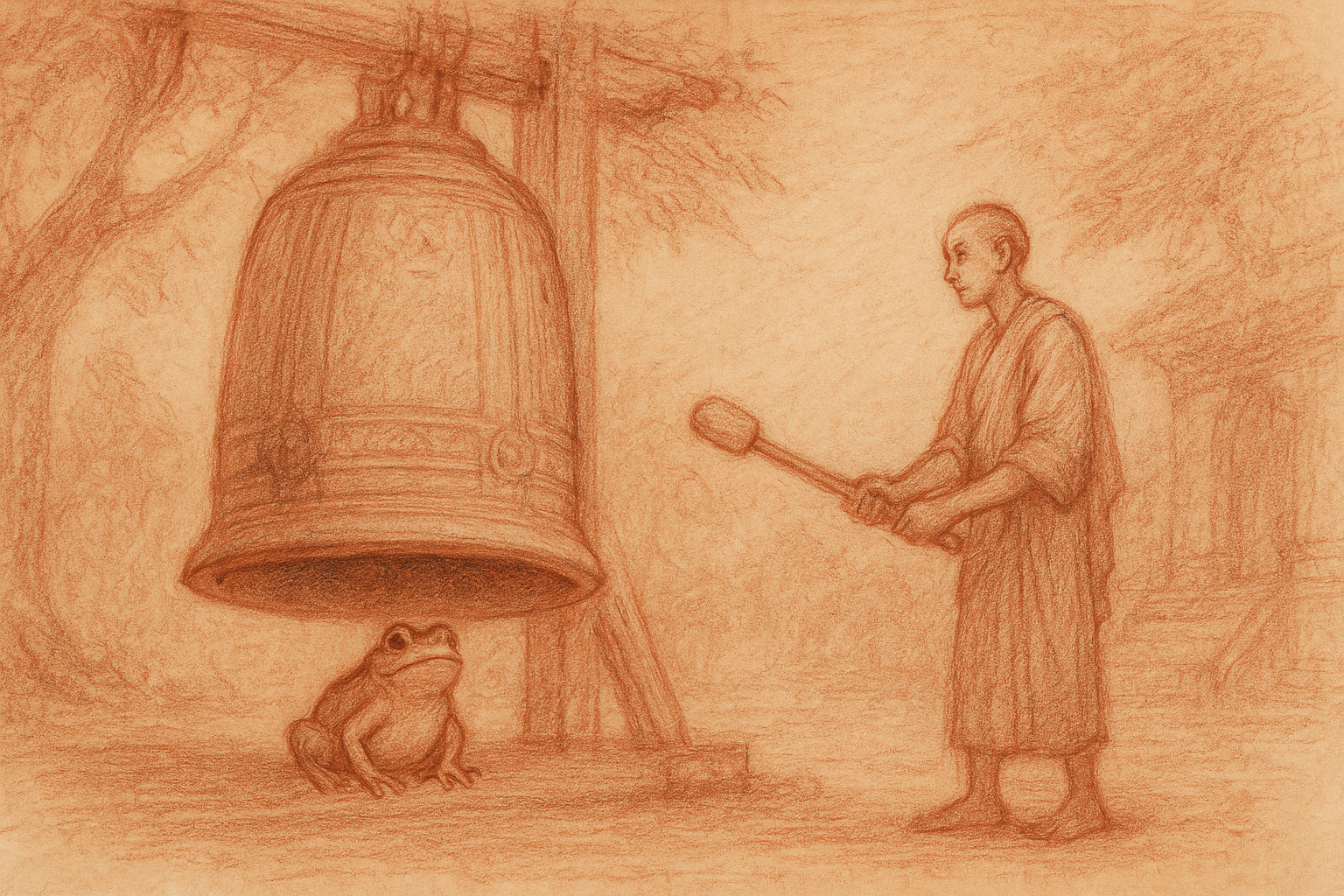
One day, seeking refuge from the midday sun, the frog hopped beneath the great bronze bell that hung near the bodhi tree. It had not been struck in many weeks—there had been no festivals, no pilgrims, no cause for the temple’s voice to rise.
“Ah,” sighed the frog, “this is where the cool ones rest.”
He found a small hollow near the rim of the bell and nestled into it like a pebble in the palm of a sleeping god. The silence was vast. The bronze shade shimmered with stillness. He dozed.
Then came the novice monk.
It was the Hour of Mindfulness.
With a soft invocation and two steady hands on the wooden striker, the novice stepped forward and gave the bell a modest, sincere tap.
GONGGGGGGGGGG…
The sound unfurled like thunder across the courtyard. Birds scattered from the trees. Leaves trembled. A squirrel dropped its prize.
And from deep within the bronze:
“CROOOOAAK!”
Startled awake, the frog had cried out by instinct. But what he heard in response astonished him.
At the moment of his croak, the entire temple had seemed to sing with him. The trees answered. The wind bowed. A butterfly stilled its wings mid-flight.
He blinked.
“I did that,” he whispered, eyes round with wonder. “I… I must be the voice of the bell.”

He thought the world echoed his voice—
until the silence spoke louder.
The next day, it happened again.
GONGGGGGG…
“CROOAAK!”
The frog swelled with pride.
By the third day, he was perfecting his timing.
“Not too soon,” he muttered. “Wait for the echo… now!”
It was glorious. He had become—he believed—the soul of the sacred sound.
“Let others ring the bell,” he said. “I am its voice.”
But pride is a slippery perch for small feet.
One afternoon, the novice struck the bell with greater zeal, and the frog—perched a little too boldly in his favoured notch—was flung into the air with a startled blorp. He landed headfirst in a bowl of rainwater, blinking up at a monk who regarded him with calm amusement.

He fell from his throne of sound—
and landed in the truth.
Sputtering and soaked, he crawled out and settled on a warm stone to dry.
From the bell, now empty of frog, came the deep, sonorous tone:
GONGGGGGG…
And it was then he understood.
The bell still sang.
The sky still shimmered.
The world still listened.
But he no longer mistook his croak for the cause.
For a time, he sat very quietly.
Then, with a small smirk only frogs can manage, he gave a soft, humble croak.
This time, it was simply a thank-you.

He no longer mistook his croak for the cause.
Now, he listens more than he sings.
And though he still lives near the temple bell,
he listens more than he sings.
Some truths, it seems,
ring louder in silence.
—
Receive the next work
Subscribe free to receive new work from the Lucas Varro Library by email.
More from the Library


See Also
A concise and impartial dictionary of absence, promises, quarrels, ordinary objects, and the troublesome instability of words.

The City of Service
The temple we inherit is a building from which almost all necessity has been removed. Nothing must be brought for it to continue being what we call a temple. The sanctuary asks nothing of us. Stone is good at this kind of independence.
A living temple was otherwise.
Water had to come in. So did grain, cloth, oil, aromatic substances, fuel. The things required for worship arrived because someone carried them across a threshold.

Houses of Wood, Light, and Smoke
Some of Angkor’s most intimate ruins do not rise above the ground at all. They are postholes, low mounds, hearths and ponds: durable traces of a domestic city built largely from things that decay. To restore that city is to see Angkor not only as stone, but as wood, smoke, water, repair, and people living within calling distance.