
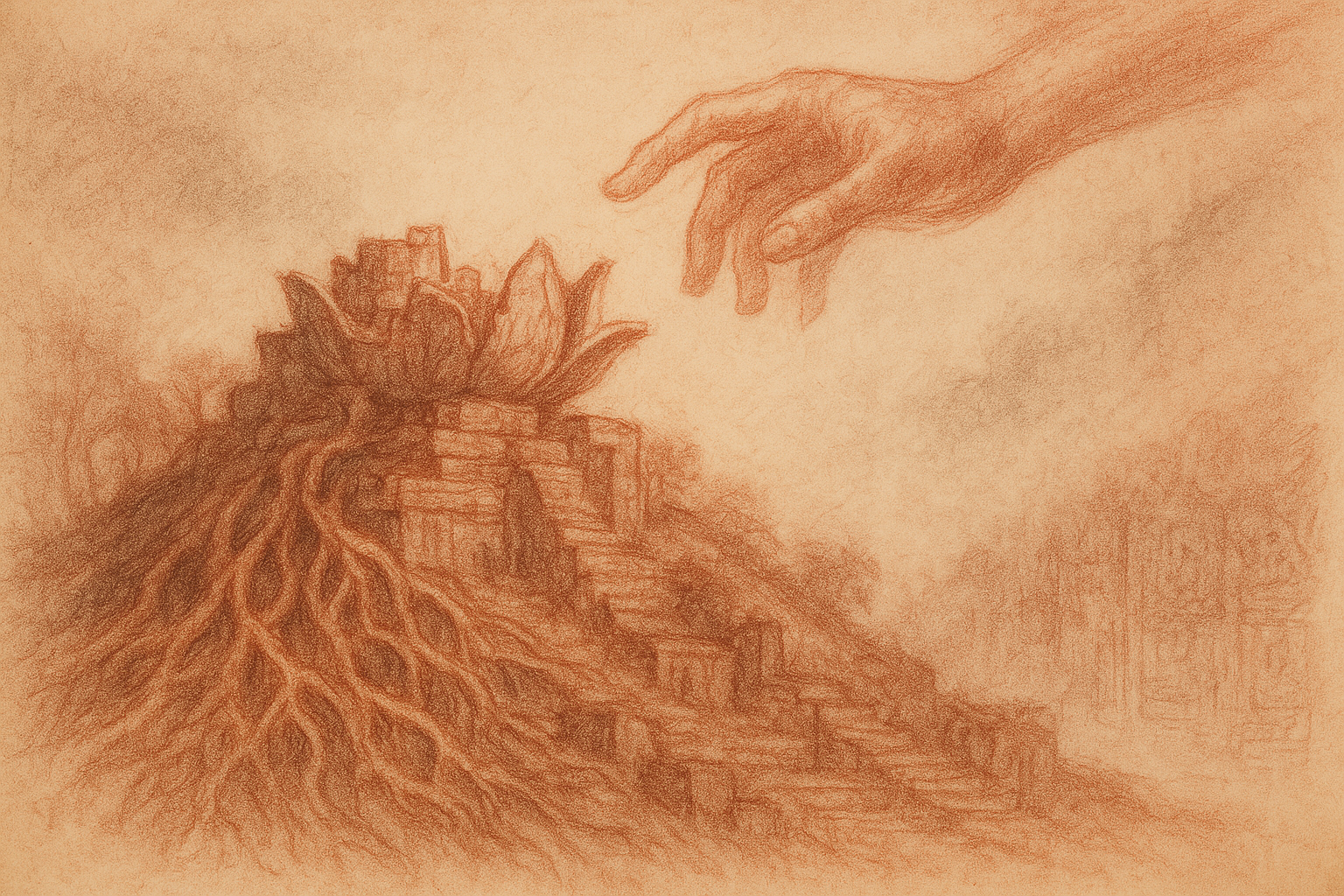

The Giant of Phnom Bakheng
In the pale ages before mortal memory, when forests spoke to stars and rivers whispered sacred hymns, a gentle giant rose slowly from the earth upon the hill now called Phnom Bakheng. He was nameless, save the silent name the moon gave him, and he moved through the twilight with the weightless grace of shadows. His skin was the hue of rich, loamy soil, and vines gently embraced his massive limbs, recognising in him a brother born from the breathing land.
The giant was alone, but never lonely. His companions were banyans whose roots held the dreams of ancestors, the soft mist that rose like incense from flooded moats, and the wind whose song he understood without words. Each dusk, he lifted his great, gentle hands to the skies, weaving quiet devotions with fingers shaped by stillness and care.
Then, guided by whispers only he could hear, he began to build a temple—a sanctuary to honour the unseen, the celestial, the eternal. Each stone he gathered was chosen slowly, lifted from the earth with reverent grace. They trembled with memory as he placed them one by one, pausing often to listen, to breathe, to let the stones themselves tell him their sacred alignment.

With a hand shaped by silence, he lifted each stone as though it were a breath offered to the sky.
And though his strength could shape mountains, the giant never hurried. He crafted the temple not for glory, but for the gods. Each block of sandstone became a prayer, laid with devotion in an endless rhythm of love and gratitude. With slow patience, the temple rose, lifting toward the heavens like a sacred lotus unfolding at the touch of moonlight.
But soon, the whispers of the giant’s devotion travelled beyond the forests and waters, reaching mortal ears filled with ambition rather than reverence. Kings arrived from the valley below, their hearts heavy with gold, their eyes hungry for swift power. They saw the giant labouring, his work measured by the pulse of stars, and they mocked his gentle, careful pace.
“What use is strength,” the mortal kings jeered, “if it moves no faster than a cloud drifting across the heavens? Temples should rise swiftly, to proclaim the might of kings, not whisper forgotten prayers.”
Yet the giant did not answer their mockery with anger or bitterness. He paused, looked quietly upon them, and saw only their restlessness—mortals bound by urgency, who could not hear the hidden songs that gave meaning to the temple stones. He bowed his great head, humbly, accepting exile over contention.
The kings drove him away with their ambitions burning like fires at his back, urging labourers to hasten, to finish what devotion had begun. But though they hurried, though sweat and toil replaced the giant’s tender silence, the temple resisted their haste. Stones cracked, walls trembled, carvings blurred and faded. Mortar failed; pillars refused their weight. And the summit—the sacred crown of devotion—remained unfinished, forever open to the sky.
Far away, hidden deep within the emerald twilight of the forests, the gentle giant wept softly beneath ancient banyans. His tears fell without bitterness, but with quiet sorrow, understanding what the kings could not—that reverence could never be rushed, that sacred silence, not ambition, must shape the stones.

Beneath roots older than kingdoms, the giant wept not in anger, but in reverent sorrow, his silence returning to the soil as song.
Centuries passed. Kingdoms rose and fell like tides, ambition swallowed by impermanence, palaces reduced to whispers. Yet upon the hill, Phnom Bakheng’s stones lingered unfinished—awaiting a devotion never to return. Wind and rain smoothed the edges, yet could not erase the silent presence, the deep breath of sacred incompletion.
And still, some nights, when the moon rises full and silver, it is said the giant’s shadow walks the temple summit once more. In those quiet hours, mortals who wander the ruins speak of feeling unseen hands gently guiding their footsteps, of whispered songs that ripple softly through their dreams, and of a tender sorrow woven through the air, teaching patience to hearts still bound by haste.
They say the giant shapes now not stone, but stillness. His great hands lift silence, arranging it as carefully as the blocks he once carried. His unseen eyes watch over the temple with a love that never waned, and each star that lights the unfinished summit is a reminder of his devotion, enduring quietly beneath the forgotten skies.
So Phnom Bakheng stands: a temple whose sanctity lies in what it lacks, in stones never set, in prayers left half-whispered. It whispers to us gently, across the expanse of years, reminding that the gods require no completion—only reverence—and that true devotion, like a star’s reflection on still water, is most luminous when it is slow, quiet, and softly, profoundly unfinished.
—
Receive the next work
Subscribe free to receive new work from the Lucas Varro Library by email.
More from the Library


See Also
A concise and impartial dictionary of absence, promises, quarrels, ordinary objects, and the troublesome instability of words.

The City of Service
The temple we inherit is a building from which almost all necessity has been removed. Nothing must be brought for it to continue being what we call a temple. The sanctuary asks nothing of us. Stone is good at this kind of independence.
A living temple was otherwise.
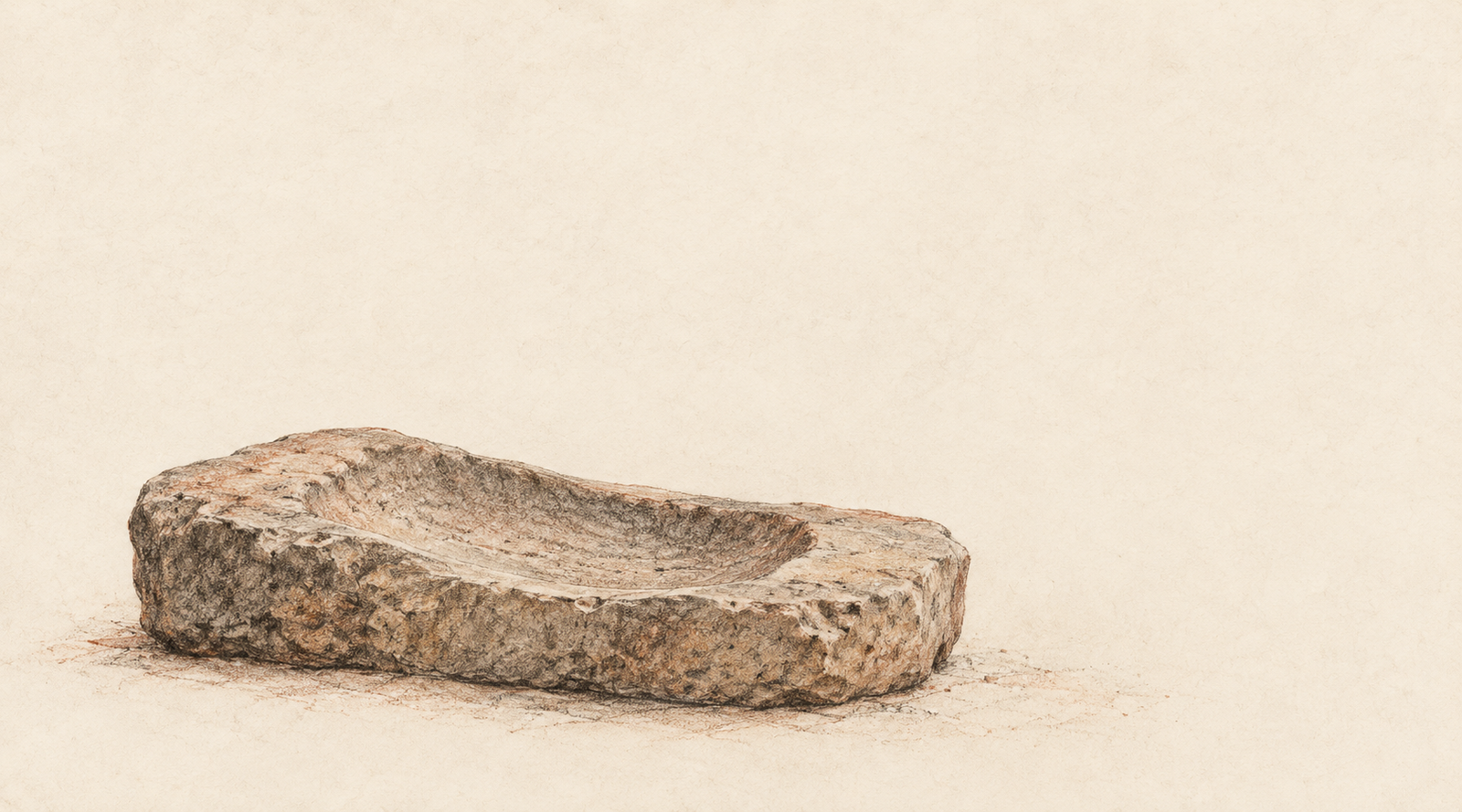
Water had to come in. So did grain, cloth, oil, aromatic substances, fuel. The things required for worship arrived because someone carried them across a threshold.


Houses of Wood, Light, and Smoke
Some of Angkor’s most intimate ruins do not rise above the ground at all. They are postholes, low mounds, hearths and ponds: durable traces of a domestic city built largely from things that decay. To restore that city is to see Angkor not only as stone, but as wood, smoke, water, repair, and people living within calling distance.