
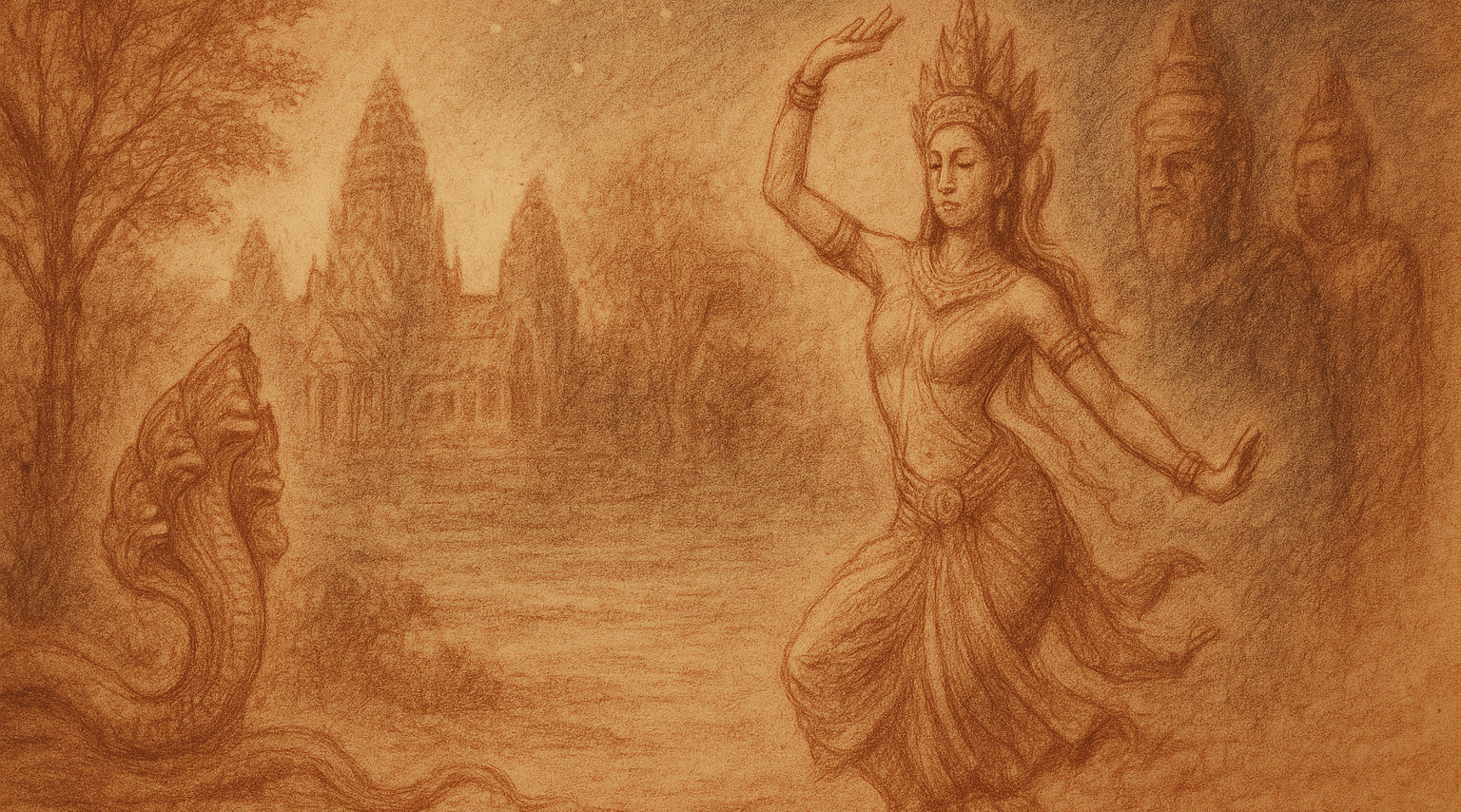

Where Gods and Stones Whisper as One
"From stone, the world arises; to stone, the world returns." — Khmer Inscription, Preah Khan
When I walk among the silent stones of Angkor, I step not merely through centuries but across the threshold of the sacred. Every carved figure, each tower, every quiet chamber breathes gently with memories of devotion—prayers whispered, incense rising softly, rituals enacted beneath the timeless gaze of stone. Here, myth, art, and faith flow seamlessly into architecture; each temple becomes a silent hymn to cosmic order.
The temples of Angkor emerged as prayers made visible, each stone shaped by a quiet, divine harmony. Within their shadows, Indian epics and Khmer cosmologies meet like rivers merging silently in a hidden valley. Yet the Khmers did not merely inherit—they transformed these teachings, threading subtle strands of local reverence. Brahmanism softened beneath their touch; rituals once fierce became contemplative, attuned to quiet spirituality. Here, the deity is near—seen, felt, embodied.
Consider the enigmatic Devaraja, the divine king whose essence scholars have long pondered. He rises not from distant heavens, but from the earth itself, entwined deeply with local spirits, guardian ancestors, and ancient rites. His presence speaks not of domination, but harmony, aligning earthly kingdoms with celestial rhythms. Through him, Khmer spirituality roots profoundly in place, echoing softly with blessings murmured by ancestors and land spirits sheltering each village, each sacred precinct.
Shaivism blossomed gently in Khmer soil, its roots nourished by local devotion. Shiva—Bhadeshvara, profound Lord of Beings—stood quietly at the heart of royal rites, ascetic yet nurturing, a divine anchor for the kingdom’s prosperity. The sacred linga, simple yet powerful, embodied fertility and royal grace, its quiet potency intertwining royal destinies with its silent vigil.
Yet, the Khmer heart also opened tenderly to Vishnu, preserver of worlds, radiant through compassionate avatars. Though Shiva’s presence resonated deeply, Vishnu’s narratives filled temple walls with quiet miracles—gentle descents among humanity, subtle acts of compassion carved into luminous stone. Temples originally devoted to Shiva often glow softly with Vaishnava imagery, revealing inner harmony, an intricate tapestry woven with devotion and reverence.
Buddhism flourished gently in Khmer soil alongside Hinduism, a quiet presence growing harmoniously. By Jayavarman VII’s time, Buddhism’s gentle light shone brightest, transforming temples like Bayon, Preah Khan, and Ta Prohm into luminous sanctuaries. Here, the Buddha stood not merely as teacher, but as compassionate conqueror of suffering, guardian of spiritual liberation. Majestic stone faces of Lokeshvara gaze with infinite compassion, their silent eyes piercing beyond the transient world into lasting peace.
Even as formal religions found expression in stone, animism breathed quietly in the shadows, murmuring beneath ceremonial rites. Neak ta spirits lingered in trees, hills, and rivers, binding communities intimately to place. Ancestor spirits watched quietly over villages, their unseen presence woven gently into daily prayers, offering protection and blessings as assuredly as gods carved in temple walls. This humble spirituality, so gently woven into daily Khmer life, perhaps reveals Angkor’s truest heart—a reverence for the sacred in all things, great and small.
Angkor’s temples are not mere monuments, but thresholds woven from stone and silence. Each carving becomes a prayer frozen in time, each relief a whispered invocation. Their very existence speaks quietly of a spiritual realm so profound it can only be felt fully in stillness. They invite us to slow our steps, quiet our minds, and listen—to let their silent reverence awaken forgotten devotions within us.
A single breath—
stones whisper the names
of forgotten gods.
These temples are not relics; they live, breathing softly beneath the Cambodian sun. They remind us gently yet persistently that sacredness is neither distant nor inaccessible—it resides here, in quiet communion between stone, sky, and heart. Each temple, each carving, each whispered prayer etched into ancient walls speaks of humanity’s ceaseless longing for the divine.
In Angkor, stones and gods whisper inseparably, inviting us softly into their eternal conversation. They speak of harmony, devotion, and the quiet sanctity of the present moment. Beneath the world's ceaseless noise lies the enduring voice of stone—a voice older than history, quieter than memory, yet powerful enough to awaken our hearts to the timeless beauty of the sacred.
To wander here is to remember—to remember we are part of this silent dialogue between earth and the divine, between the impermanent and the eternal. It is to realise gently, profoundly, that the sacred has never been lost, only forgotten—and in the quiet whisper of Angkor’s stones, we find ourselves invited once more into stillness, into awe, into mystery.
—
Receive the next work
Subscribe free to receive new work from the Lucas Varro Library by email.
More from the Library


The Leaf and the Pencil
A leaf holds my attention. Then I remember that I can draw. The pencil reveals things I had never noticed, but introduces its own demands: proportion, shading, the desire to make something beautiful. When I try to describe the encounter, language presents another difficulty. An essay about the uncertain distance between looking at something, understanding it, and being present with it.


The Work We Return To
We have become very good at measuring persistence, and less good at asking what deserves it.
A musician begins the same passage again. A writer returns to an unfinished sentence. Someone stands before a familiar face carved in stone, with nothing new to photograph.
What brings us back when enthusiasm has gone? And how do we distinguish devotion from the demands that quietly consume the rest of our lives?

Under the Gallery
Rain, a carved hand, and the small movements of lives separated by centuries. A new literary piece from The Vow.