
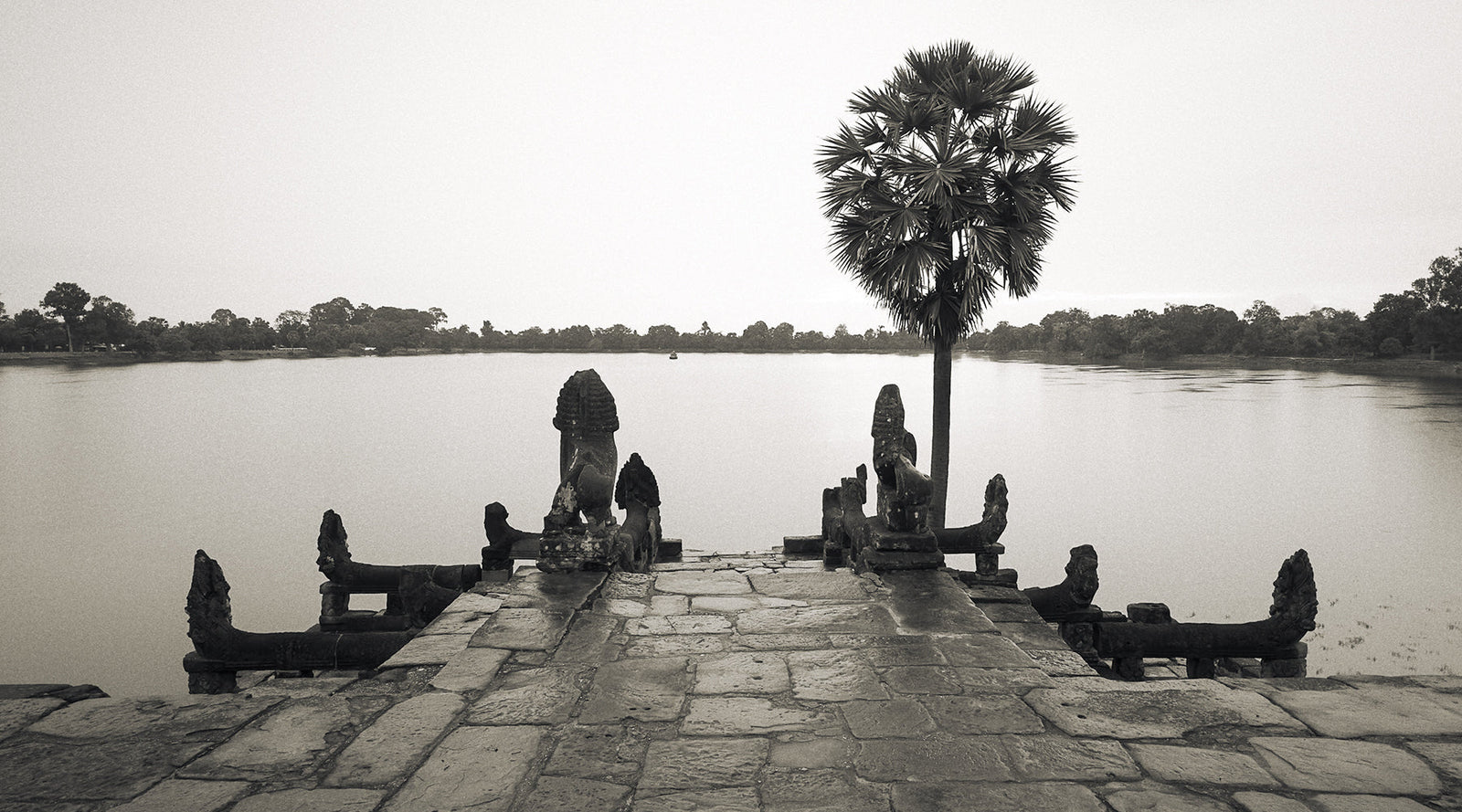

Where Stillness Becomes the Frame
At Srah Srang, sacred stillness is not an absence—it is an offering. This vast reservoir, known as the “Royal Bath,” sits east of Banteay Kdei like a vessel for light. First excavated in the 10th century and refined under Jayavarman VII in the 12th, the site bears layers of intention—cosmic, devotional, architectural. The cruciform jetty extends not toward water, but toward presence. The lions and nāga stationed there have weathered their fierceness into quiet guardianship.
In Sanctum, Lucas Varro does not depict this place—he enters it. Captured just after dawn, following a heavy rain, the photograph was made using medium-format black-and-white film. The exposure lasted hours, and the light barely changed. The lake remained lacquer-smooth, untouched by ripple. What the film received was not a moment but a breath—the kind of breath that holds something sacred before releasing it again.
In his studio, the artist shaped the print using classical chiaroscuro techniques, coaxing shadow and light into presence. The final hand-toning brought a warmth to the image that was not seen on-site, but felt. Each impression rests on Hahnemühle Bamboo paper—chosen for its softness, tonal sensitivity, and ecological spirit.
As part of the Spirit of Angkor series, Sanctum sits at the still centre. It does not offer narrative. It offers quiet. It does not point—it receives. And in doing so, it becomes not an image of place, but a threshold into presence.
Each print is a signed and numbered archival pigment impression, limited to 25 + 2 Artist’s Proofs. Included in the Collector’s Package are a Certificate of Authenticity, a facsimile of the field-made Chalk Study, and contemplative texts that echo the silence within the frame.
To live with Sanctum is to live with a breath held open—a hush that watches, steadies, and remains.
More from the Library

See Also
A concise and impartial dictionary of absence, promises, quarrels, ordinary objects, and the troublesome instability of words.

The City of Service
The temple we inherit is a building from which almost all necessity has been removed. Nothing must be brought for it to continue being what we call a temple. The sanctuary asks nothing of us. Stone is good at this kind of independence.
A living temple was otherwise.
Water had to come in. So did grain, cloth, oil, aromatic substances, fuel. The things required for worship arrived because someone carried them across a threshold.

Houses of Wood, Light, and Smoke
Some of Angkor’s most intimate ruins do not rise above the ground at all. They are postholes, low mounds, hearths and ponds: durable traces of a domestic city built largely from things that decay. To restore that city is to see Angkor not only as stone, but as wood, smoke, water, repair, and people living within calling distance.

$895
Srah Srang, Angkor, Cambodia — 2024
Limited Edition Archival Pigment Print
Edition
Strictly limited to 7 prints + 2 Artist’s Proofs
Edition Number
This listing is for the first numbered print from the Large Collector Edition: 1/7
Medium
Hand-toned black-and-white archival pigment print on Hahnemühle Bamboo — a museum-grade fine art paper chosen for its quiet tactility and reverent depth, echoing the spirit of the temples.
Signature & Numbering
Each print is individually signed and numbered by the artist on the border (recto)
Certificate of Authenticity
Accompanies every print
Image Size
28 x 28 inches (71.1 x 71.1 cm)
A pale hush lingers above the royal reservoir of Srah Srang. Rain has passed, but its breath still clings to the stones. The lake lies still as lacquered silk, holding light without shimmer. On the cruciform jetty, stone lions lean forward—not as protectors, but as witnesses. One lone palm lifts skyward, offering no judgment, only presence.
Here, stillness is not empty. It is full of memory, of breath, of reverence. The nāga no longer bare their teeth. Their serpent bodies curl like blessings around the void. All motion has been set aside. Even time bows its head.
I stood in this hush for hours. The shutter open, the film receiving not form but atmosphere. I did not seek to capture. I waited, and was offered. Later, I shaped the image in the darkroom, drawing forth chiaroscuro with care, hand-toning each impression to echo the warmth of wet stone after rain.
Printed on museum-grade Hahnemühle Bamboo paper and strictly limited to twenty-five numbered prints and two Artist’s Proofs, each impression is signed on the border recto.
Let this image keep vigil in your space, a quiet mirror of stillness and breath.
Click here to step into the Artist’s Journal and walk the still jetty once more.