
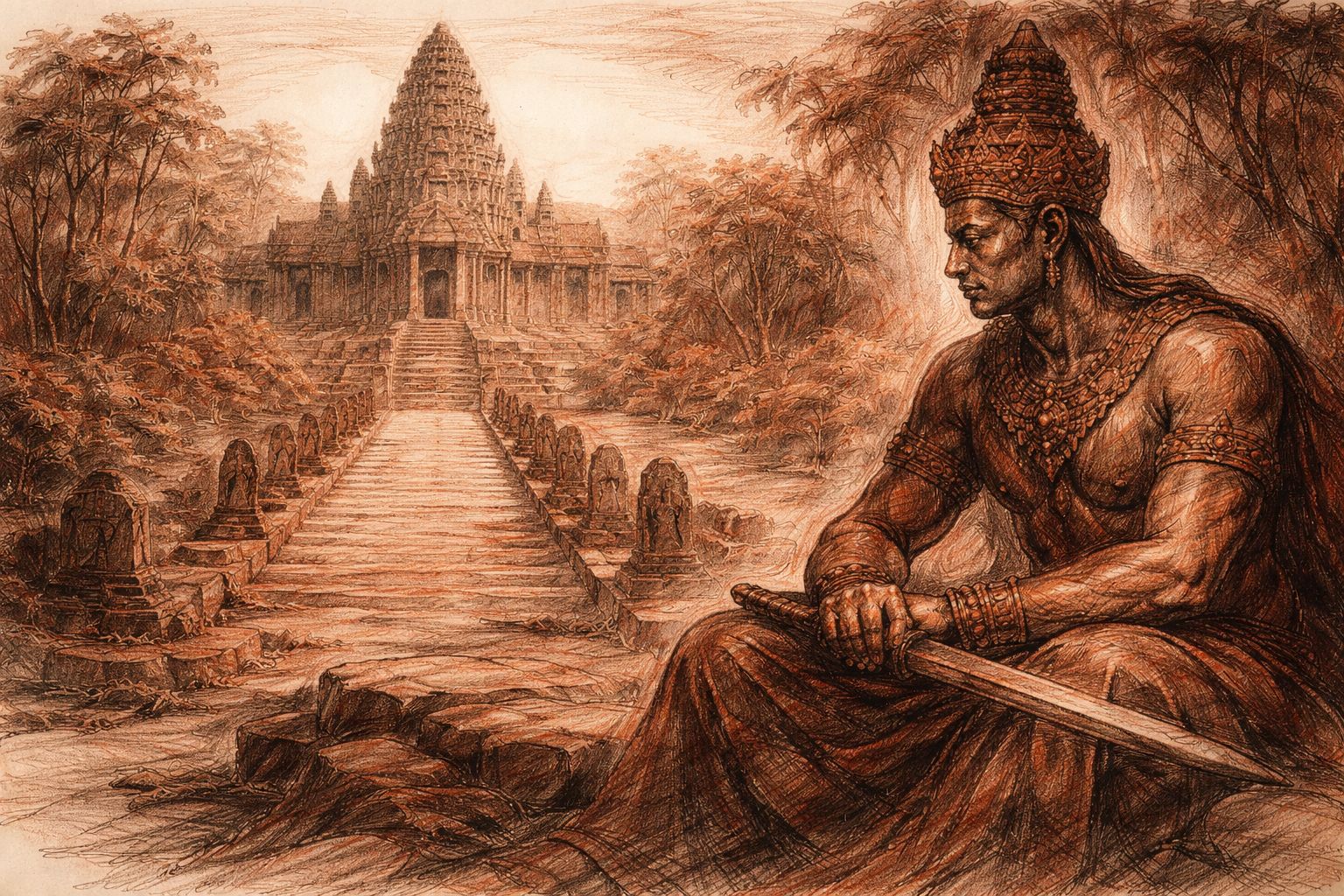

Jayavarman VI — The King Who Ruled from Elsewhere
Angkor did not always rule from Angkor.
In the late eleventh century, the centre loosened. Authority thinned, distance widened, and the great stone city found itself governed by a king whose gravity lay elsewhere. Jayavarman VI did not seize Angkor so much as step around it, drawing the empire northward by a quiet but decisive shift of weight.
He came to power in 1080, after years of internal fracture and an exhausted reign under Harshavarman III. The old line faltered. Rebellion flickered. Champa resisted. Into this instability stepped Jayavarman VI—almost certainly a regional ruler from the Mun River basin, a man shaped by frontier politics rather than palace ritual.
His accession was not smooth, nor universally recognised. For years, sovereignty may have been divided: Angkor itself perhaps still loyal to the displaced dynasty, while Jayavarman VI ruled from the north, supported by networks of land, kinship, and ritual authority unfamiliar to the capital. This was not a revolution of crowds, but a re-alignment of centres.
What made his rule endure was not force, but sanction.
The great Brahmin Divakarapandita—already ancient, already revered—performed the coronation. With that act, ritual continuity bridged political rupture. The state did not collapse; it recalibrated. Jayavarman VI became king not because he claimed Angkor’s past, but because he secured its sacred procedures.
And yet, Angkor itself remained strangely untouched by him.
He left almost no mark in the capital. No grand state temple rose under his name. No monumental inscription proclaimed his vision at the empire’s heart. Instead, his architecture flowered in the north, at Phimai—Vimayapura—where stone was refined rather than multiplied, and form quietly rehearsed a future yet to arrive.
Phimai matters because it whispers rather than declares. Its central tower, smooth and rising, anticipates the serene verticality that would later find full voice at Angkor Wat. Here, under Jayavarman VI, the Angkor Wat style began not as imperial spectacle, but as regional experiment.
This tells us something essential about the man.
Jayavarman VI did not rule through visibility. He ruled through placement. He allowed Angkor to remain symbolically central while functionally displaced, governing from a homeland whose power lay in control of land, water, and routes rather than crowds and ceremony. His reign, described in inscriptions as peaceful, unfolded without the drama of conquest or collapse.
Even his religion resists easy categorisation. Though remembered as a Shaivite, his gifts extended across the sacred landscape—to Vat Phu, Preah Vihear, Phnom Sandak—suggesting not zealotry, but syncretic maintenance. The king’s task, here, was not conversion but balance.
He died in 1107, prematurely, leaving no direct heir. The throne passed to his brother, Dharanindravarman I, a man described as assuming kingship “without desire for royalty.” It is a revealing phrase. Power, by then, was heavy. The work of consolidation had been done.
Jayavarman VI received the posthumous name Paramakaivalyapada—“he who has attained supreme isolation.” It is a name that feels earned. He stands slightly apart from Angkorian memory: neither builder-king nor destroyer, neither reformer nor restorer.
He was something rarer.
Jayavarman VI was the king who proved that Angkor could be ruled from elsewhere—and that the future of the empire might be shaped at its edges, quietly, before returning in stone to the centre.
—
Receive the next work
Subscribe free to receive new work from the Lucas Varro Library by email.
More from the Library


See Also
A concise and impartial dictionary of absence, promises, quarrels, ordinary objects, and the troublesome instability of words.

The City of Service
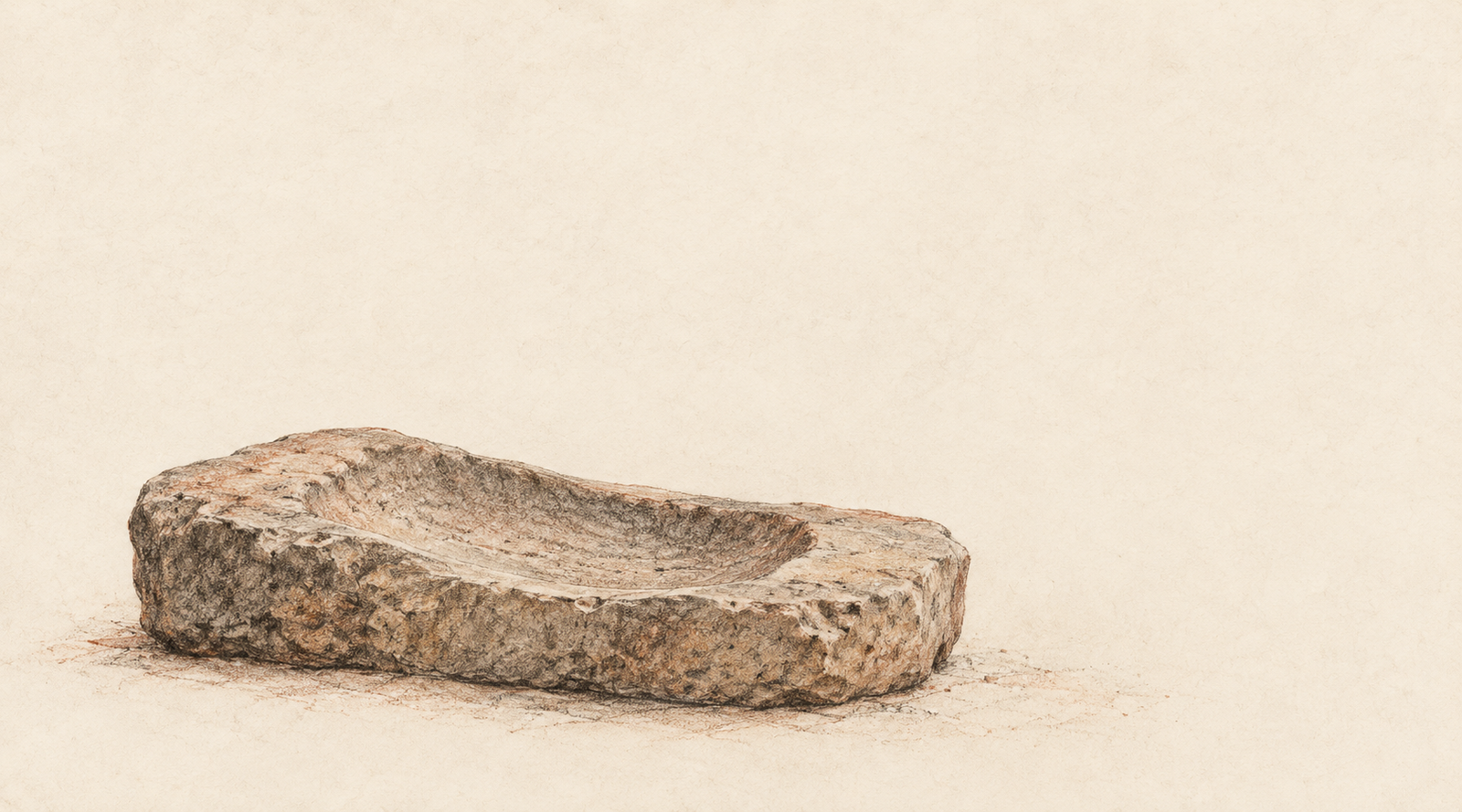
The temple we inherit is a building from which almost all necessity has been removed. Nothing must be brought for it to continue being what we call a temple. The sanctuary asks nothing of us. Stone is good at this kind of independence.
A living temple was otherwise.
Water had to come in. So did grain, cloth, oil, aromatic substances, fuel. The things required for worship arrived because someone carried them across a threshold.


Houses of Wood, Light, and Smoke
Some of Angkor’s most intimate ruins do not rise above the ground at all. They are postholes, low mounds, hearths and ponds: durable traces of a domestic city built largely from things that decay. To restore that city is to see Angkor not only as stone, but as wood, smoke, water, repair, and people living within calling distance.