
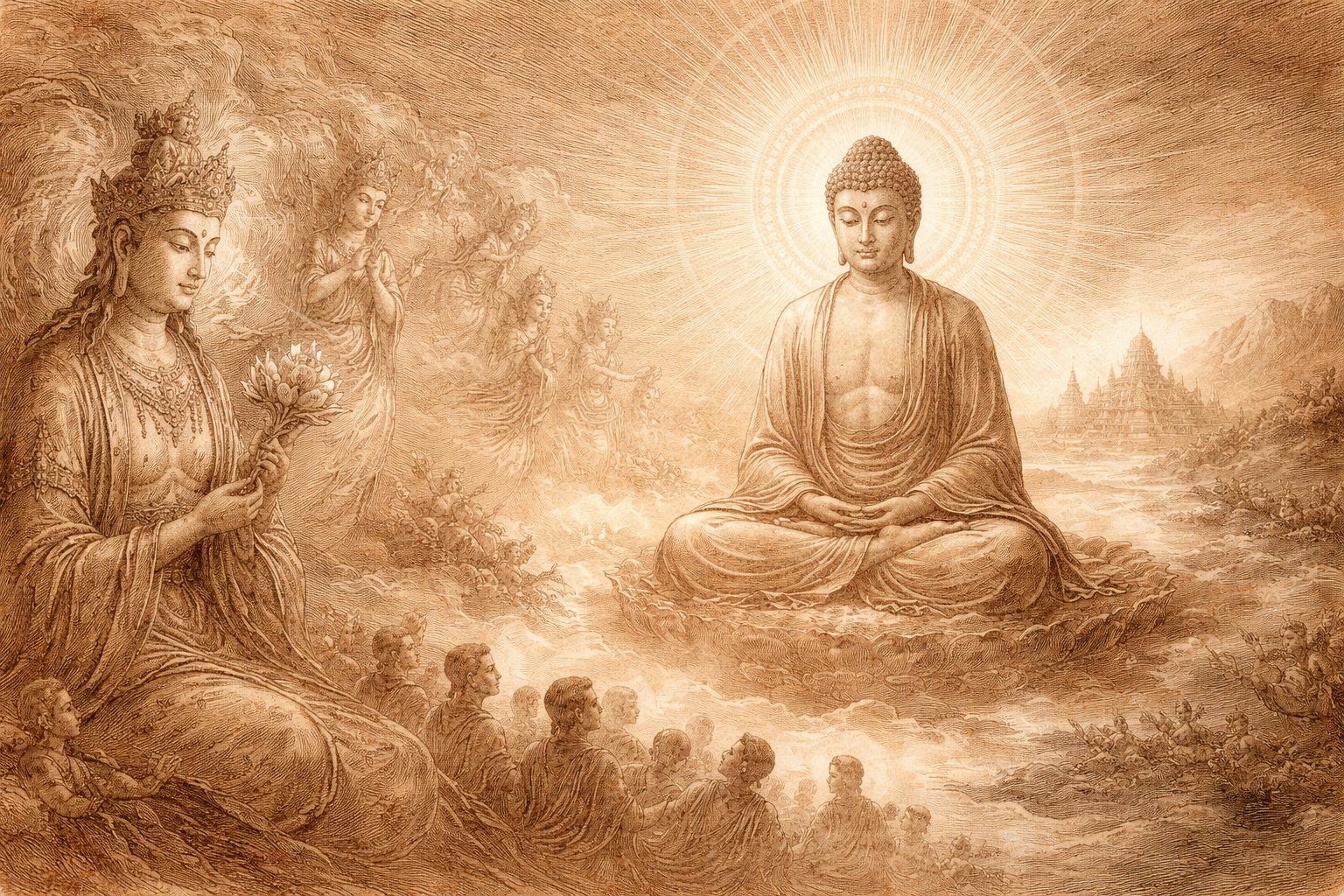

Amitabha — The Measureless Light That Waits
In the western quarter of the Buddhist cosmos, where the sun completes its long descent and the world exhales its final light, there abides a stillness not born of darkness, but of fulfilment. This is the realm of Amitabha, the Buddha of infinite splendour, whose radiance does not blaze or consume, but endures—quiet, measureless, and inexhaustible.
Amitabha does not stride into the world. He does not intervene with gesture or command. He remains seated in meditation, unmoving, as though time itself has settled around him. Yet from this perfect stillness issues a light that travels everywhere. It is a light not of revelation, but of invitation—a gentle certainty that no being is beyond return.
In Mahayana cosmology, Amitabha is not a bodhisattva who labours within the world, but a Tathagata: a fully awakened Buddha, one of the Five Buddhas of Wisdom who together articulate the total architecture of enlightenment. His domain is the west, the direction of endings, death, and release. His realm is Sukhavati, the Western Paradise, often translated as the Land of Bliss—not a heaven of reward, but a sanctuary of perfect conditions, where awakening is no longer obstructed by fear, ignorance, or exhaustion.
To falter, in Buddhist thought, is not a moral failure. It is an existential condition. Beings grow weary. Minds fragment. Attention slips. Compassion thins. Amitabha’s vow was made precisely for such moments. He is the refuge not of the strong, but of the tired—the ones who cannot complete the path through effort alone.
From his infinite light emanates the figure of Avalokiteshvara, known in the Khmer world as Lokeshvara, the Bodhisattva of Compassion. Tradition tells that Lokeshvara was born from a ray of light issuing from Amitabha’s right eye while the Buddha remained in deep contemplation. The symbolism is exacting: compassion is not separate from wisdom, nor action from stillness. What moves in the world is born from what remains unmoved.
This lineage is preserved in stone. In Angkorian statuary, a small, meditating Amitabha appears in the headdress of Lokeshvara, seated above the brow, silent and sovereign. It is not an emblem of hierarchy, but of origin. Compassion looks outward because wisdom looks inward. Mercy flows because light abides.
Amitabha’s work is not to judge, but to receive. Through the intercession of compassion, the dead and the broken are guided westward—not spatially, but inwardly—towards a rebirth unburdened by the compulsions of suffering. In Sukhavati, awakening is not wrestled from the world; it unfolds naturally, like breath returning to rhythm.
Among the Five Buddhas of Wisdom, Amitabha governs the purification of desire—not by suppression, but by transfiguration. What once grasped becomes luminous. What once clung becomes spacious. Desire, illuminated, loses its hunger and becomes devotion, attention, care.
To contemplate Amitabha is to contemplate the possibility that enlightenment does not always arrive as fire or rupture. Sometimes it waits, patiently, as light waits at dusk—certain that even the slowest traveller will, eventually, turn west.
—
Receive the next work
Subscribe free to receive new work from the Lucas Varro Library by email.
More from the Library


See Also
A concise and impartial dictionary of absence, promises, quarrels, ordinary objects, and the troublesome instability of words.

The City of Service
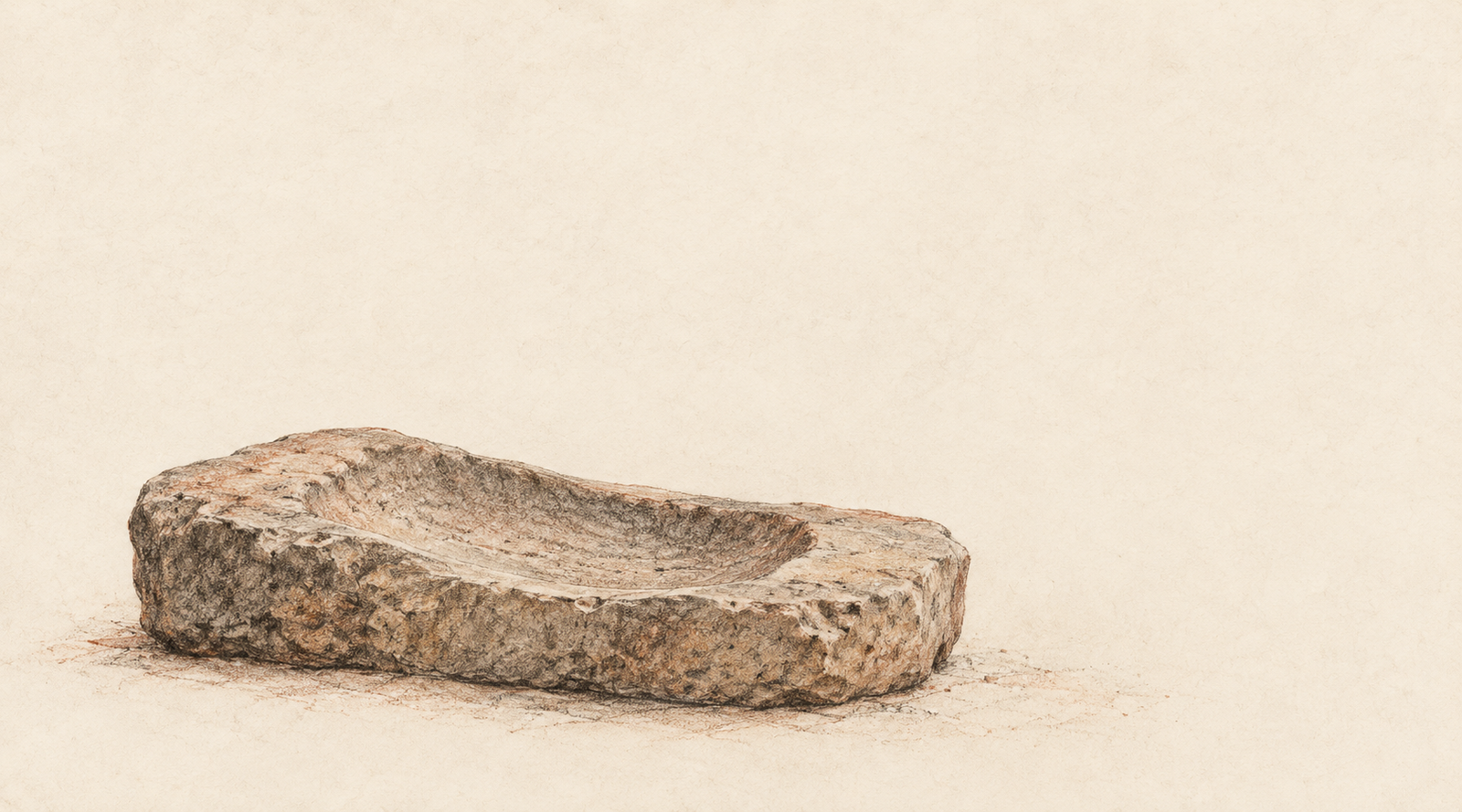
The temple we inherit is a building from which almost all necessity has been removed. Nothing must be brought for it to continue being what we call a temple. The sanctuary asks nothing of us. Stone is good at this kind of independence.
A living temple was otherwise.
Water had to come in. So did grain, cloth, oil, aromatic substances, fuel. The things required for worship arrived because someone carried them across a threshold.


Houses of Wood, Light, and Smoke
Some of Angkor’s most intimate ruins do not rise above the ground at all. They are postholes, low mounds, hearths and ponds: durable traces of a domestic city built largely from things that decay. To restore that city is to see Angkor not only as stone, but as wood, smoke, water, repair, and people living within calling distance.