

Anantasayin — Where the World Pauses to Be Remembered
There is a moment in the life of the cosmos when nothing moves forward.
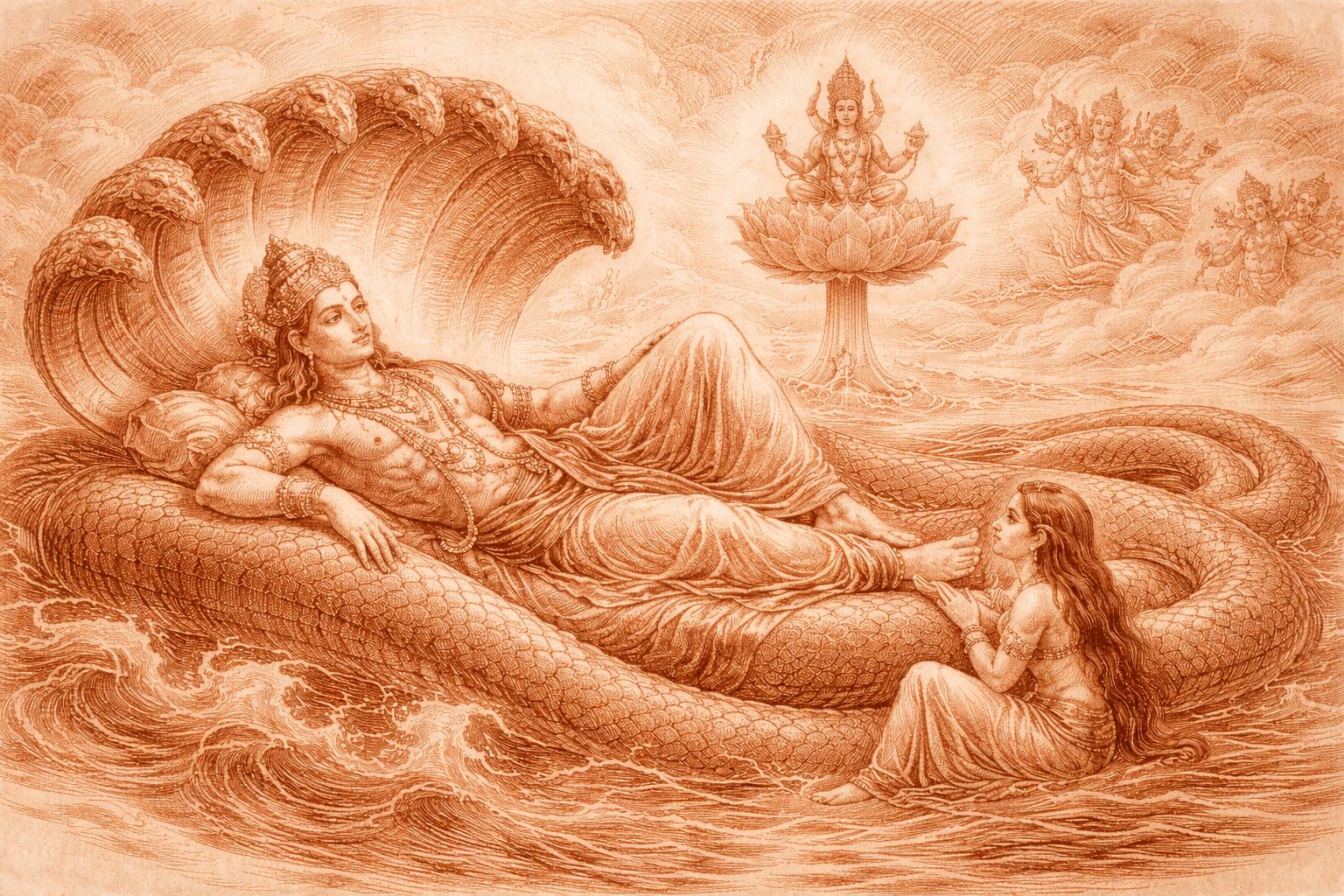
The fires have gone out. The waters have closed over the ruins of form. Time loosens its grip and becomes a tide rather than a line. In that interval—between the ending of one world and the imagining of the next—Vishnu reclines upon the endless body of the serpent Ananta. This posture is called Anantasayin: Vishnu resting upon the Infinite.
It is not a scene of exhaustion. It is a scene of containment.
Vishnu lies in yoganidra, the yogic sleep in which consciousness turns inward without vanishing. Around him stretches the primordial Ocean of Milk—the undifferentiated field from which all forms arise and into which they return. Beneath him coils Ananta, whose very names disclose his function. Ananta means “Endless.” Shesha means “Remainder.” He is that which persists when the universe has been withdrawn: not debris, but essence; not ruin, but memory.
The serpent’s many heads unfurl above Vishnu like a living canopy. Seven, nine, sometimes more—the number is less important than the gesture. This is vigilance without aggression, protection without effort. Ananta does not restrain the god; he supports him. His coils form a cradle in which the universe may safely be forgotten for a while.
In this image, creation is no longer an act of command. It is an act of recollection.
When the moment arrives, a lotus will rise from Vishnu’s navel, and upon it will appear Brahma, the architect who gives physical shape to what has already been dreamed. But Anantasayin precedes that emergence. It is the stillness before articulation—the state of pure potentiality in which the blueprint has not yet been projected.
At Vishnu’s feet sits Lakshmi, massaging his legs with unhurried devotion. In this context, prosperity is not accumulation but continuity. Fortune attends the god not to stimulate action, but to ensure that rest itself is auspicious. The universe is cared for even while it sleeps.
Khmer theologians and artists understood the depth of this image. At West Mebon, a colossal bronze Vishnu once reclined upon Ananta at the centre of the great baray. Water flowed across the god’s body, turning the reservoir into a ritual ocean and the sculpture into a living axis of renewal. Here, Anantasayin was not an abstract idea but a hydraulic theology: cosmic sleep translated into rain, fertility, and political stability.
At Kbal Spean, the same scene was carved directly into the riverbed. Water passing over Vishnu and the serpent was sanctified before reaching the fields below. The myth became a technology of blessing, ensuring that the pause between cycles nourished the land rather than leaving it barren.
In temple lintels and pediments—from Angkor Wat to Preah Khan and Banteay Srei—the motif appears again and again. Sometimes the lotus bears Brahma; sometimes it remains an implied bud. The distinction is subtle but meaningful. When Brahma is absent, the image speaks of suspension rather than commencement. The world has not yet begun to move.
Khmer artists often transformed Ananta into the reachisey, a dragon-like being with leonine features and short legs. This was not distortion but localisation: the cosmic serpent translated into a form that could stride across thresholds, bridge water and stone, and anchor the heavens to the earth. The naga became architectural.
The contrast with Ananta’s brother Vasuki clarifies the image further. Vasuki is the serpent of strain, stretched taut during the Churning of the Sea of Milk. He enables transformation through friction and risk. Ananta, by contrast, is the serpent of rest. He ensures that something survives the churning intact. Without Vasuki, nothing new would emerge. Without Ananta, nothing would remain.
Anantasayin therefore marks the most fragile and most essential moment in the cosmic cycle: the pause that prevents total erasure. It tells us that the universe is not reborn from chaos alone, but from what chaos fails to consume. The world does not begin with action, but with being held.
Here, the god sleeps—not because creation is finished, but because it is safe to dream again.
—
Receive the next work
Subscribe free to receive new work from the Lucas Varro Library by email.
More from the Library

Houses of Wood, Light, and Smoke
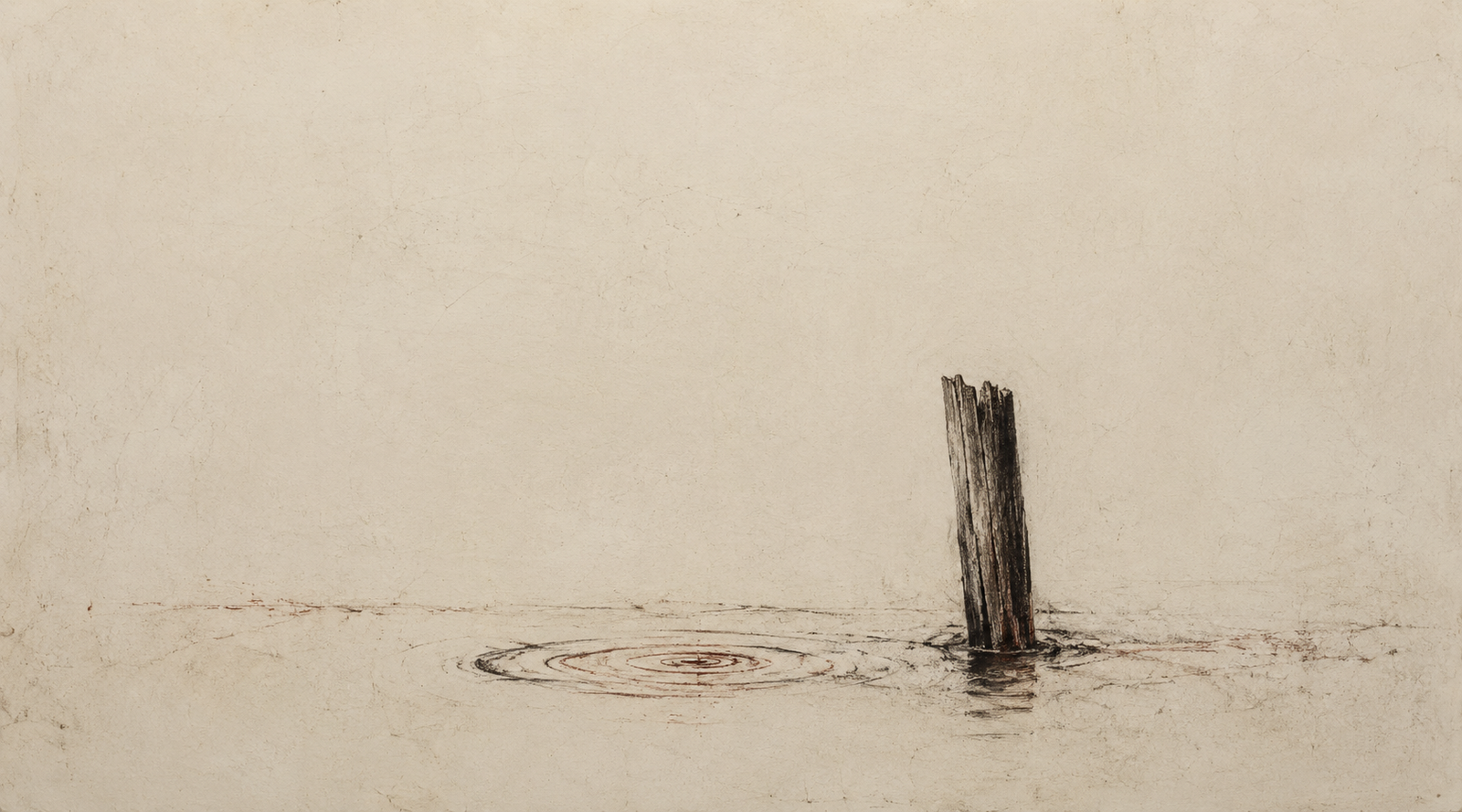
Some of Angkor’s most intimate ruins do not rise above the ground at all. They are postholes, low mounds, hearths and ponds: durable traces of a domestic city built largely from things that decay. To restore that city is to see Angkor not only as stone, but as wood, smoke, water, repair, and people living within calling distance.

What Stone Brings Forth
I had mistaken a gift for something being expelled.
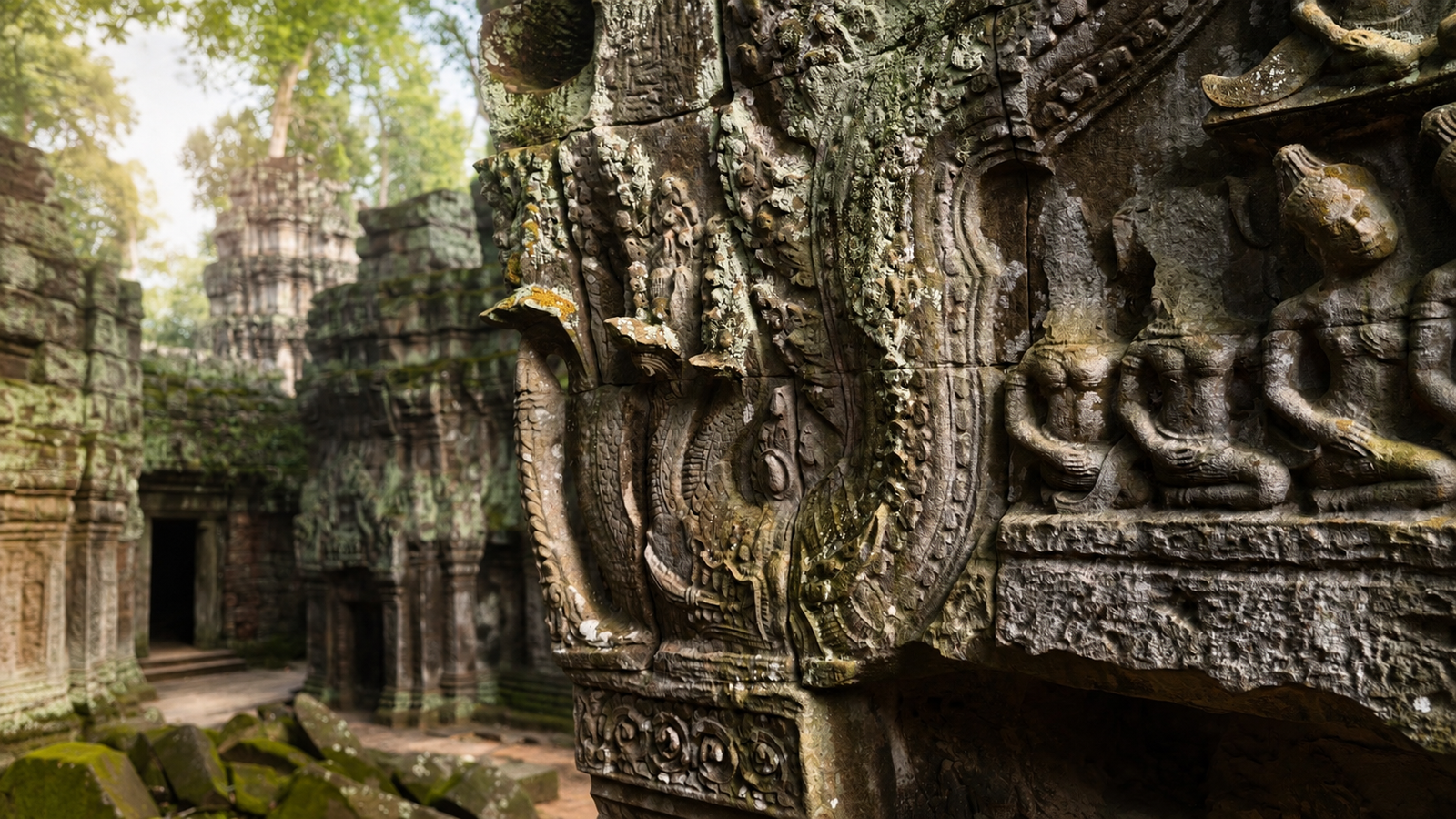
Beneath the nāga's mouth, a stone garland descended bead by bead. Nearby, a makara opened its jaws and another form emerged. Looking closer, the whole temple began to change: serpent became ornament, ornament became architecture, architecture became foliage.
The forest did not introduce this language.
It answered it.

The Eighth Daughter
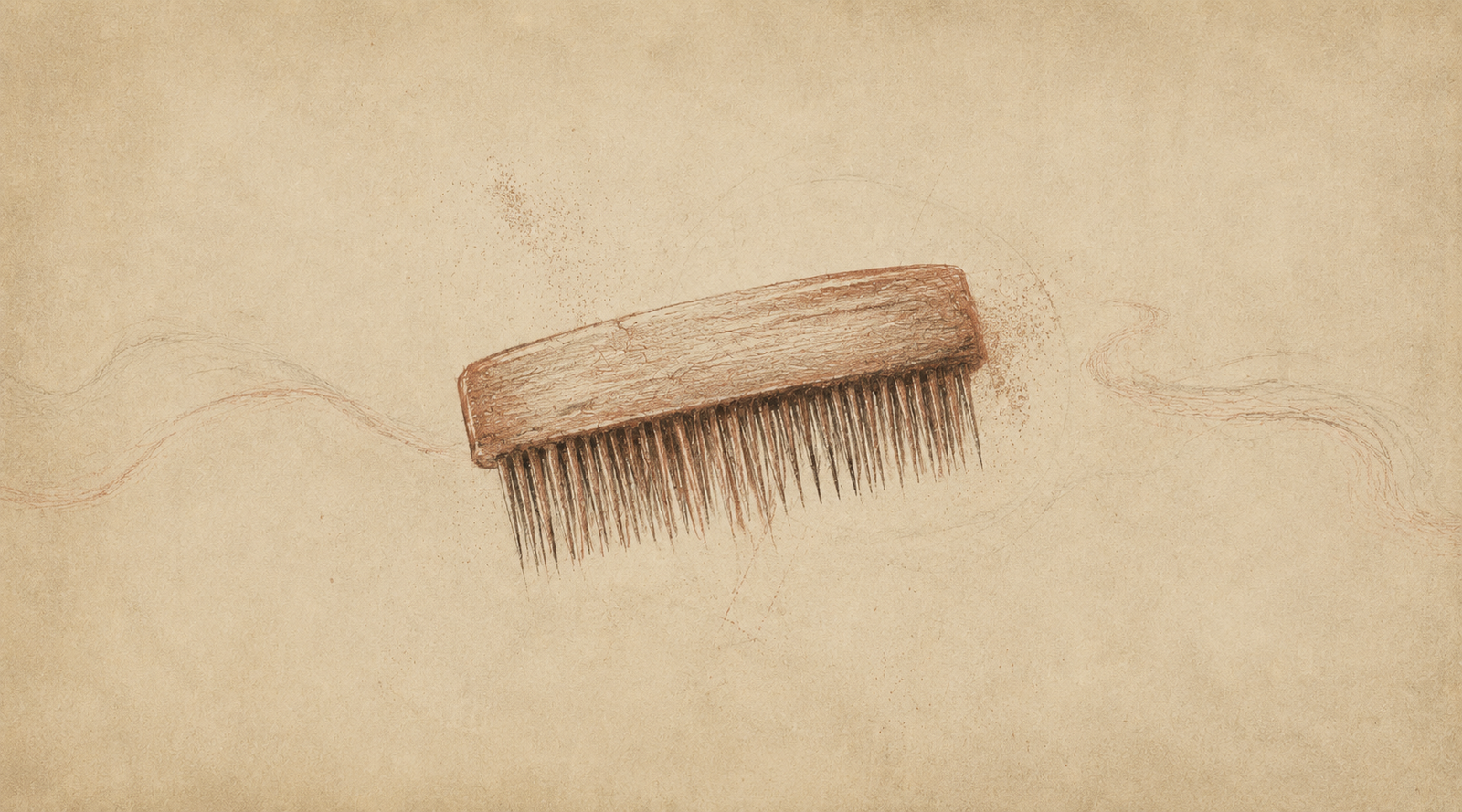
Seven daughters have already been taken by Yamata-no-Orochi when Susanoo reaches the River Hi. Only Kushinada-hime remains. The Eighth Daughter retells the Kojiki episode through a family’s waiting, a girl transformed into a comb, and the patient preparation for the serpent’s return.