

Angkor — A City That Learned to Listen
Angkor means city.
Not metaphor. Not poetry. Simply city—nagara, nakorn, Angkor. A place where people lived, prayed, governed, argued, married, cultivated rice, buried their dead, and looked to the sky for alignment. Only later did the word gather its halo.
To speak of Angkor now is to speak of something larger than settlement or capital. It names an empire, an era, a civilisation, a field of ruins, and a memory that still shapes Cambodia’s sense of itself. But the meaning begins with grounded intention: a city designed to hold heaven and earth in balance.
From the coronation of Jayavarman II in 802 CE to the last great stone temples of the late thirteenth century, Angkor unfolded as a continuous act of building and rebuilding—five centuries of measured ambition. Capitals shifted. Dynasties rose and corrected one another. Gods changed names. Yet the underlying question remained constant: how does a human city align itself with the order of the cosmos?
Angkor was never a single place.
It was a sequence.
The first durable capital emerged at Hariharalaya, in today’s Roluos. From there, the centre of gravity moved north to Yashodharapura, anchored by the temple mountain of Phnom Bakheng. Later still came Angkor Thom, fortified and monumental, rebuilt after catastrophe. Each capital was not a rejection of the previous one, but a refinement—an adjustment of scale, orientation, and theological emphasis.
What binds them together is not stone alone, but water.
Angkor was a hydraulic city long before the term existed. Vast reservoirs—the barays—were carved into the plain, linked by canals that directed seasonal flows from the Kulen Hills toward the Tonle Sap. This network was not merely practical. It was cosmological. Water represented the primordial ocean; control of water signalled harmony between king, land, and sky.
Rice fed the population. Fish fed the villages. Stone fed belief.
At its height, Angkor supported a population approaching a million people—one of the largest pre-industrial urban complexes on earth. Yet it did so without dense stone housing. The city was largely wooden, seasonal, adaptable. The temples were the permanent elements: ritual anchors rising from a living, breathing landscape.
Every major temple functioned as a cosmogram.
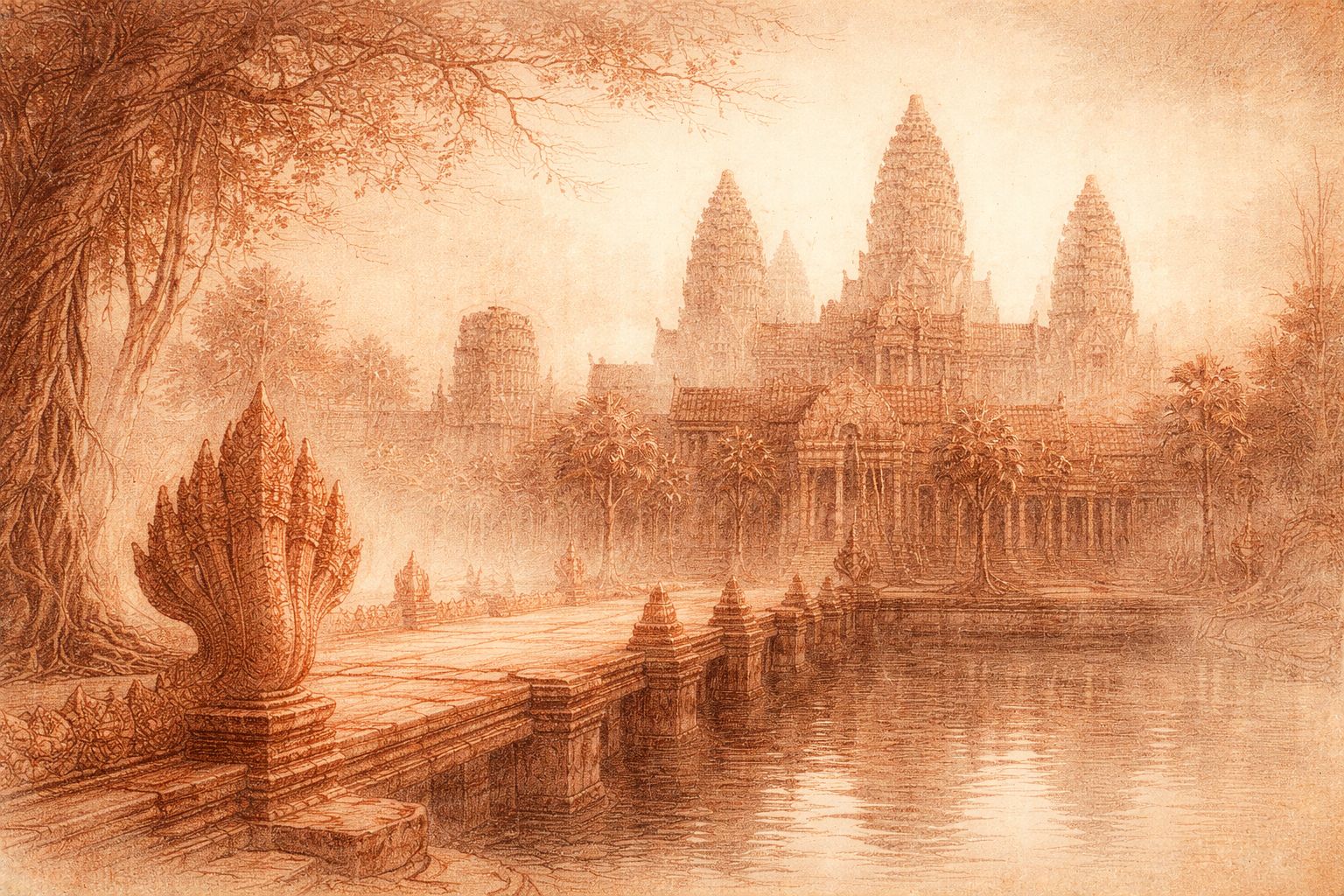
The temple mountain rose as Mount Meru, the axis of the universe. Surrounding moats became cosmic seas. Concentric walls mirrored celestial ranges. The central sanctuary aligned the vertical axis—zenith and nadir—often marked physically by a deep shaft beneath the tower, binding heaven, earth, and underworld into a single line of force.
To cross a causeway was to enact transition.
Naga balustrades stretched like rainbows over water, symbolically linking the human realm with the divine. At Angkor Thom, the famous processions of gods and demons pulling the serpent recreate the Churning of the Ocean of Milk—the moment when order, immortality, and meaning are wrested from chaos.
This was not decoration. It was instruction.
The king ruled not simply by force or lineage, but by alignment. Through the Devaraja cult, the monarch’s inner essence was linked to a divine principle, often Shiva, embodied in the linga. Kings built to maintain that alignment; temples were acts of governance as much as devotion.
When alignment failed, the city adapted.
The decline of Angkor was not a sudden collapse, but a slow unravelling. Climatic instability strained the hydraulic network. Repeated warfare with Ayutthaya weakened the centre. Most profoundly, the religious worldview shifted. Theravada Buddhism, less reliant on monumental stone and royal mediation, redirected spiritual life toward monasteries, villages, and inward practice.
Stone no longer needed to speak so loudly.
By the fifteenth century, the court moved south, closer to maritime trade. Angkor Thom ceased to be the capital, though it was never abandoned entirely. Monks continued to pray. Villagers continued to farm. The city did not die; it exhaled.
What remains today—within the Angkor Archaeological Park and beyond—is not a ruin field but a record of attention. Angkor shows what happens when a civilisation commits itself, over centuries, to listening: to water, to seasons, to geometry, to myth, and to the limits of human authority.
It is a city that does not explain itself.
It waits.
—
Receive the next work
Subscribe free to receive new work from the Lucas Varro Library by email.
More from the Library


See Also
A concise and impartial dictionary of absence, promises, quarrels, ordinary objects, and the troublesome instability of words.

The City of Service
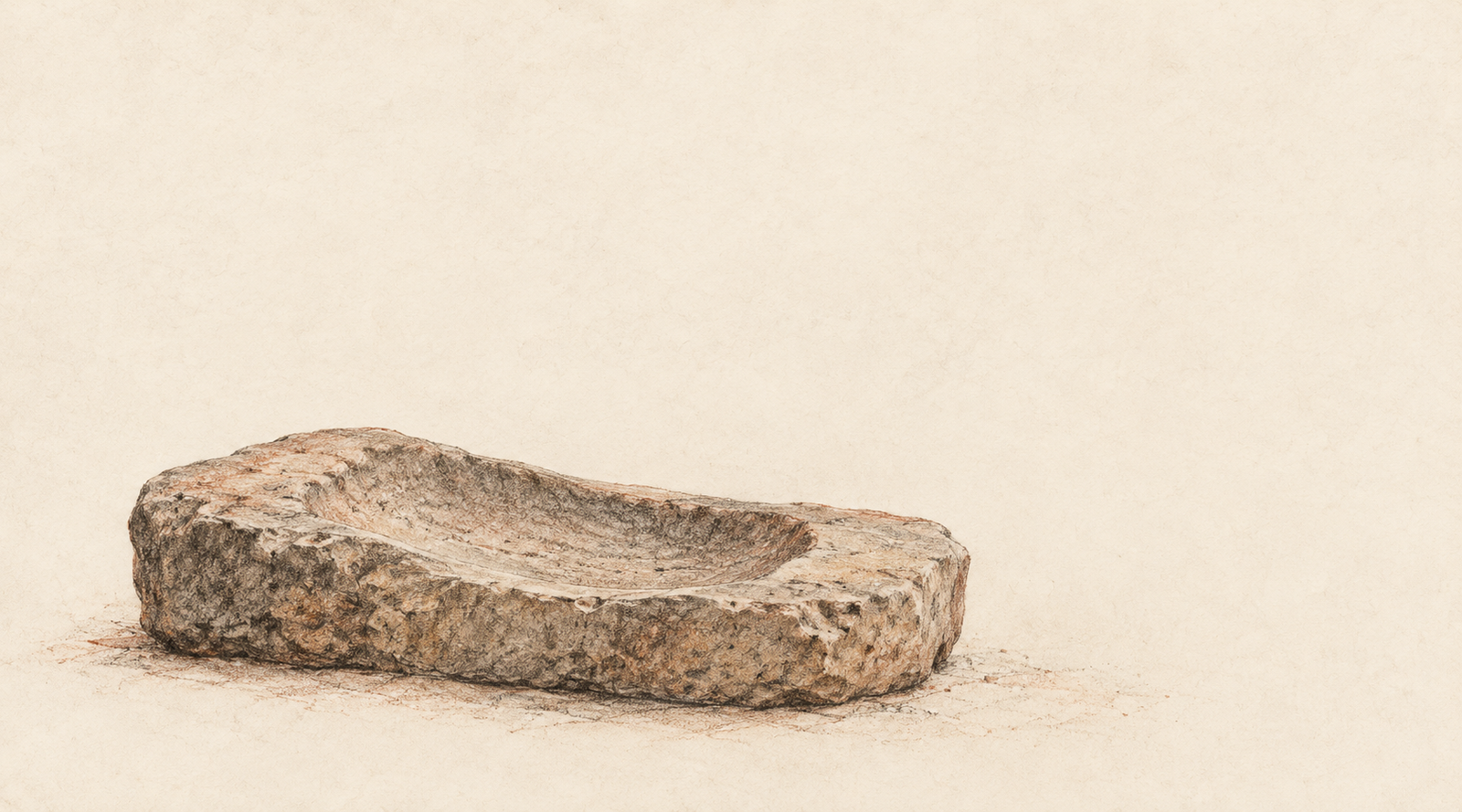
The temple we inherit is a building from which almost all necessity has been removed. Nothing must be brought for it to continue being what we call a temple. The sanctuary asks nothing of us. Stone is good at this kind of independence.
A living temple was otherwise.
Water had to come in. So did grain, cloth, oil, aromatic substances, fuel. The things required for worship arrived because someone carried them across a threshold.

Houses of Wood, Light, and Smoke
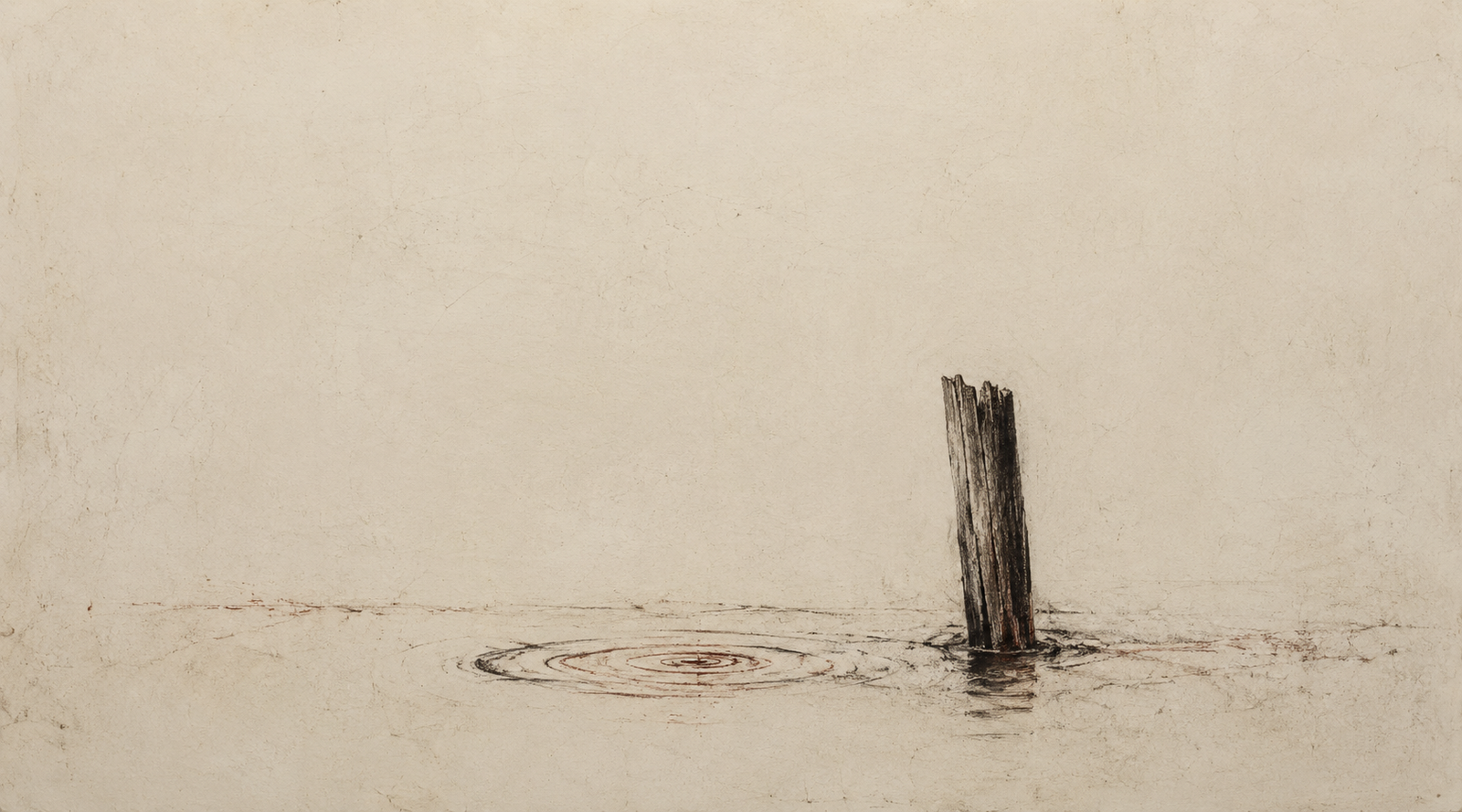
Some of Angkor’s most intimate ruins do not rise above the ground at all. They are postholes, low mounds, hearths and ponds: durable traces of a domestic city built largely from things that decay. To restore that city is to see Angkor not only as stone, but as wood, smoke, water, repair, and people living within calling distance.

$895
Angkor Wat Temple, Angkor, Cambodia — 2020
Limited Edition Archival Pigment Print
Edition
Strictly limited to 7 prints + 2 Artist’s Proofs
Edition Number
This listing is for the first numbered print from the Large Collector Edition: 1/7
Medium
Hand-toned black-and-white archival pigment print on Hahnemühle Bamboo — a museum-grade fine art paper chosen for its quiet tactility and reverent depth, echoing the spirit of the temples.
Signature & Numbering
Each print is individually signed and numbered by the artist on the border (recto)
Certificate of Authenticity
Accompanies every print
Image Size
28 x 28 inches (71.1 x 71.1 cm)
Before first light touches stone, before the world is named, the western causeway of Angkor Wat extends like a breath held in the body of the earth. No footsteps echo. The sky holds its silence in cloudlight.
The naga balustrades curve inward like gestures of remembrance. Their symmetry does not lead to a structure, but to presence. The temple’s towers wait on the horizon, not to be seen—but to be met. Here, in the hush before form, something sacred begins.
Lucas Varro entered this space before dawn, passing through the western gopura in darkness. He stood without framing or thought, listening. The camera’s bellows opened like a breath. The long exposure received not an image, but a moment of surrender.
Captured on large format black-and-white film, the photograph was shaped using classical chiaroscuro techniques and hand-toned by the artist. The final print is an archival pigment print on Hahnemühle Bamboo paper, offered in a strictly limited edition of 25 + 2 Artist’s Proofs.
Each one a threshold, waiting to be crossed in silence.
Click here to enter the Artist’s Journal and walk deeper into the hush.
Previously titled ‘Causeway, Angkor Wat Temple, Cambodia. 2020,’ this photograph has been renamed to better reflect its place in the series and its spiritual tone. The edition, provenance, and authenticity remain unchanged.