
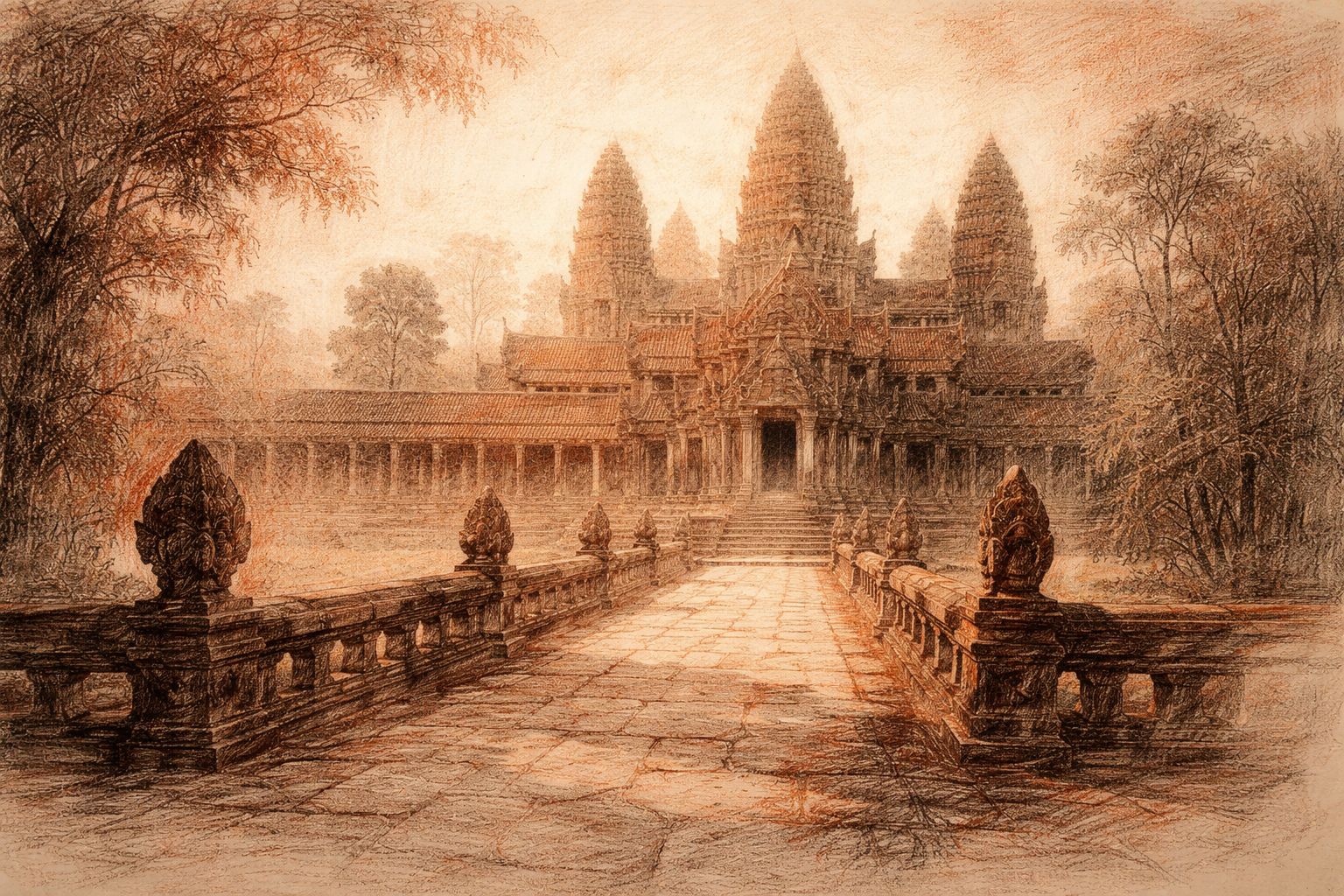

Angkor Architectural Styles and the Language of Stone
Stone That Learns to Breathe
Angkor’s architecture does not advance by steps so much as by listening. Stone listens to brick. Laterite listens to earth. Sandstone listens to light. Across six centuries, the temples do not merely grow larger or more ornate; they learn how to hold presence. Each style is not a replacement but a memory carried forward, a deepening of attention, as though the ground itself were slowly discovering how to stand upright and speak.
In the earliest sanctuaries, brick still remembers fire. Towers rise alone, compact, their walls softened by stucco and shadow. Doorways are framed with stone not for display but for endurance, the threshold already marked as a place of consequence. These early forms do not announce ambition. They are intimate, almost hesitant. The god is housed, not proclaimed. What matters is not scale, but orientation — the quiet fact of turning something toward the east and asking it to remain there.
As the centuries turn, the language grows more confident. Brick yields to laterite; laterite accepts the weight of sandstone. The temples begin to gather themselves into enclosures, learning the discipline of boundary and return. A single tower becomes many; many are drawn into alignment. The ground is no longer merely occupied but composed. Causeways appear, not yet monumental, but deliberate — stone paths that teach the body how to approach.
With the first true temple-mountains, architecture assumes its role as cosmology made walkable. Vertical ascent becomes instruction. Each terrace is not a platform but a question: how much weight can the body carry upward without losing its centre? Stone answers by becoming steeper, more exacting. The climb is not dramatic, but it is decisive. The pilgrim does not wander; the pilgrim is directed.
In the tenth century, something subtle shifts. Ornament tightens its grip, then releases it. Carving reaches moments of astonishing intimacy, only to withdraw again into restraint. The temples experiment with density and pause, with enclosure and opening. Galleries begin to form — not yet fully continuous, but already implying movement without exposure. Space starts to flow rather than accumulate.
By the time sandstone claims dominance, confidence has become calm. Mass is no longer shouted; it is held. Walls thicken. Joints tighten. The building no longer explains itself through decoration but through proportion. This is architecture that trusts gravity. It does not ask to be admired. It waits.
At its classical height, Angkor achieves a rare equilibrium: complexity without confusion, abundance without excess. Towers curve with a gentleness that belies their weight. Galleries widen, admitting air and shadow. Reliefs stretch in long, unbroken sequences, not to overwhelm but to steady the gaze. Everything seems to know exactly how much is enough. Stone has learned restraint.
Then, inevitably, the balance tilts. Construction accelerates. Plans expand outward rather than upward. The mountain flattens into a city. Faces appear — watching, repeating, multiplying — not as portraits, but as presence made visible. The temples of this late period are vast, intricate, and deeply human. They are less polished, more urgent. Stone begins to record not just ideals, but events, labour, crowds, fatigue. Architecture turns outward, absorbing life as it passes.
In the final phases, permanence loosens its grip. Wood returns. Stone withdraws to terraces and thresholds. The great structures remain, but they are no longer multiplied. What endures is not innovation, but adaptation. Angkor does not collapse; it thins. It learns how to stop building without stopping being.
Seen this way, Angkorian architectural styles are not a sequence of aesthetic decisions, but a long moral education in material. Brick teaches vulnerability. Laterite teaches patience. Sandstone teaches precision. Each temple is a sentence spoken by the same place, adjusted for time, power, and belief. The styles do not compete. They converse.
To walk among them is to feel that architecture, here, is not frozen history but accumulated listening. Stone remembers what it was asked to do. And in the quiet spaces between towers, galleries, and causeways, it still waits — not to be decoded, but to be approached with the same measure it once demanded from those who built it.
—
Receive the next work
Subscribe free to receive new work from the Lucas Varro Library by email.
More from the Library


See Also
A concise and impartial dictionary of absence, promises, quarrels, ordinary objects, and the troublesome instability of words.
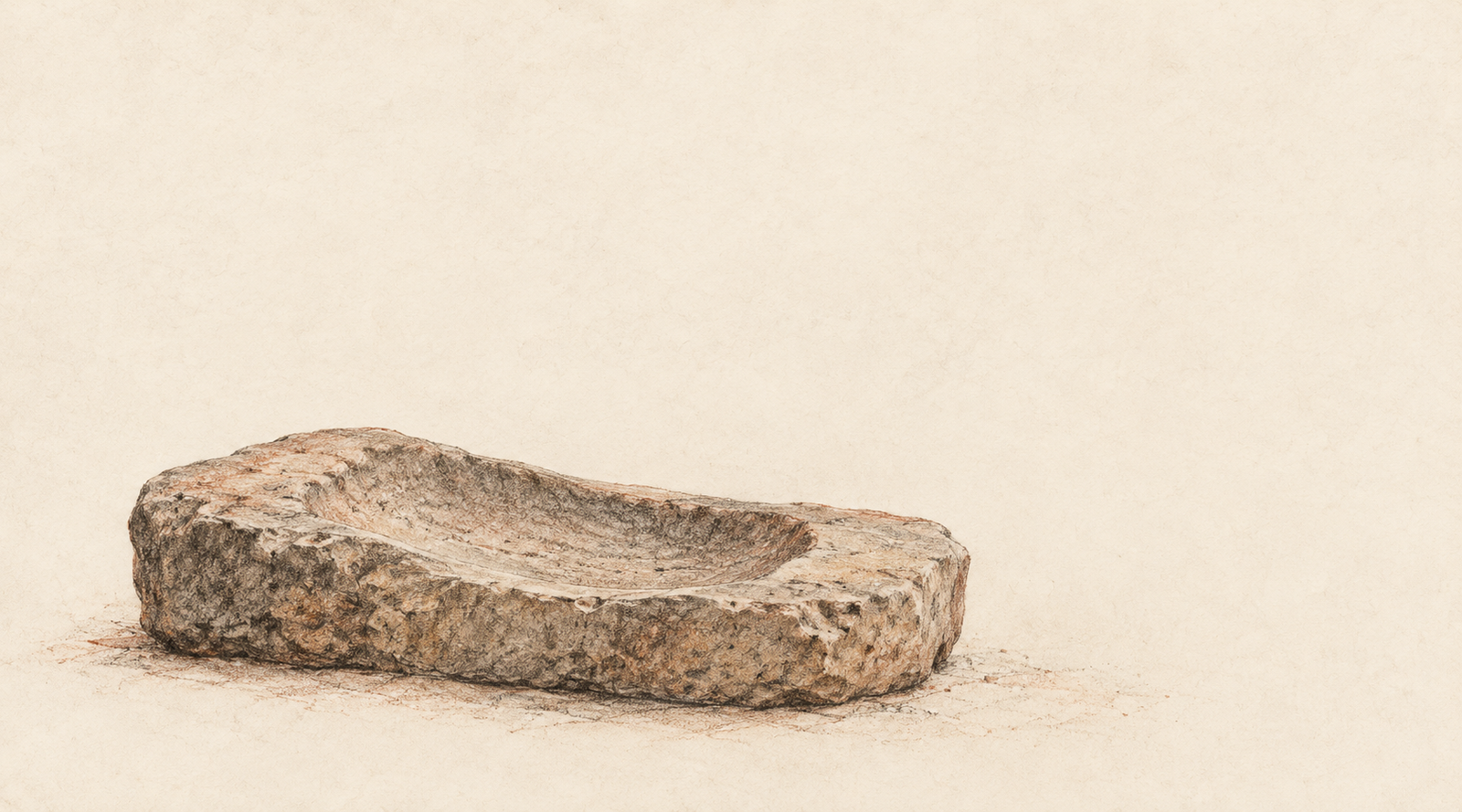

The City of Service
The temple we inherit is a building from which almost all necessity has been removed. Nothing must be brought for it to continue being what we call a temple. The sanctuary asks nothing of us. Stone is good at this kind of independence.
A living temple was otherwise.
Water had to come in. So did grain, cloth, oil, aromatic substances, fuel. The things required for worship arrived because someone carried them across a threshold.


Houses of Wood, Light, and Smoke
Some of Angkor’s most intimate ruins do not rise above the ground at all. They are postholes, low mounds, hearths and ponds: durable traces of a domestic city built largely from things that decay. To restore that city is to see Angkor not only as stone, but as wood, smoke, water, repair, and people living within calling distance.