
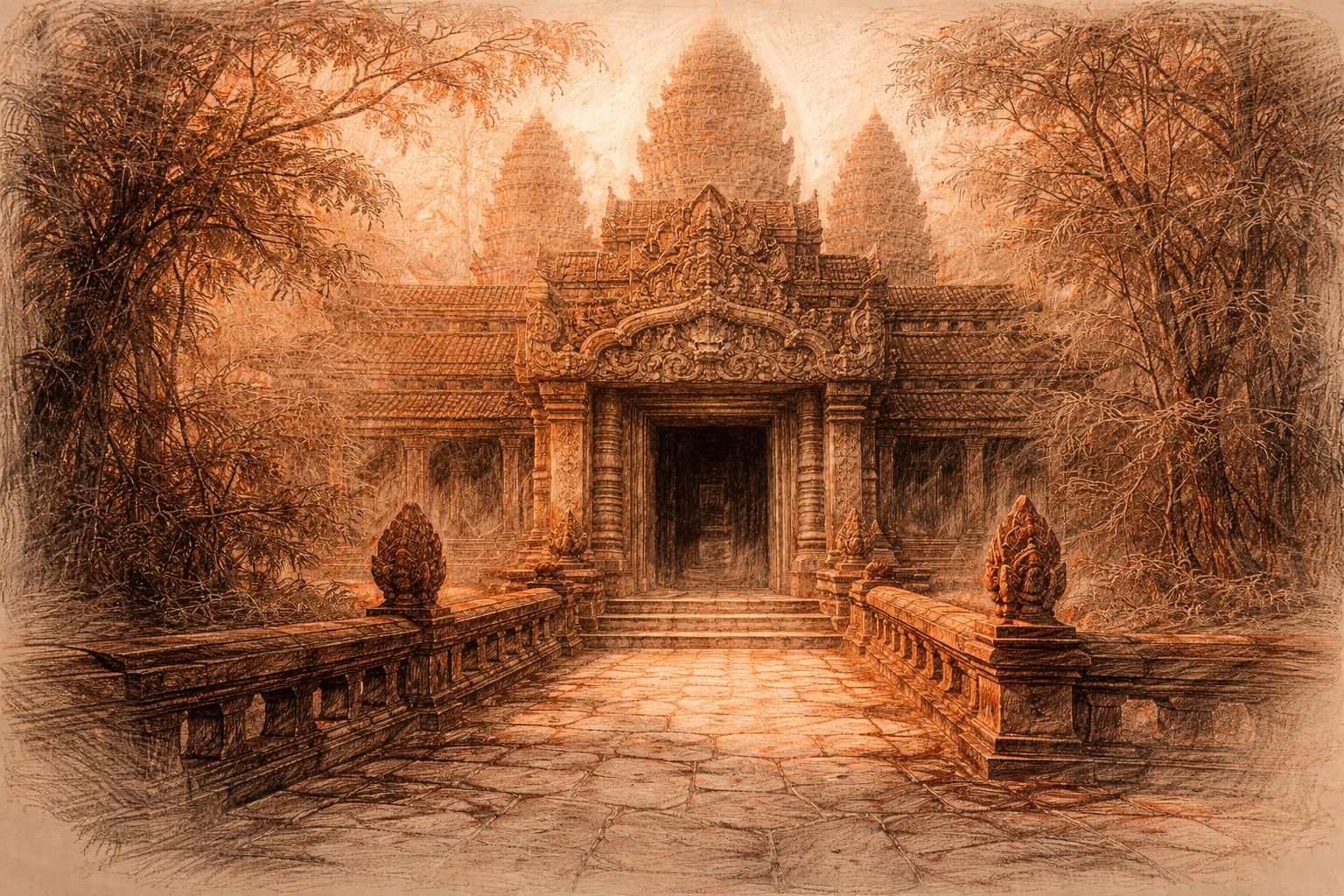

Angkor Lintel Styles and the Language of the Threshold
The Threshold Learns to Speak
A lintel is not an ornament. It is a sentence placed above a pause. At Angkor, the stone above the doorway learns, slowly and deliberately, how to carry meaning without raising its voice. To pass beneath a lintel is to move under a thought that has been compressed into weight, symmetry, and restraint. These carvings do not ask to be read; they ask to be crossed.
In the earliest sanctuaries, the lintel is almost the only place where stone dares to speak at all. Brick walls remain quiet, stuccoed, perishable. Above the door, however, sandstone gathers itself into form. Curving arches stretch between inward-facing makaras, creatures that seem less decorative than necessary, as though the threshold itself required guardians capable of swallowing danger before it entered. The composition is compact, contained, protective. Figures appear, but they are held within strict frames. Even the gods seem disciplined by the limits of the stone.
As these early forms loosen their grip, the arch begins to straighten. Makaras withdraw. Human figures step forward. The lintel experiments with narrative, tentatively at first, placing scenes beneath the beam as if testing whether story can survive compression. What emerges is not exuberance, but confidence. The stone is learning how much it can hold without breaking its silence.
When garlands replace arches, something decisive has happened. Vegetation unfurls across the lintel, no longer swallowed or restrained, but woven into a continuous band. Leaves, knots, and pendants spill outward with controlled generosity. The doorway is no longer guarded by beasts or framed by rigid geometry. It is crowned by growth. The threshold becomes less a barrier than a transition, less a warning than a welcome.
With the emergence of Angkor proper, the lintel finds its mature grammar. A central kala appears — not monstrous, not benevolent, simply unavoidable. It does not threaten. It watches. From its mouth or hands, garlands extend, looping downward in balanced arcs. The composition becomes symmetrical, centred, resolved. Tiny figures hide within foliage, but they do not disrupt the order. They submit to it. The lintel now performs a precise task: to slow the body just enough for attention to gather before entry.
As carving reaches its peak, the stone becomes dense with incident. Figures crowd the space. Scenes swell until no surface is left unclaimed. Gods ride their mounts, narratives unfold across the beam, and the lintel becomes a compressed epic. Yet even here, discipline remains. No gesture escapes the frame. No line wanders. The exuberance is total, but it is not chaotic. The threshold bears the weight of story without collapsing into noise.
Later, restraint returns — not as refinement, but as necessity. Figures thin out. Garland segments break apart. The kala retreats to the lower edge, diminished, almost apologetic. What remains is not elegance but residue. The lintel continues to mark the doorway, but it no longer insists. It has learned when to withdraw.
Seen across centuries, Angkor’s lintel styles do not progress toward mastery so much as oscillate between fullness and silence. At times the stone speaks richly, insisting on narrative, presence, and cosmic order. At others, it limits itself to pattern and sign. What never changes is the lintel’s role as mediator. It is the moment where architecture pauses before allowing passage, where belief is offered one last chance to gather itself.
To walk beneath these carvings is to feel how seriously Angkor treated thresholds. The lintel does not decorate the doorway; it completes it. It reminds the body that crossing is never neutral, that every entry carries consequence. Long after towers crumble and roofs fall away, the lintel remains, suspended between two spaces, still doing its work — holding meaning just long enough for someone to pass beneath it.
—
Receive the next work
Subscribe free to receive new work from the Lucas Varro Library by email.
More from the Library


See Also
A concise and impartial dictionary of absence, promises, quarrels, ordinary objects, and the troublesome instability of words.
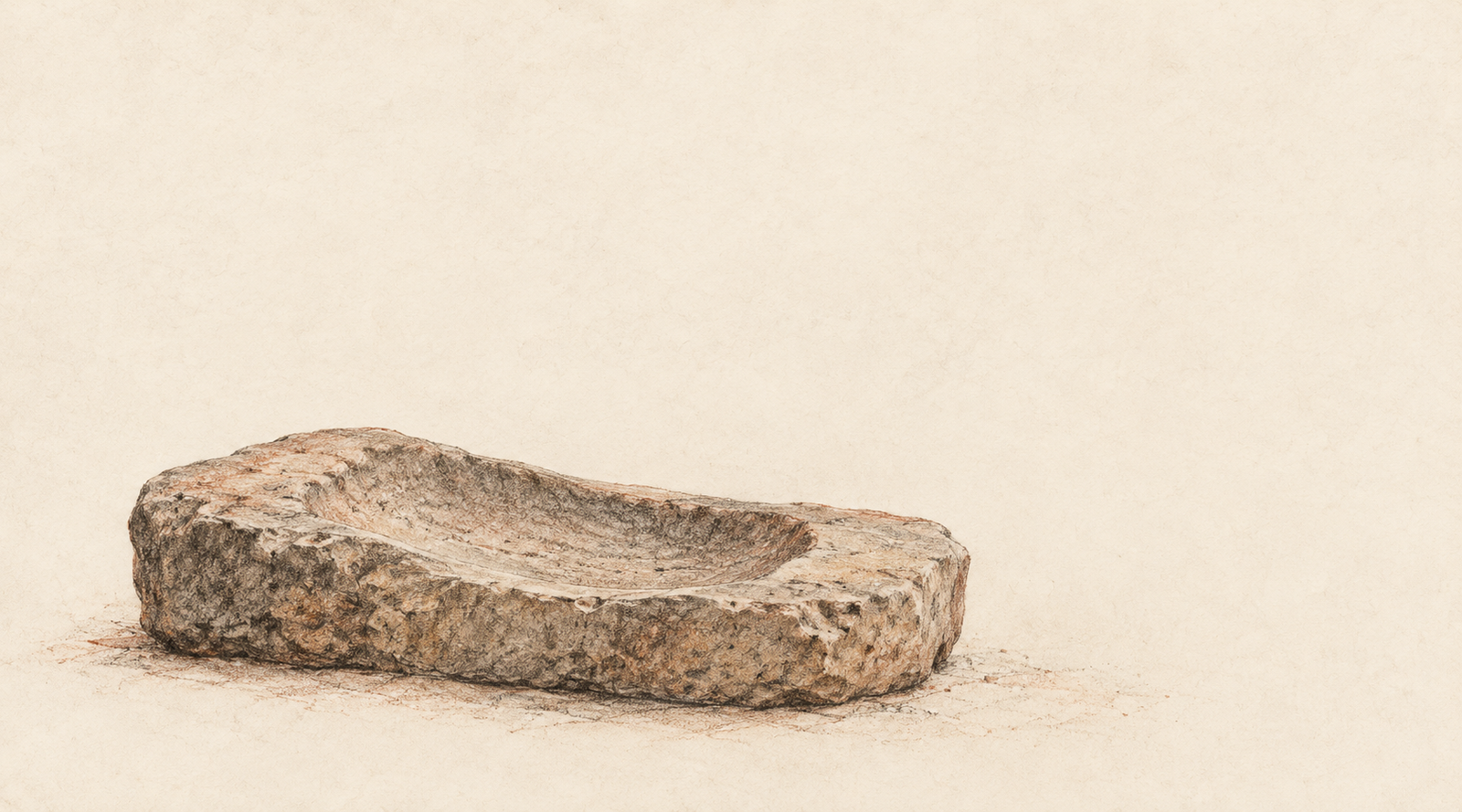

The City of Service
The temple we inherit is a building from which almost all necessity has been removed. Nothing must be brought for it to continue being what we call a temple. The sanctuary asks nothing of us. Stone is good at this kind of independence.
A living temple was otherwise.
Water had to come in. So did grain, cloth, oil, aromatic substances, fuel. The things required for worship arrived because someone carried them across a threshold.
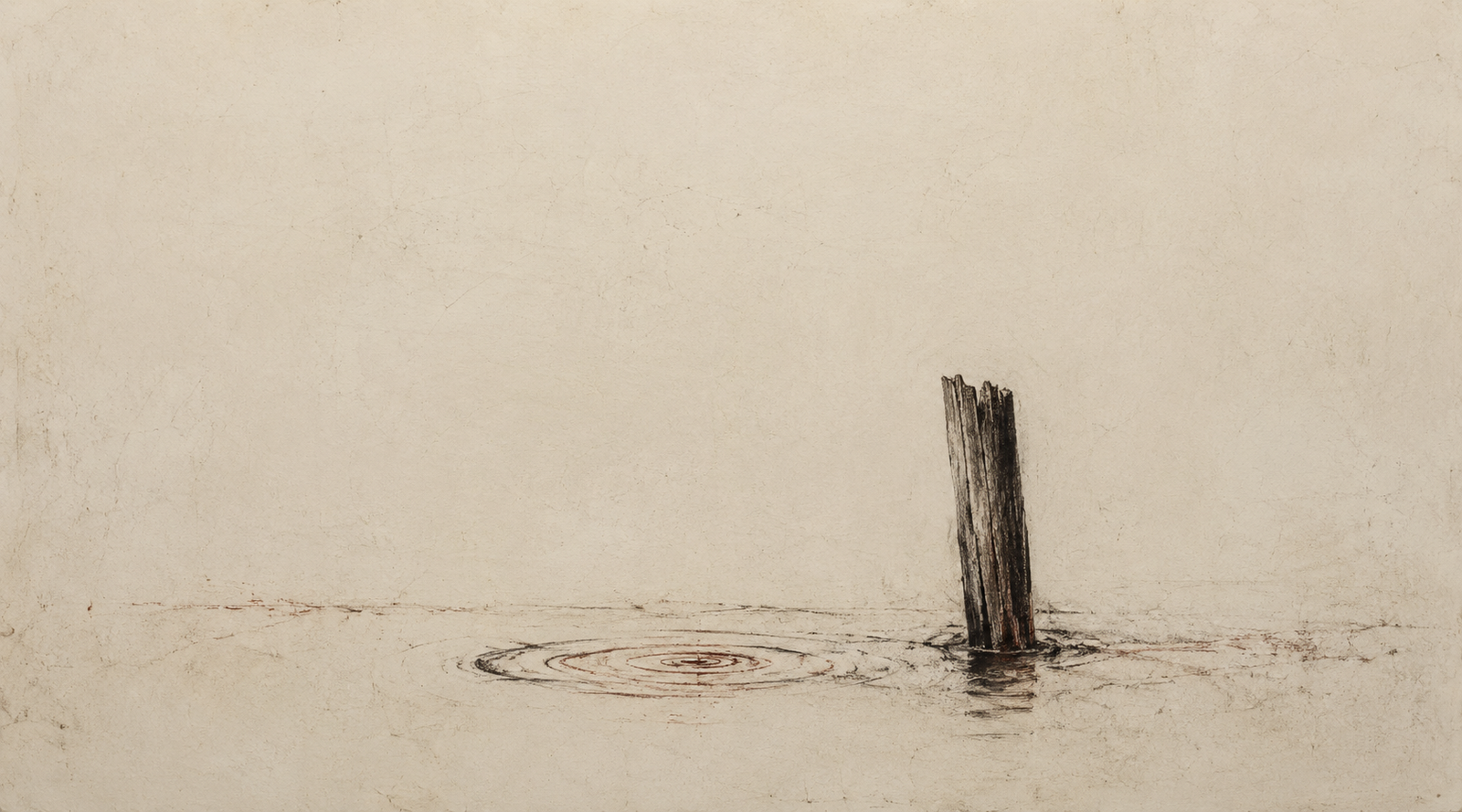

Houses of Wood, Light, and Smoke
Some of Angkor’s most intimate ruins do not rise above the ground at all. They are postholes, low mounds, hearths and ponds: durable traces of a domestic city built largely from things that decay. To restore that city is to see Angkor not only as stone, but as wood, smoke, water, repair, and people living within calling distance.