
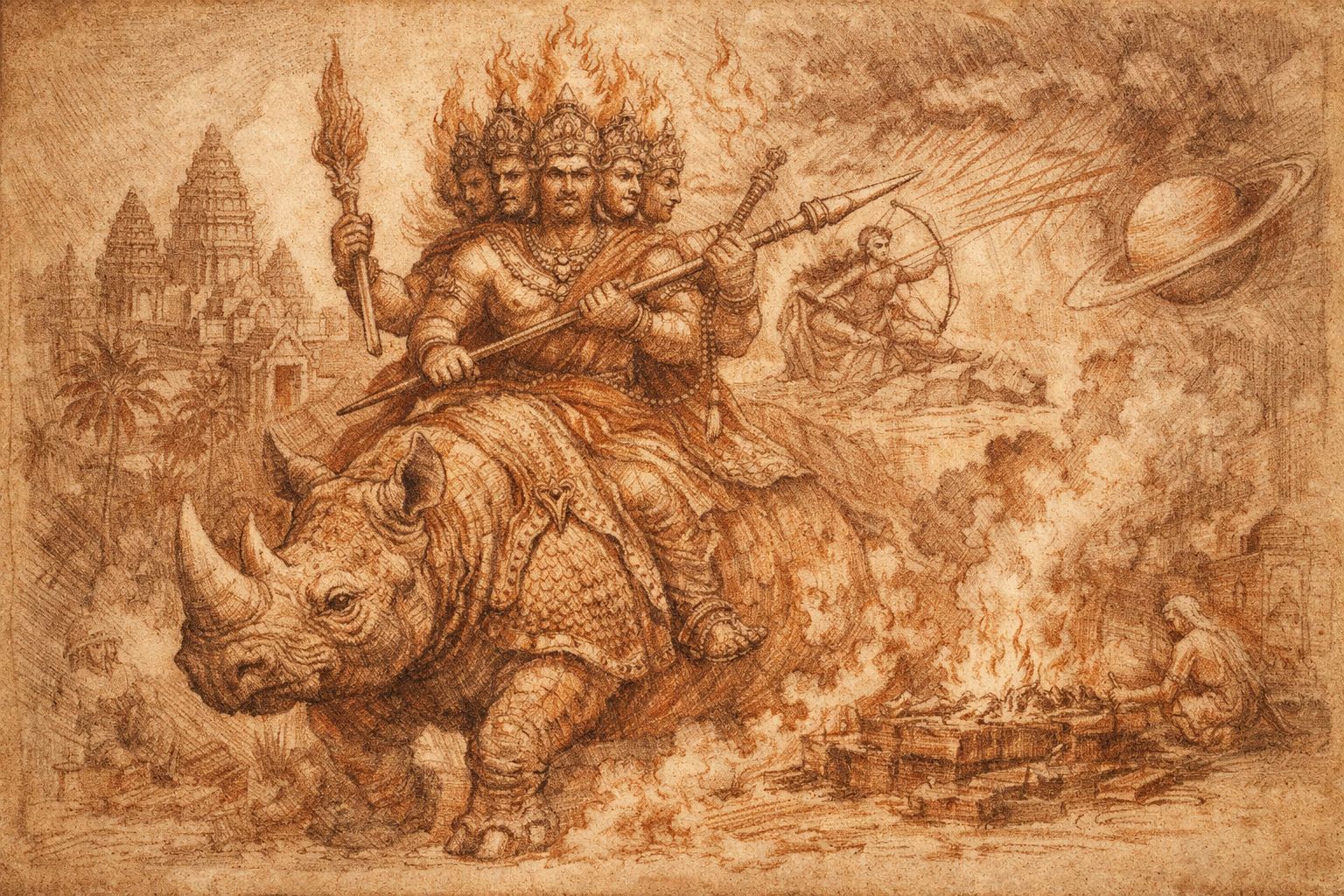

Agni — Keeper of the Living Flame
Fire is never still at Angkor.
Even where no flame is visible, it is present—latent in brick, sleeping in laterite, waiting in the breath of stone. Agni is not merely the god of fire here; he is its discipline. He teaches that fire must be kept, not unleashed.
In the Vedic imagination, Agni is the first priest. He is the flame that opens every rite, the mouth through which offerings pass from the human world into the unseen. What is placed in fire is not destroyed but translated. Smoke becomes ascent; heat becomes speech. In this way Agni stands between realms, neither wholly divine nor mortal, but entrusted with passage. He is the intermediary who makes exchange possible.
This mediating role gave Agni a moral gravity unlike that of any other god. He cleanses because he consumes without preference. He grants immortality not by sparing the body, but by reducing it to what may travel onward. In the sacrificial fire, sin is not judged—it is burned down to silence. Fire does not remember.
At Angkor, this understanding was never abstract. Fire was installed, housed, and guarded. The so-called “libraries” that flank Khmer temples were not repositories of text, but Fire Shrines—places where the sacred flame was rekindled each morning, returned to breath after the night’s concealment. The flame was a presence that had to be welcomed back, tended, and acknowledged. Without it, ritual could not begin. Without it, the gods could not hear.
Agni’s position among the dikpalas, the Guardians of the Directions, is the South-east—the quarter of ignition, where day is born through heat and where intention first takes fire. This is the direction of thresholds and beginnings, not endings. Even destruction, under Agni’s authority, is preparatory. Ash is not ruin; it is readiness.
Nowhere is this clearer than in the Khmer re-imagining of Agni’s form. In India, he rides a ram or goat—animals of sacrificial heat and swift combustion. But at Angkor, Agni mounts the rhinoceros. This is not ornament. It is theology rendered in muscle.
The rhinoceros was believed capable of crossing burning grasslands unharmed, its hide impervious to flame. It does not flee fire; it moves through it. In choosing this vahana, the Khmer transformed Agni from a volatile blaze into a controlled force—fire armoured, disciplined, and sovereign. Fire no longer runs wild. It advances with weight.
This image appears repeatedly across the Khmer world—at Angkor Wat, Beng Mealea, Banteay Samre, and Phnom Rung—sometimes as a solitary mount, sometimes drawing a chariot. In the great relief of Krishna’s victory over Bana, Agni appears as a giant with multiple heads and arms, a being too expansive for a single profile. Fire cannot be fully seen; it must be understood by its effects.
At Banteay Srei, Agni is more elusive still. In the eastern pediment of the northern library, the burning of the Khandava Forest unfolds without his figure. The flames are implied, not carved. Instead, we see Krishna and Arjuna raising a canopy of arrows to block Indra’s rain, allowing the fire to complete its hunger. Agni works through agents. Fire rarely appears as itself.
This restraint is essential. Agni is not only the fire of sacrifice, but the fire of cremation—the eater of bodies, the witness of final rites. For this reason, Khmer cosmology aligns him with Saturn, the slow and sombre planet of endings. In the navagraha sequence at Angkor Wat, Agni stands as Saturn’s regent, embodying fire’s darker office: reduction, delay, and inexorable completion.
Yet even here, Agni is not malevolent. The cremation fire is not an enemy of life but its final service. It frees what cannot travel onward in its present form. In some ritual traditions, Agni is said to outlast the sun itself, for the sacred fire burns through the night while the sun is concealed. Dawn does not begin the fire; it inherits it.
At the end of a cosmic age, it is Agni who consumes the world in a universal conflagration—not as punishment, but as preparation. The rain that follows is not conquest, but mercy. What remains is not absence, but potential.
To walk Angkor attentively is to sense this everywhere: in brick darkened by centuries of heat, in laterite that once held flame, in shrines designed not for idols but for fire itself. Agni teaches that civilisation does not begin with stone, but with the decision to keep a flame alive—to tend it daily, to restrain it, and to trust it with what must pass beyond our keeping.
Fire, here, is not chaos.
It is covenant.
—
Receive the next work
Subscribe free to receive new work from the Lucas Varro Library by email.
More from the Library


See Also
A concise and impartial dictionary of absence, promises, quarrels, ordinary objects, and the troublesome instability of words.

The City of Service
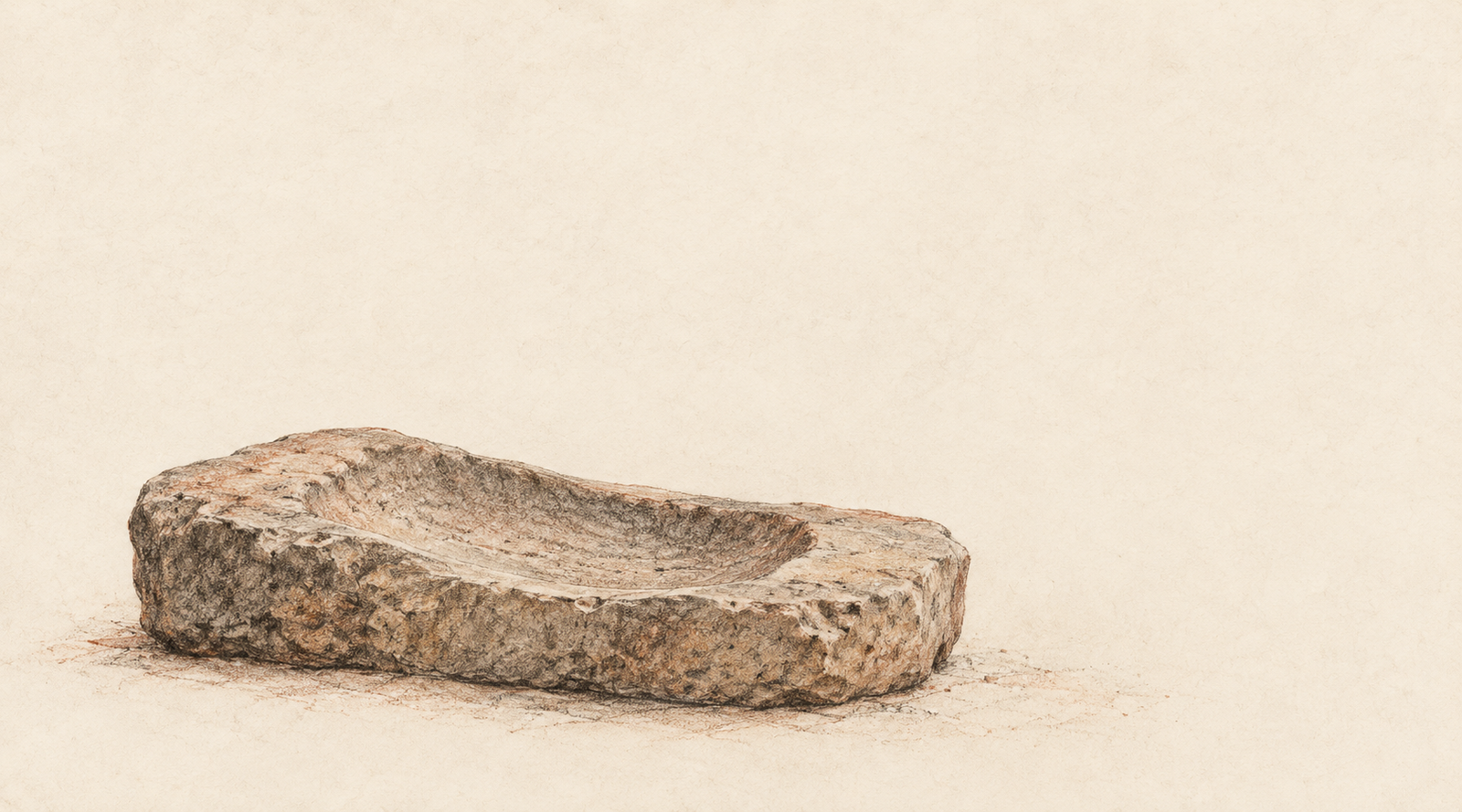
The temple we inherit is a building from which almost all necessity has been removed. Nothing must be brought for it to continue being what we call a temple. The sanctuary asks nothing of us. Stone is good at this kind of independence.
A living temple was otherwise.
Water had to come in. So did grain, cloth, oil, aromatic substances, fuel. The things required for worship arrived because someone carried them across a threshold.


Houses of Wood, Light, and Smoke
Some of Angkor’s most intimate ruins do not rise above the ground at all. They are postholes, low mounds, hearths and ponds: durable traces of a domestic city built largely from things that decay. To restore that city is to see Angkor not only as stone, but as wood, smoke, water, repair, and people living within calling distance.