
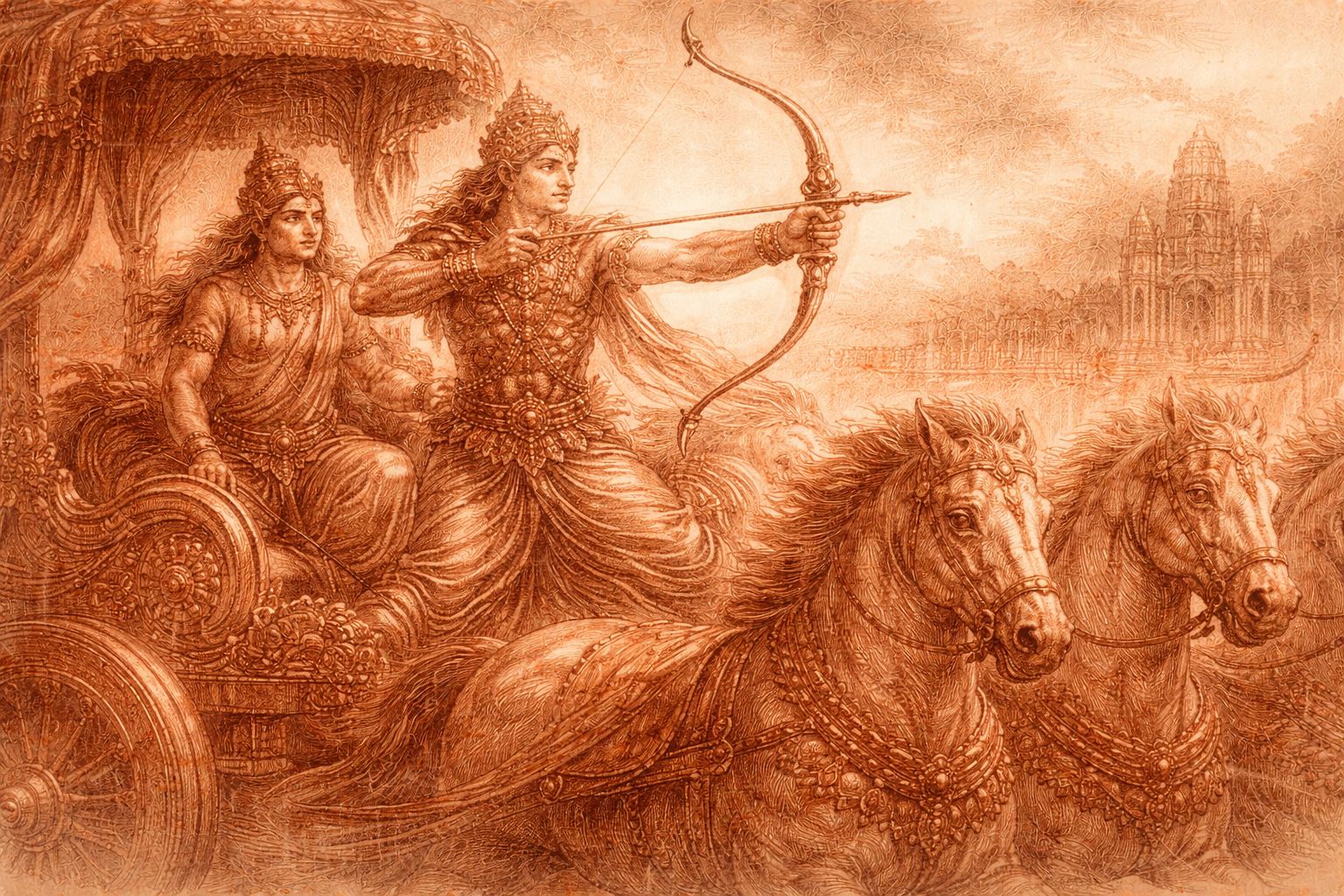

Arjuna — The Warrior Who Learned to Lower His Bow
Among the heroes of the Mahabharata, Arjuna stands closest to the human centre.
He is not the strongest, nor the most ferocious. He is not the most ruthless, nor the most assured. What distinguishes him is hesitation—the capacity to pause, to doubt, and to listen when certainty fractures. In this, Arjuna becomes more than a warrior. He becomes a mirror.
Born to Queen Kunti through the divine agency of Indra, Arjuna inherits celestial skill, but not celestial detachment. His life unfolds as a long education in the limits of power. Each weapon he acquires demands not only strength, but restraint; each victory reveals a deeper obligation.
From the beginning, his excellence is unmistakable. He wins Draupadi through an archery feat no other prince can accomplish, striking a hidden target while disguised as a mendicant. He becomes Agni’s chosen instrument in the burning of the Khandava forest, holding back Indra’s rain with a lattice of arrows so dense it seals the sky. He stands firm even against the gods, yet never claims supremacy over them.
His greatest trial, however, is not martial.
It is inward.
Seeking the weapons necessary to confront his cousins, Arjuna withdraws into austerity, subjecting his body to discipline until even the gods take notice. When Shiva approaches him disguised as a mountain hunter, Arjuna does not recognise divinity. He recognises challenge. Their duel is fierce, intimate, stripped of pageantry. Only when Arjuna’s pride breaks—when he bows rather than strikes—does the god reveal himself.
Power is granted not to the victorious, but to the yielded.
This lesson follows Arjuna to the field of Kurukshetra.
There, facing teachers, elders, cousins, and friends arrayed for slaughter, his will collapses. The bow slips from his hand. His strength deserts him. He is paralysed by pity, by dread, by the realisation that righteousness, when enacted, carries unbearable cost.
This is the moment that defines him.
As his charioteer, Krishna does not command him to fight. He teaches him to see. The Bhagavad Gita unfolds not as doctrine, but as orientation: act without attachment, fight without hatred, surrender outcome while committing fully to duty. Arjuna is not asked to become divine. He is asked to become aligned.
When he lifts his bow again, it is not with certainty, but with clarity.
In Khmer temples, this tension is carved with deliberate care. At Angkor Wat, Arjuna rides into battle with Krishna as charioteer—armed hero guided by unarmed wisdom. At Banteay Srei, his arrows hold back the rain itself, not as defiance of the gods, but as obedience to a higher necessity. In the Arjunakirata scenes at the Bayon and the Baphuon, kings see their own reflection: authority tested, pride humbled, mandate confirmed only through submission.
Arjuna’s enduring power lies here.
He shows that strength without guidance is violence, and guidance without courage is impotence. The chariot moves only when both are present. The bow strikes true only when the hand is steady and the heart has consented.
Arjuna does not conquer doubt.
He passes through it.
And in doing so, he becomes the figure through whom divine intention enters the human world—not as thunder, but as decision.
—
Receive the next work
Subscribe free to receive new work from the Lucas Varro Library by email.
More from the Library


See Also
A concise and impartial dictionary of absence, promises, quarrels, ordinary objects, and the troublesome instability of words.

The City of Service
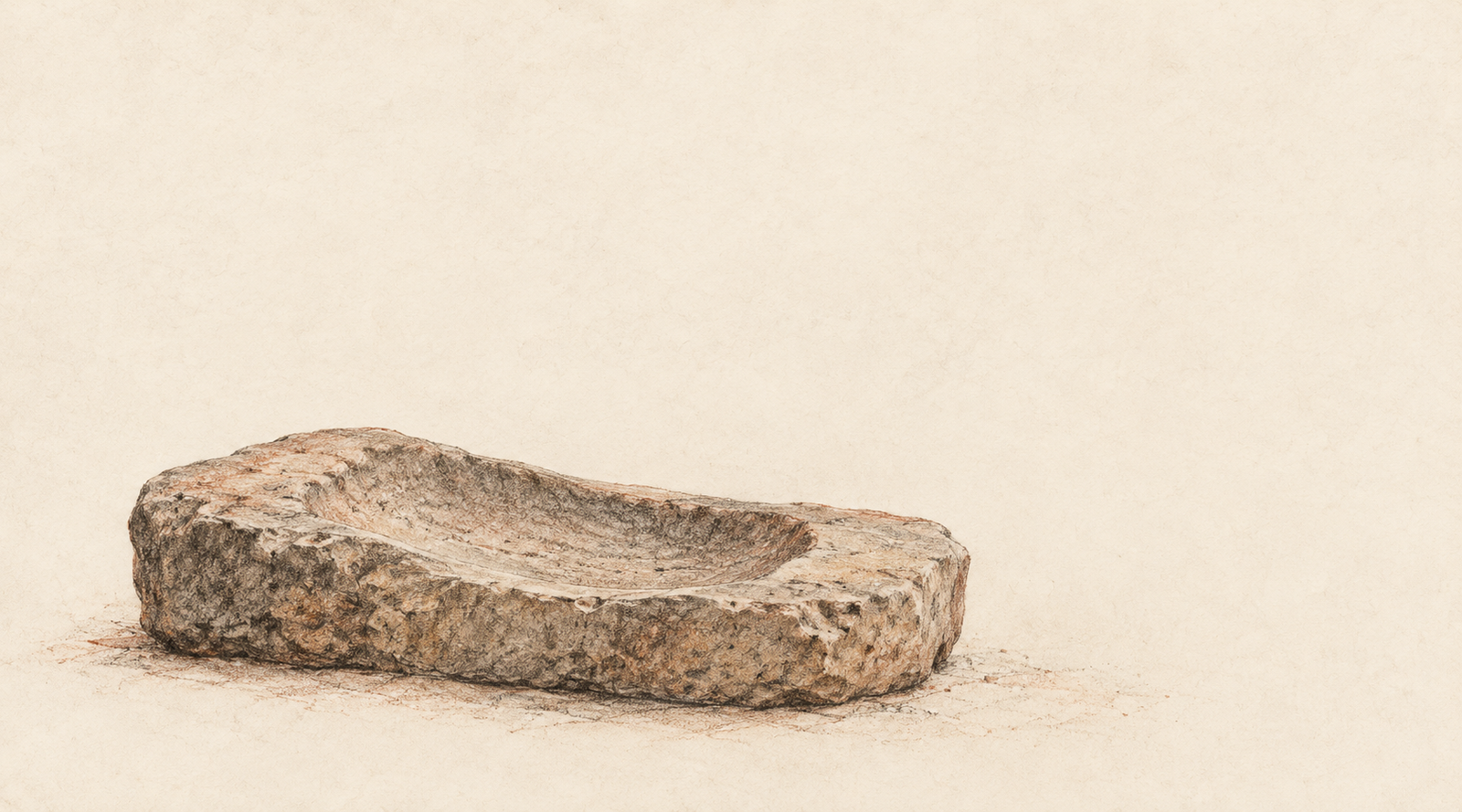
The temple we inherit is a building from which almost all necessity has been removed. Nothing must be brought for it to continue being what we call a temple. The sanctuary asks nothing of us. Stone is good at this kind of independence.
A living temple was otherwise.
Water had to come in. So did grain, cloth, oil, aromatic substances, fuel. The things required for worship arrived because someone carried them across a threshold.


Houses of Wood, Light, and Smoke
Some of Angkor’s most intimate ruins do not rise above the ground at all. They are postholes, low mounds, hearths and ponds: durable traces of a domestic city built largely from things that decay. To restore that city is to see Angkor not only as stone, but as wood, smoke, water, repair, and people living within calling distance.