

Arishta — When Disorder Wears the Shape of Strength
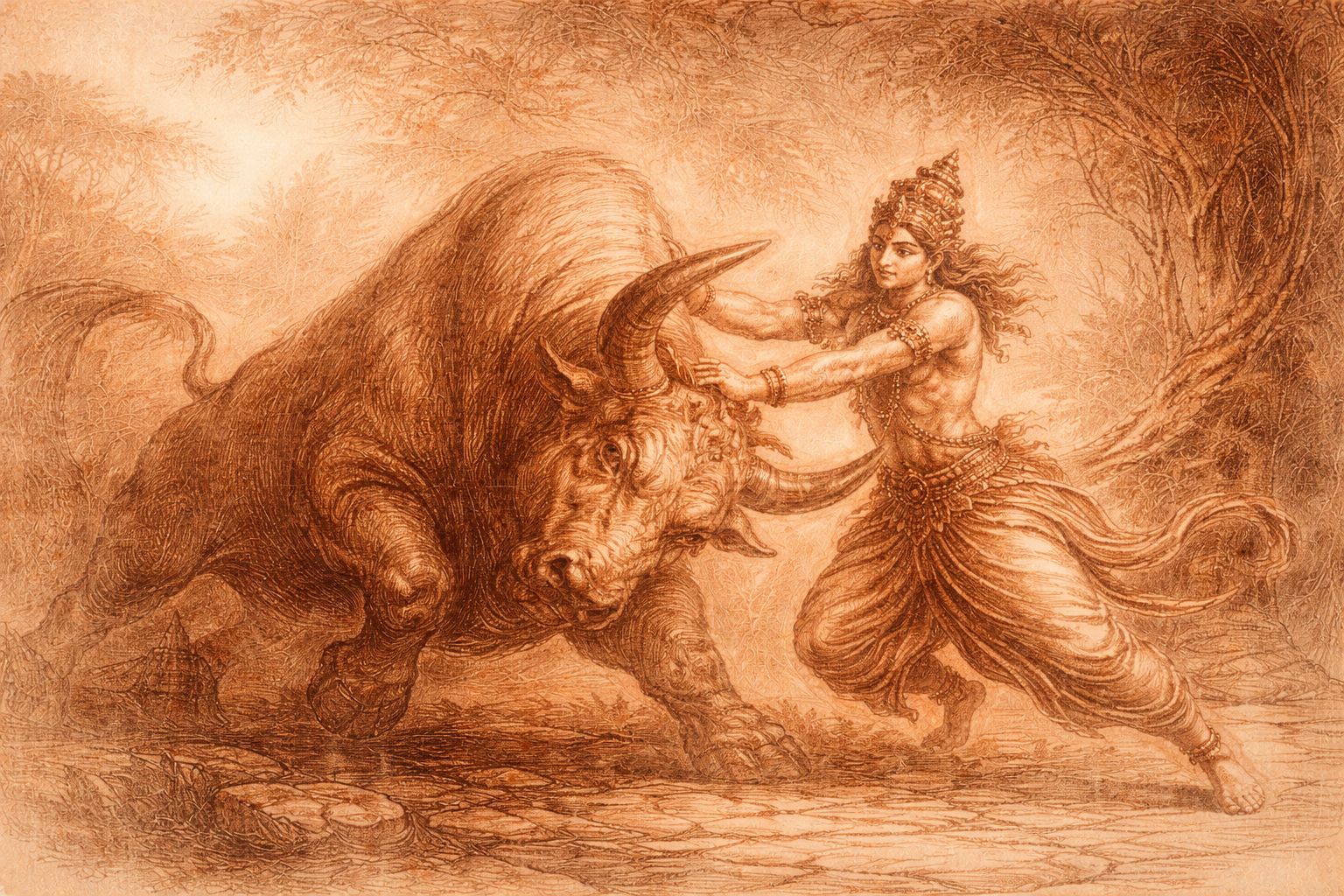
He comes as an ox.
Not as a shadow, not as a whisper, but as weight—hooves breaking earth, breath scorching the fields, horns curved like questions no one wishes to answer. Arishta does not arrive quietly. He announces himself through disruption.
In the mythic record, Arishta—also known as Arishtasura—is an asura, a being of immense power aligned not with chaos itself, but with excess. Sent by King Kamsa to kill his nephew Krishna, Arishta takes the form of a gigantic bull and is loosed upon the pastoral world of Vraja, a landscape defined by cattle, milk, rhythm, and care.
The choice of form is not incidental.
The bull is strength harnessed. Fertility disciplined. Power placed under yoke and measure. In agrarian cosmology, the ox is not wild—it is essential. To corrupt that figure is to threaten the entire moral economy of the land. Arishta does not merely attack Krishna; he attacks the conditions that allow life to proceed in season and balance.
His presence distorts nature itself. Cows neglect their calves. Breeding cycles fracture. The ground trembles beneath hooves meant to plough, not to shatter. Breath becomes poison. Clouds scatter. What should nourish instead terrifies.
This is the true danger of the asura: not destruction alone, but misplacement.
Arishta embodies power that has slipped its purpose.
In the encounter that follows, Krishna does not retreat. He does not summon weapons. He meets the bull directly, hand to horn, strength to strength. When Arishta charges with thunderous force, Krishna catches him—not once, but twice. The struggle is intimate, physical, almost agricultural in its imagery. Horns are seized. The body is thrown. The ground receives the blow.
In one telling, Krishna twists the bull’s body as one would wring cloth.
The metaphor is exacting. Chaos is not blasted away; it is worked through, compressed, and exhausted. Order is restored not by annihilating force, but by mastery.
The final act is precise. Krishna pulls out one of Arishta’s horns and uses it to end him. The very emblem of threat becomes the instrument of resolution. Power destroys itself when placed back into right proportion.
This moment echoes far beyond pastoral legend.
In Khmer reliefs, the scene appears again and again—at Bakong, at Preah Vihear, at Angkor Wat, at Phimai. The image is compact and unmistakable: the young god, calm and centred, overcoming brute force without spectacle. For Khmer kings, this was not merely mythological ornament. It was political theology in stone.
To rule was to restrain.
The king, like Krishna, was charged with recognising when strength had become distortion—when force threatened rhythm rather than sustaining it. Arishta thus becomes a symbol not of foreign invasion alone, but of internal imbalance: rebellion, hubris, ecological rupture, untimely ambition.
The bull must fall not because it is strong, but because its strength no longer listens.
There is a deeper, quieter lesson embedded here. Arishta is not evil because he is an asura. He is dangerous because he occupies the wrong role. His fall does not erase power from the world; it reassigns it.
In this way, the myth aligns with Angkor’s broader cosmology. Excess is not banished. It is disciplined. Shadow is not denied. It is held at the threshold. The universe continues not by eliminating force, but by teaching it where—and when—it belongs.
Arishta reminds us that disorder often arrives disguised as vitality.
And that true sovereignty lies in knowing when to take the horn from the beast and return the field to silence.
—
Receive the next work
Subscribe free to receive new work from the Lucas Varro Library by email.
More from the Library


See Also
A concise and impartial dictionary of absence, promises, quarrels, ordinary objects, and the troublesome instability of words.

The City of Service
The temple we inherit is a building from which almost all necessity has been removed. Nothing must be brought for it to continue being what we call a temple. The sanctuary asks nothing of us. Stone is good at this kind of independence.
A living temple was otherwise.
Water had to come in. So did grain, cloth, oil, aromatic substances, fuel. The things required for worship arrived because someone carried them across a threshold.

Houses of Wood, Light, and Smoke
Some of Angkor’s most intimate ruins do not rise above the ground at all. They are postholes, low mounds, hearths and ponds: durable traces of a domestic city built largely from things that decay. To restore that city is to see Angkor not only as stone, but as wood, smoke, water, repair, and people living within calling distance.