
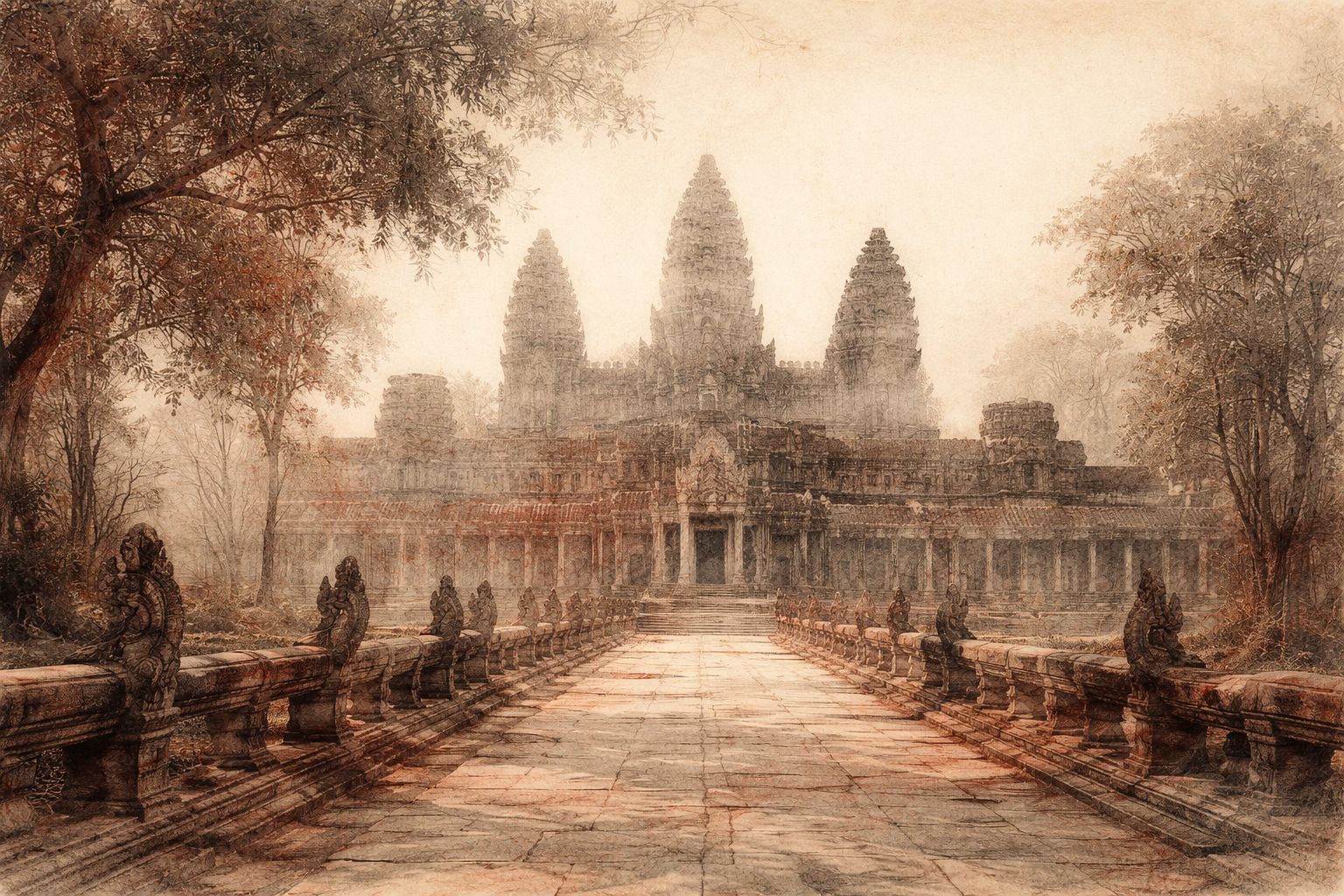

Brahman at Angkor: Stone, Stillness, and the Ground of Being
At Angkor, there are mornings when the stone seems not to represent anything at all. It simply holds. Light arrives without announcement. Galleries lengthen. Shadow settles into joints cut eight centuries ago. Nothing here instructs; nothing persuades. The place waits until the visitor learns how to stand without grasping. In such moments, the question of origin loosens its grip. One stops asking what made this world and begins to feel what sustains it.
Brahman is not named in the reliefs. It is not carved into lintels or personified in the calm severity of faces. Yet its presence can be traced in the way the temples refuse to end. Towers rise not to culminate but to recur. Corridors repeat until the body loses its measure of progress. Causeways extend across water as if distance itself were a ritual rather than a means. The architecture does not describe a story; it establishes a field in which story becomes secondary to continuity.
Here, substance outweighs event. Stone outweighs action. What matters is not what happens, but what remains available when nothing happens at all.
In Indian thought, Brahman names that which does not enter time yet allows time to appear. It is not an object among objects, nor a summit to be reached. It is the condition by which reaching and arriving are even possible. At Angkor, this principle is not argued. It is rehearsed bodily. One walks. One pauses. One feels the return of the same forms under different light, the same proportions approached from altered directions. The temples do not point elsewhere. They thicken presence until elsewhere becomes unnecessary.
The early Khmer builders understood this without abstract declaration. Their stone does not seek transcendence through escape, but through saturation. Laterite cores are buried beneath sandstone skins, unseen yet indispensable. Water is contained, not to be mastered, but to be mirrored and returned. Nothing here is purely functional. Everything is foundational. The visible rests upon the invisible with quiet trust.
Brahman, in its oldest sense, was known as a power that swelled and sustained, a force that grew from within rather than descending from above. This inward expansion can be felt at Angkor in the way space seems to breathe. Enclosures do not compress; they dilate attention. The pilgrim does not feel enclosed so much as gathered. Even the great enclosures of Angkor Wat hold the body as a vessel holds air: defining shape without confining essence.
What emerges, slowly, is the recognition that the temples are not statements about divinity but exercises in recognition. They do not tell the visitor what is ultimate. They create the conditions under which the visitor might stop mistaking surfaces for foundations. The discipline is architectural, not doctrinal.
This is why the gods here feel less like rulers than thresholds. Vishnu reclining upon the serpent is not presented as an episode but as a posture of being. The ocean, the body, the coil beneath him are not separate elements assembled into a scene. They are the same substance adopting different densities. Form is not opposed to formlessness; it is one of its permissible gestures.
To walk these corridors attentively is to encounter the old teaching that the self is not other than its source. Atman, spoken of in the texts as the inner witness, finds its architectural analogue in the pilgrim’s own awareness as it moves through stone. The body advances, but something deeper remains still, observing both movement and rest. The mind begins to sense that this stillness is not private. It belongs to the place as much as to the person.
The illusion of separation arises easily here. The scale overwhelms. The past asserts its weight. One is tempted to feel small, transient, peripheral. Yet the longer one remains, the more this sense of distance erodes. The stone does not diminish the visitor; it absorbs them into its rhythm. The self loosens, not through loss, but through recognition that it was never isolated to begin with.
Indian philosophy names this misperception avidya, ignorance not as lack of information but as mis-seeing. At Angkor, ignorance manifests as haste. The belief that one must move on, see more, understand faster. The temples quietly resist this. They offer repetition without reward, scale without climax. Eventually the visitor either leaves, or learns to stop demanding conclusions.
When that demand falls away, something else becomes audible. Not a voice, but a steadiness. The sense that what looks like multiplicity is sustained by an underlying sameness. Walls differ, towers vary, bas-reliefs teem with movement, yet the stone remains stone. It does not aspire to be other than itself. It allows difference without fragmentation.
This is not the world as illusion in the crude sense of falsity. It is the world as appearance: a play of maya that does not deceive so much as distract. The temples do not deny the world’s forms. They refine attention until form is no longer mistaken for foundation. One learns to see the clay in the vessel, the air in the chamber, the water beneath the reflection.
The ancient saying “tat tvam asi” is not inscribed here, but it is enacted. The pilgrim who lingers long enough feels the subtle collapse of distance between observer and observed. The stones do not mirror the self; they dissolve the boundary that required mirroring in the first place. What remains is a quiet continuity, unclaimed and unpossessed.
In this way, Angkor does not teach metaphysics. It trains recollection. It returns the visitor to a recognition that precedes belief: that the ground of one’s own awareness is not separate from the ground of the world. The king who commissioned these temples, the mason who cut the joints, the pilgrim who walks them now—all participate in the same sustaining presence, differentiated by time but not by essence.
Brahman, here, is not an idea to be grasped. It is the patience of stone. It is the way the morning light does not hurry. It is the endurance that allows empires to rise, fade, and be absorbed without bitterness. The temples do not mourn their makers. They continue to offer themselves as thresholds into stillness.
To leave Angkor after such an encounter is to carry away very little in the way of explanation. What remains is a change in posture: a slower step, a softened gaze, a trust in what underlies the visible. One may not name this as Brahman. One may not name it at all. But the recognition lingers, like air released from a broken vessel, revealing that it was always part of the wider sky.
—
Receive the next work
Subscribe free to receive new work from the Lucas Varro Library by email.
More from the Library


See Also
A concise and impartial dictionary of absence, promises, quarrels, ordinary objects, and the troublesome instability of words.

The City of Service
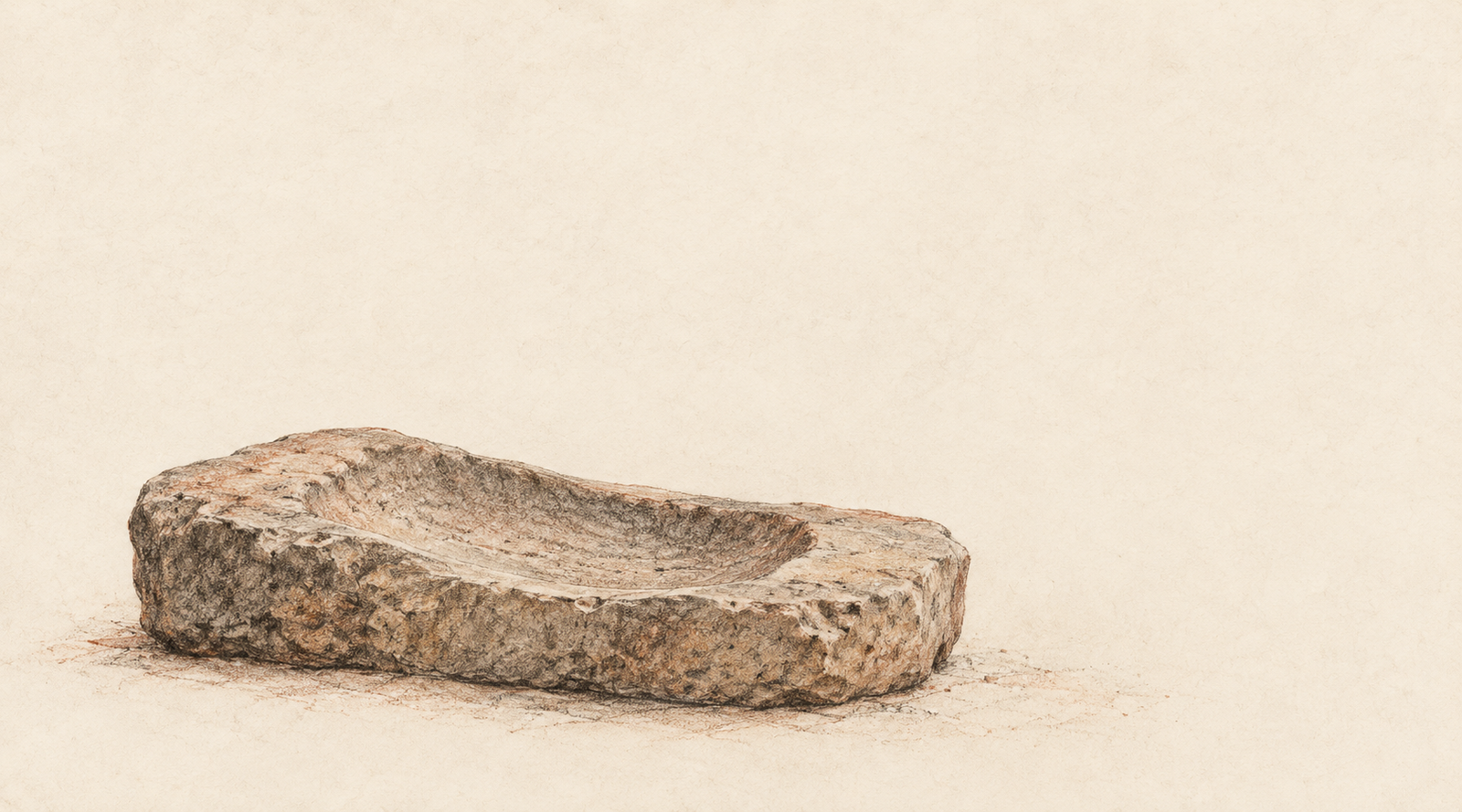
The temple we inherit is a building from which almost all necessity has been removed. Nothing must be brought for it to continue being what we call a temple. The sanctuary asks nothing of us. Stone is good at this kind of independence.
A living temple was otherwise.
Water had to come in. So did grain, cloth, oil, aromatic substances, fuel. The things required for worship arrived because someone carried them across a threshold.

Houses of Wood, Light, and Smoke
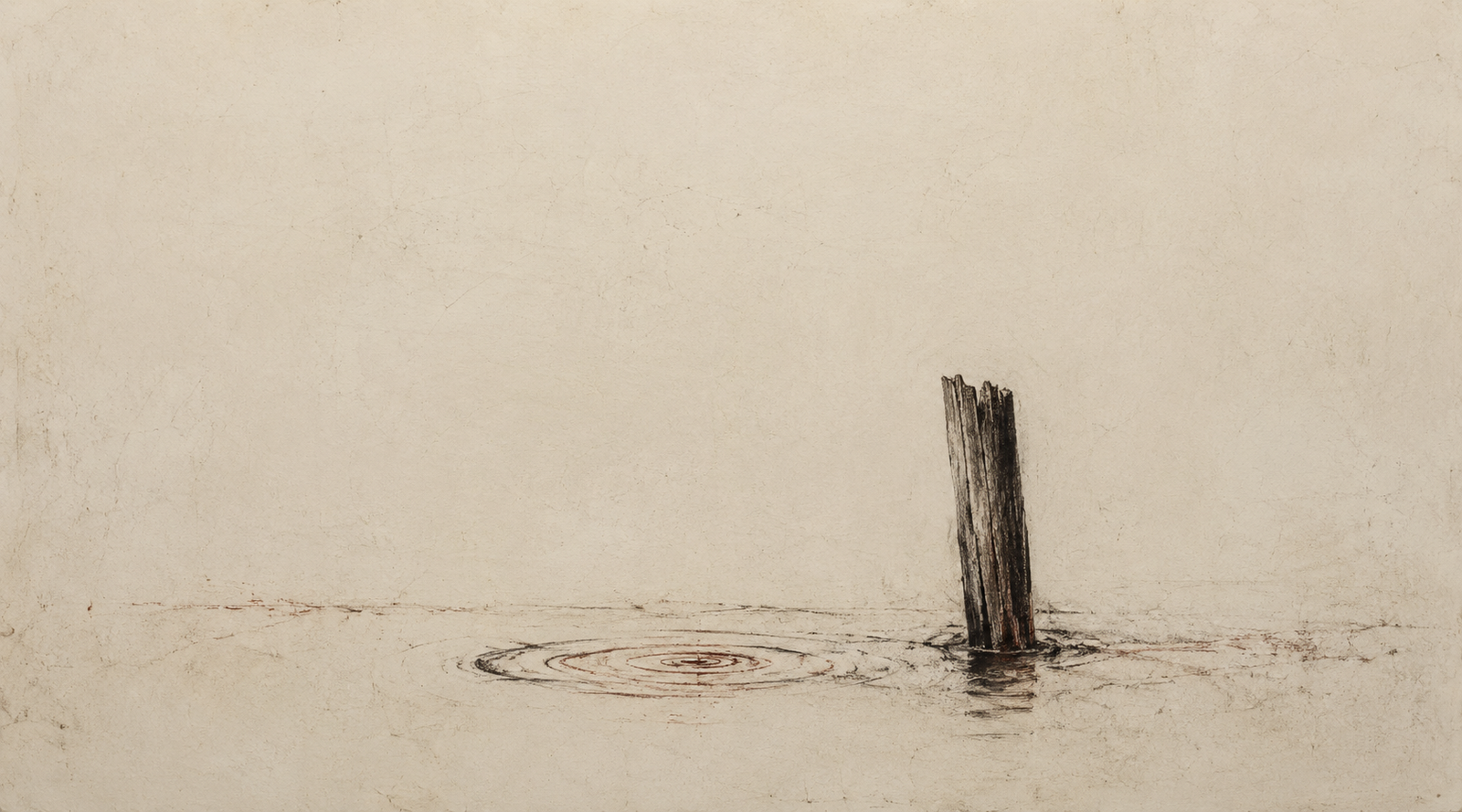
Some of Angkor’s most intimate ruins do not rise above the ground at all. They are postholes, low mounds, hearths and ponds: durable traces of a domestic city built largely from things that decay. To restore that city is to see Angkor not only as stone, but as wood, smoke, water, repair, and people living within calling distance.