
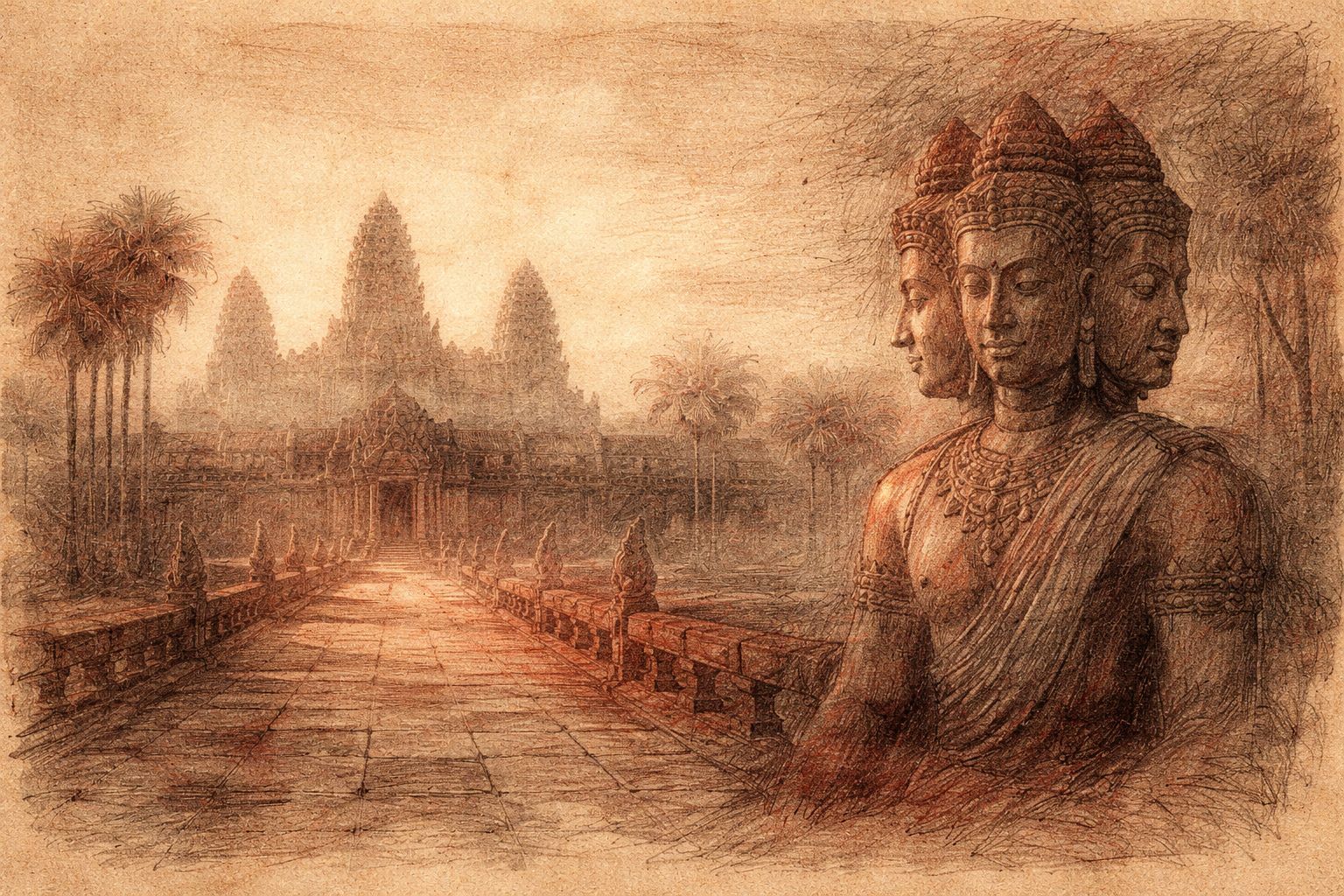

Brahma and the Quiet Order of Stone
Brahma is present in Angkor less as a figure than as a condition. He does not arrive with drama, nor does he linger in recognisable cult or procession. Instead, he is sensed where form first hesitates into being—where stone holds proportion before it carries narrative, where orientation precedes devotion. His presence is architectural before it is theological, structural before it is named.
In the reliefs, his four faces do not assert authority so much as attention. They do not confront the viewer; they survey. Each gaze is turned outward, aligned to a cardinal direction, as if creation itself were an act of sustained watching. Nothing here is expressive. There is no gesture of command. Brahma does not act upon the world so much as allow it to unfold within a measured frame. Creation is not urgency. It is calibration.
In Khmer stone, he is often heavier than his counterparts. The body settles downward. There is no suggestion of flight or combat. Even when seated among the Trimurti, his posture carries the weight of sequence rather than power. Vishnu preserves; Shiva releases. Brahma bears the interval between. He occupies the moment when possibility condenses into arrangement—when the abstract commits to dimension.
His origin myth mirrors this restraint. Born from the lotus rising from Vishnu’s navel during yoga-nidra, Brahma does not initiate creation through will. He emerges because conditions have aligned. The ocean is already present. The serpent already coils. Sleep already holds the god. From this stillness, the lotus lifts—not violently, not suddenly, but as a measured consequence. Brahma appears seated, not standing. The world begins not with movement, but with placement.
This logic is repeated in the temples themselves. The central tower does not explain its primacy. It simply stands where it must. From it, galleries radiate; courtyards unfold; causeways align. The vastupurusamandala does not narrate belief—it enacts it. Brahma’s role is embedded in the fact that everything else knows where to be. He is the unseen axis around which time and ritual turn.
The hamsa that carries him is rarely emphasised, yet its presence is telling. A creature of water and air, it does not belong wholly to either realm. It rests, floats, lifts, returns. In this, it mirrors Brahma’s own function. Creation is not escape from matter, nor surrender to it. It is the art of moving between states without being claimed by either. Breath does this constantly—ham and sa, rising and falling, naming itself without speech. Creation hums rather than declares.
In Angkor, Brahma’s relative absence of temples is not a diminution. It is fidelity to role. Creation is not something to be worshipped repeatedly; it happens once, and then again only after everything has been undone. Brahma belongs to thresholds that cannot be revisited at will. He appears at beginnings and disappears into structure. By the time the pilgrim arrives, his work has already been completed.
And yet he remains. In the careful spacing of towers. In the patience of proportion. In the refusal of excess. Where the temple holds together without strain, Brahma is present. Not as image, but as balance. Not as story, but as order quietly sustained.
—
Receive the next work
Subscribe free to receive new work from the Lucas Varro Library by email.
More from the Library


See Also
A concise and impartial dictionary of absence, promises, quarrels, ordinary objects, and the troublesome instability of words.
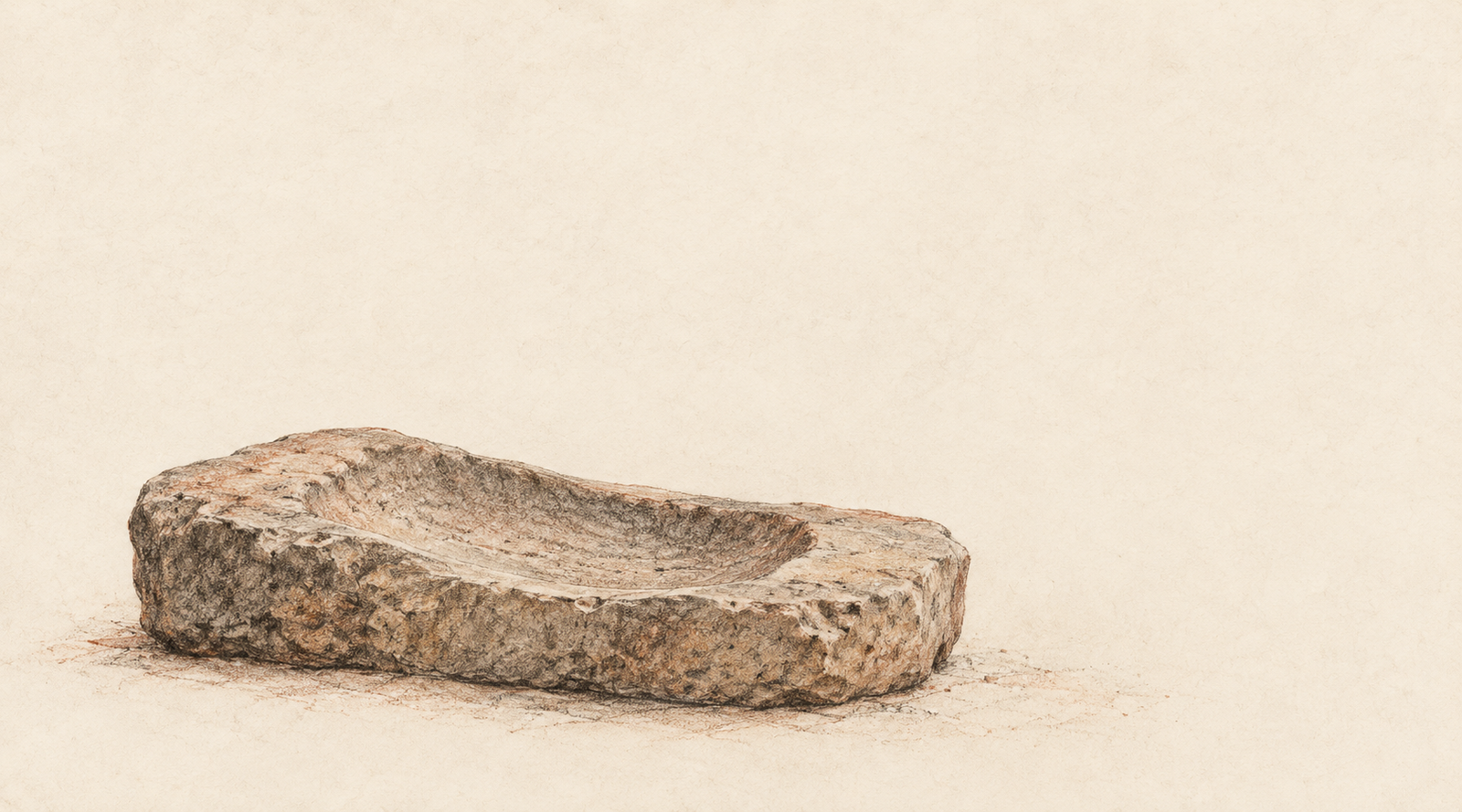

The City of Service
The temple we inherit is a building from which almost all necessity has been removed. Nothing must be brought for it to continue being what we call a temple. The sanctuary asks nothing of us. Stone is good at this kind of independence.
A living temple was otherwise.
Water had to come in. So did grain, cloth, oil, aromatic substances, fuel. The things required for worship arrived because someone carried them across a threshold.
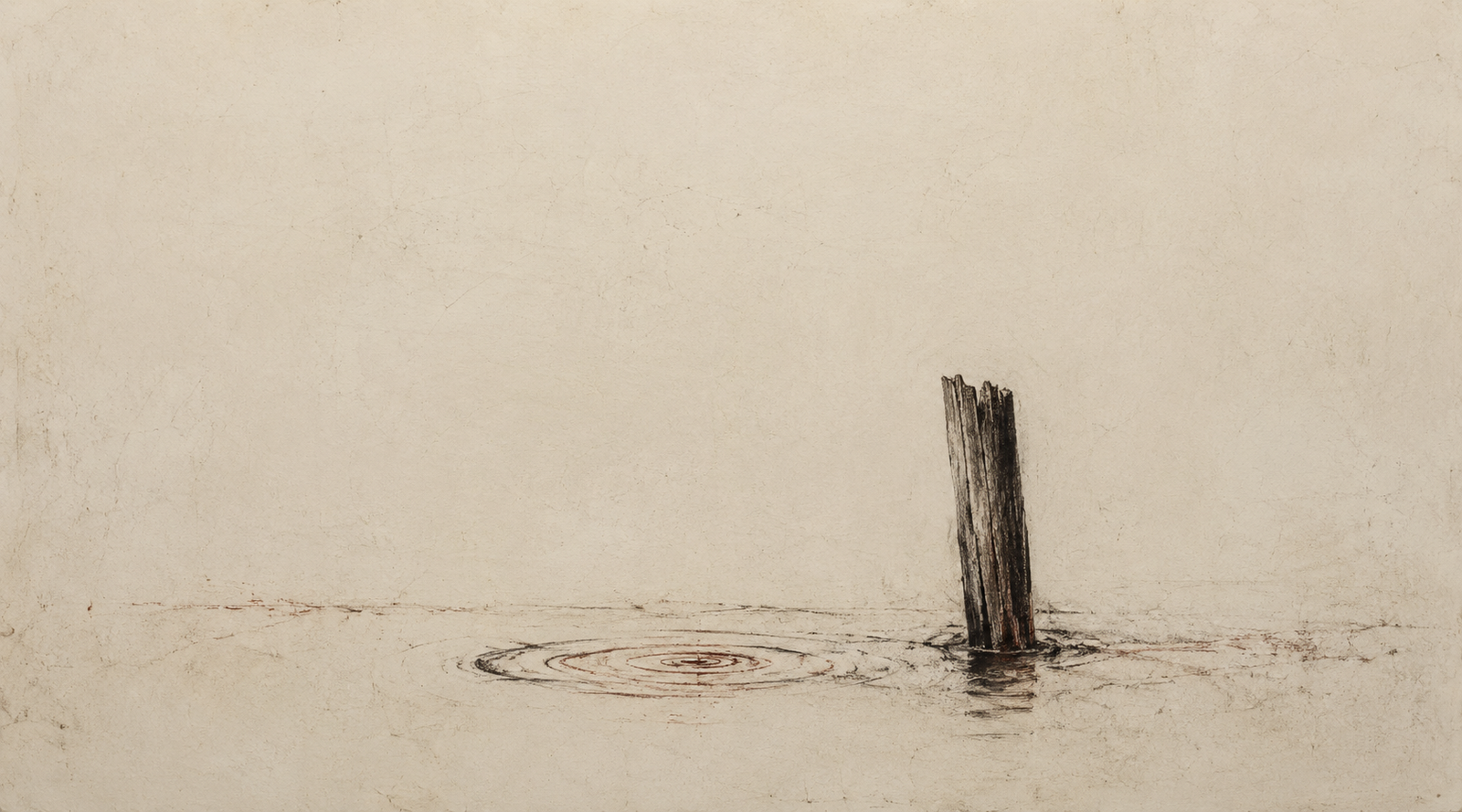

Houses of Wood, Light, and Smoke
Some of Angkor’s most intimate ruins do not rise above the ground at all. They are postholes, low mounds, hearths and ponds: durable traces of a domestic city built largely from things that decay. To restore that city is to see Angkor not only as stone, but as wood, smoke, water, repair, and people living within calling distance.