
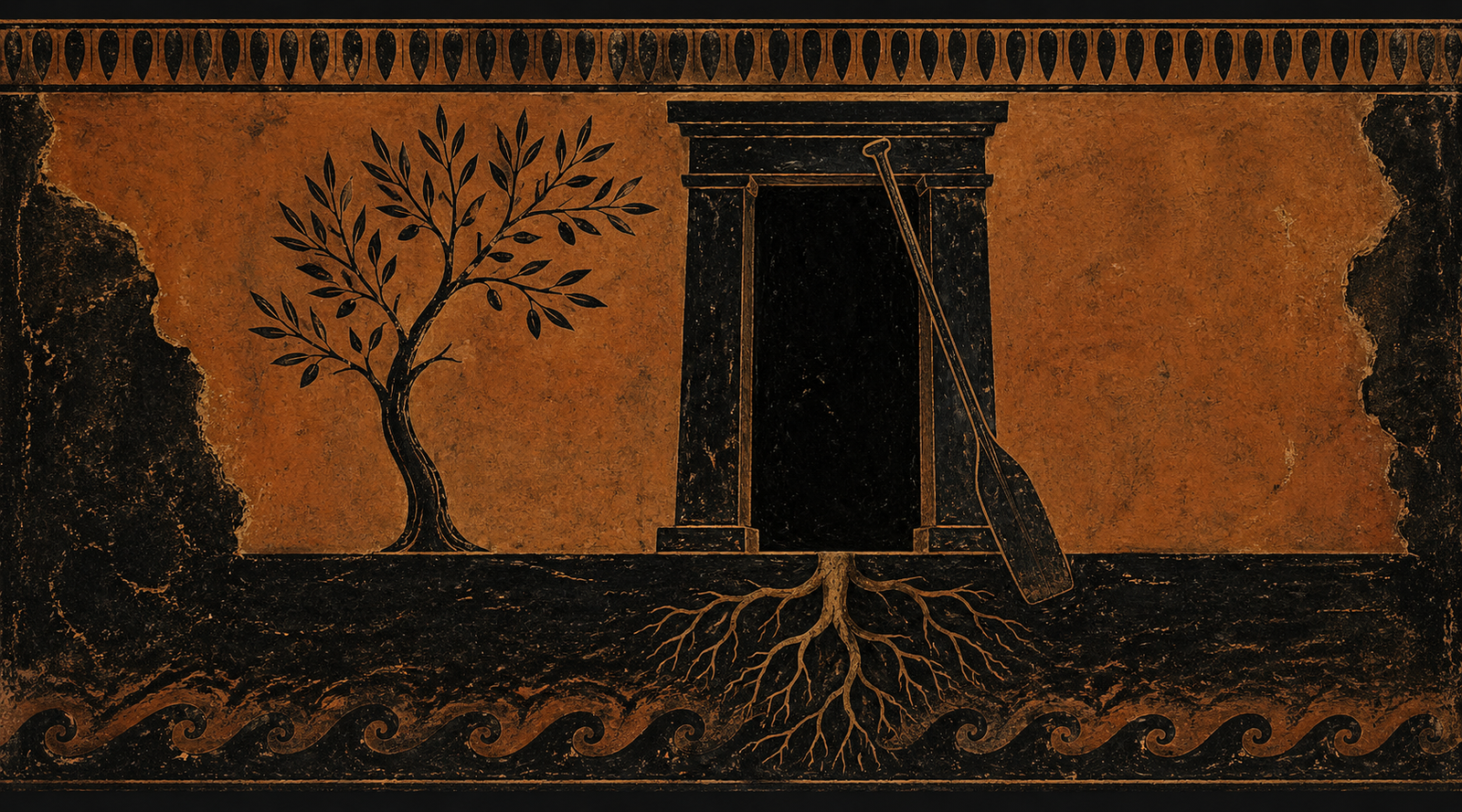

No Man Comes Home IV — The Stranger Washed Ashore
Naked, nameless, and reduced to need, Odysseus must re-enter the human world without terrifying it.
Girls came laughing into the morning.
That was how the human world returned to him.
Not with trumpets, not with armed men, not with a king’s summons or a wife’s cry from the threshold, but with bright voices near water, the slap of wet cloth against stone, mule-bells, baskets, sunlight, the small disorder of youth set loose from the house for necessary work and pleasure disguised as duty.
Nausicaa came among them like one whom childhood had not yet released and marriage had already begun to claim.
She was still at the age when a girl may run with servants and princesses both, when laughter can cross rank more easily because the future has not yet hardened every place. Yet she had dreamed in the night of linens, marriage, honour, the household awaiting her departure into another house. The goddess had placed the dream there. Gods often enter the young through the doors already opening.
So she came to the river with garments.
Her father’s robes. Her brothers’ tunics. Her own bright cloths. The visible order of a household carried in woven things.
They washed. They spread the garments over stones and bushes where the sun could complete the labour. Then they ate. Then, because the work had ended and the morning had not, they played.
A ball rose into the air.
For one breath, no one on the shore was thinking of kings, wars, suitors, shipwrecks, gods, or the long infection of absence.
The ball fell wide.
A cry followed it.
The girls’ voices struck the leaves.
Odysseus woke.
He did not know where he was.
This is one of the cruellest mercies of sleep: it returns the body before it returns the life. For a moment there is only breath, light, ache, the mouth dry with salt, the limbs heavy under leaves. Then memory comes back not as story, but as impact. Island. Raft. Storm. Water. Prayer. River. Dark. Leaves.
Still alive.
The knowledge hurt.
Survival often does.
He lay under the branches and listened.
Women’s voices.
Young.
Near.
The body understood danger before the mind arranged it. A naked man near young women is not yet a supplicant. He is first a threat. Rank cannot be seen beneath salt and leaves. Suffering is not innocence to those who must fear the body that carries it. If he rushed out, they would scatter. If he stayed hidden, he would remain animal and die perhaps of shame or cold or hunger. If he spoke from cover, he might seem more monstrous than if seen.
He needed clothing.
He needed food.
He needed passage.
He needed not to terrify those from whom he must ask mercy.
Odysseus gathered himself.
There was no dignity available to him. Only the choice of how to lose it.
He broke a branch thick with leaves and held it before his body. The gesture did not restore honour. It acknowledged the terms under which honour might someday return. He stepped from the thicket, salt-stiff, torn, swollen-eyed, hair fouled by the sea, skin marked by rock and weather, more like a thing dragged from wreckage than a man approaching speech.
The girls screamed and fled.
All but one.
Nausicaa stood.
Athena had put courage in her, but courage does not cancel fear. It only gives fear a body that does not immediately obey it. The princess stood by the river, bright clothes behind her, servants scattering among the stones, the stranger before her with leaves in his hands and the sea still written over him.
Odysseus saw her seeing him.
That mattered.
A man who has commanded armies and spoken before kings must learn, in one instant, how not to use the powers that once preserved him. Force would ruin him. Command would shame him. Complaint would lower him. Desperation would frighten her. Flattery would be visible if badly used. Truth would be too large if offered whole.
Speech must find a form that need does not corrupt.
He did not approach.
That was his first act of intelligence.
He knelt where he was, or nearly knelt; close enough to supplication that the law could recognise him, not so close that her body must decide between compassion and flight. He placed distance inside the plea. It was the only gift he possessed.
This is where civilisation begins: in the discipline of one’s need before another’s fear.
Then he spoke.
Not his name.
Names are power, and power had not been granted him here.
He spoke first as one uncertain whether he addressed a goddess or a mortal girl. This was courtesy, strategy, wonder, and protection together. If she were divine, reverence was owed. If she were mortal, honour lifted fear into relation. He praised without touching. He placed her beauty beyond ordinary measure, then bound his own need to the humblest requests: clothing, direction, pity.
He did not tell her who he was.
He told her what she needed to know in order not to fear mercy.
Shipwreck. Loss. No companions. Many days at sea. A stranger cast upon her land.
Nothing more.
His speech made a small shelter around both of them.
Nausicaa listened.
She was young, but not foolish. The palace had taught her rank; the dream had taught her marriage; the gods had taught her this morning without telling her why. She understood that the man before her was ruined, and that ruin had not made him low. His words had come from a body almost emptied of everything except measure. That impressed her more than splendour would have done.
A beautiful man in fine clothes requires no courage from the eye.
A ruined man who can still speak with restraint asks the soul to declare itself.
She declared it.
“Stranger,” she said.
The word did not save him.
It received him into law.
She reminded the girls of what they had forgotten in fear: that beggars and strangers come from Zeus, that little gifts are dear to those who have nothing, that the man was not to be treated as an animal because the sea had made him look like one. She ordered food, clothing, oil. She gave commands with the first clear outline of the woman she would become.
The servants returned.
Slowly.
Fear, once scattered, does not gather at once. They looked at the stranger from the sides of their faces, ashamed perhaps of having run, not yet ashamed enough to come near without glancing at one another. But Nausicaa’s courage had made a road for them. They obeyed because she had stood.
Odysseus withdrew to wash.
There are washings that cleanse.
This was not one of them.
Water took salt from his skin, mud from his limbs, some of the storm from his hair. Oil entered the body like remembered civilisation. Cloth covered him. The naked threat became a stranger. The stranger became nearly a man. But no water can wash away what brought the body to the river. Cleanliness is not restoration. It is only the first lie mercy tells kindly enough to be useful.
Athena touched him then.
Not with softness.
With appearance.
The body that had seemed broken took on proportion again. His shoulders recovered their old authority. His hair fell with something like brightness. His face, cleared of salt and distortion, became difficult to dismiss. The girls looked again and saw not the same man improved, but the danger of having misread him.
Nausicaa saw too.
Beauty is not harmless when it returns to a powerful man.
A moment earlier, he had needed her mercy. Now the world had begun rearranging itself around him. She felt the shift and did not mistake it. The gods had set before her a stranger who might be noble, perhaps kingly, perhaps touched by divinity, certainly marked by suffering. In another kind of story, this would have become fulfilment.
In this one, it became instruction.
She wished aloud, almost to herself and almost to the servants, that such a man might be called her husband.
The wish was innocent.
That did not make it simple.
Odysseus heard enough.
He knew the danger of houses before he entered them. A girl’s kindness can become rumour in a city quicker than a ship crosses harbour. A stranger seen beside the king’s daughter can become a story before the stranger has spoken his name. Honour, once stirred, does not ask whether innocence intended injury.
Nausicaa knew this also.
Her grace lay not only in helping him, but in understanding the cost of being seen helping him.
She told him how to enter the city.
Not beside her.
Behind.
At a distance.
She would go first with the mule-cart, garments folded, servants restored to order. He would wait in the grove of Athena until time and separation made their arrival less dangerous to her name. Then he would come to the palace. He must pass the people. He must ignore their looks. He must go directly to her mother, Arete, queen of the house. He must clasp her knees. Mercy, if it came, would come through the woman whose judgement governed the inner strength of the court.
Nausicaa did not know how much she had revealed.
In every true house, the visible king is not always the first door.
Odysseus listened carefully.
Here again, the old gift returned: not force, not rank, not even courage, but attention sharpened by need. He received the map as one receives a weapon. Grove. City. Palace. Queen. Knees. Words. Timing. Silence.
A man without a ship must make a vessel of instruction.
They ate.
Hunger is humiliating because it interrupts grandeur. No matter what one has endured, the body still asks for bread. Odysseus ate as one who had been returned to the lower laws. Food first. Then speech. Then road. This, too, belonged to hospitality. The body must be honoured before the story is demanded.
When he had eaten, he blessed her.
Here speech became dangerous again.
A blessing from a ruined stranger can carry more weight than praise from a safe man. He wished her a husband, a house, concord, the deep good of two minds joined in one dwelling. He spoke of marriage not as possession, nor beauty’s reward, but as the rare order by which a house can stand against the world.
He was thinking of Penelope.
Nausicaa may have known this.
Or perhaps she only felt that the blessing had passed through some older grief before reaching her.
The morning changed.
The garments had dried. The mules were yoked. The servants gathered what must be gathered. Nausicaa climbed into the cart, no longer merely the laughing girl of the river, not yet the wife her dream had summoned, but altered by having stood between fear and mercy.
Odysseus remained by the shore until she had gone ahead.
That distance was part of her gift.
He followed later, under the goddess’s concealment. Mist gathered around him, not because he was ashamed, but because a stranger entering a city carries danger on both sides. The city may harm him. He may disturb the city. Concealment is sometimes the only way mercy reaches the right door.
Scheria rose before him.
The Phaeacians lived close to the gods and far from ordinary ruin. Their ships knew the sea too well. Their orchards gave in season and beyond season. Their walls stood secure. Their houses shone. It was a people skilled in passage, feasting, song, and the polished arts of receiving those whom the sea delivered. They were almost too fortunate to understand the man approaching them.
Almost.
Odysseus passed through streets where no one saw him clearly. Athena’s mist kept eyes from fastening. Children, men, women, workers, sailors, voices, wheels, animals, smoke: the dense human order moved around him, near enough to touch, withheld enough not to claim him. After the island, after the storm, after leaves and nakedness, the sight of a city was nearly unbearable.
Not because it was grand.
Because it was inhabited.
Every doorway reminded him of the door he had not yet reached. Every household noise struck against the silence of Ithaca as he imagined it and did not imagine it rightly. He saw men going home without ceremony, women carrying baskets, servants laughing, elders seated in public ease. Ordinary life wounded him more sharply than marvels. Monsters could be fought, deceived, escaped, endured. But an ordinary evening in a city not his own opened the place in him where home had become both desire and accusation.
He came to the palace.
Its splendour would later be described, because men enjoy naming abundance: bronze walls, golden doors, silver posts, dogs of precious metal, orchards rich beyond season, servants swift as thought, lamps burning like contained stars. Such things mattered. Wealth is one language by which a house tells the stranger what power he has entered.
Odysseus saw them.
But he did not stop for wonder.
Need has a narrower eye.
He crossed the threshold.
Inside, the Phaeacian lords sat at their feast. Cups passed. Voices rose. Order held. This was not the corrupted feast of Ithaca. No man here ate another man’s house under the mask of courtship. The abundance had legitimacy in it. It did not stink of theft.
Odysseus moved through them unseen until he reached the queen.
Then the mist fell.
A stranger appeared in the hall.
The feast stopped.
That is the old power of supplication: it interrupts every order except the one older than rank.
Before any man could measure him, Odysseus clasped Arete’s knees.
He had come to a queen through the instruction of a girl. He had entered a palace by concealment and made himself visible at the lowest possible height. This is the paradox of supplication: the man kneels so that his humanity may stand.
He spoke.
Again, not everything.
Never everything.
He named suffering without arranging it into glory. He named the goddess who had held him, the sea that had broken him, the girl who had guided him. He asked for passage home. He did not first ask to be admired. He asked to be sent.
Home.
The word entered the hall and changed it.
For those who are safe, home is often background. It waits unexamined while feasts proceed, while songs are sung, while ships are prepared for other men. But when a stranger kneels in a shining hall and asks for conveyance to his own land, every listener is required to remember that safety is not universal. The word home becomes visible only when someone has been kept from it.
The Phaeacians looked at him.
Some saw ruin.
Some saw nobility.
Alcinous saw enough to rise.
Arete saw more.
Queens often do.
Her eyes moved not first to the man’s face, but to the garments. Women know the history of cloth. She recognised the work of her own household, the garments washed that morning by her daughter’s hands, now covering the stranger kneeling before her. Cloth had betrayed the path mercy took.
“Stranger,” she said, “where did you get these clothes?”
The question was simple.
Therefore dangerous.
Odysseus understood at once that the truth must be arranged without harming the girl who had saved him. This is the work of speech in a world where innocence can be damaged by appearance. He told the story carefully: shipwreck, river, Nausicaa, food, clothing, direction. He made clear that the girl had acted with honour. If he came alone, it was because she had preserved her name as well as his need.
Speech carried strategy.
The strategy protected truth.
Arete listened.
Alcinous listened.
The hall listened.
The stranger had passed the first test: not merely suffering, not merely eloquence, but the ability to receive mercy without making it dangerous for the merciful.
That is rarer than gratitude.
The king offered him honour, seat, food, and then what he had asked for: passage. Ships would take him. Phaeacian sailors knew the sea’s roads better than other men know the paths between fields. If he desired home, home would be made reachable.
Odysseus did not weep.
Not then.
Hope, in public, must be handled with discipline.
They gave him food. They gave him a place beside the king. They poured wine. The hall resumed, but not as before. A stranger’s need had entered it. Hospitality had become more than splendour. It had become obligation.
Outside, night deepened.
Inside, song waited.
There would be games, gifts, questions, a bard whose voice opened Troy like a wound, and at last the tale Odysseus would tell about himself. But not yet. For one night he sat unnamed among people who honoured him without possessing him.
That was a mercy.
A dangerous one.
Because every kindness shown to the concealed man brings him nearer the moment when concealment must become story.
He ate.
He listened.
He kept his name.
The king beside him did not know whom he had honoured. The queen did not yet know what grief had entered under her daughter’s cloth. The singers did not yet know what song would do to the stranger when Troy returned in another man’s mouth. The Phaeacians, safe in their shining house, did not yet know that they were receiving the man whose passage home would cost them the favour of the sea.
No one knew enough.
That was why the night could still be beautiful.
Odysseus sat among them, clothed, fed, unnamed, almost restored.
Almost.
The body had been washed.
The story had not.
—
No Man Comes Home is a twelve-canto literary retelling of The Odyssey within The House of Cadmus: a poem of return, concealment, recognition, and the cost of surviving long enough to come home.
—
Receive the next work
Subscribe free to receive new work from the House of Cadmus Library by email.
More from the Library


See Also
A concise and impartial dictionary of absence, promises, quarrels, ordinary objects, and the troublesome instability of words.

The City of Service
The temple we inherit is a building from which almost all necessity has been removed. Nothing must be brought for it to continue being what we call a temple. The sanctuary asks nothing of us. Stone is good at this kind of independence.
A living temple was otherwise.
Water had to come in. So did grain, cloth, oil, aromatic substances, fuel. The things required for worship arrived because someone carried them across a threshold.

Houses of Wood, Light, and Smoke
Some of Angkor’s most intimate ruins do not rise above the ground at all. They are postholes, low mounds, hearths and ponds: durable traces of a domestic city built largely from things that decay. To restore that city is to see Angkor not only as stone, but as wood, smoke, water, repair, and people living within calling distance.