
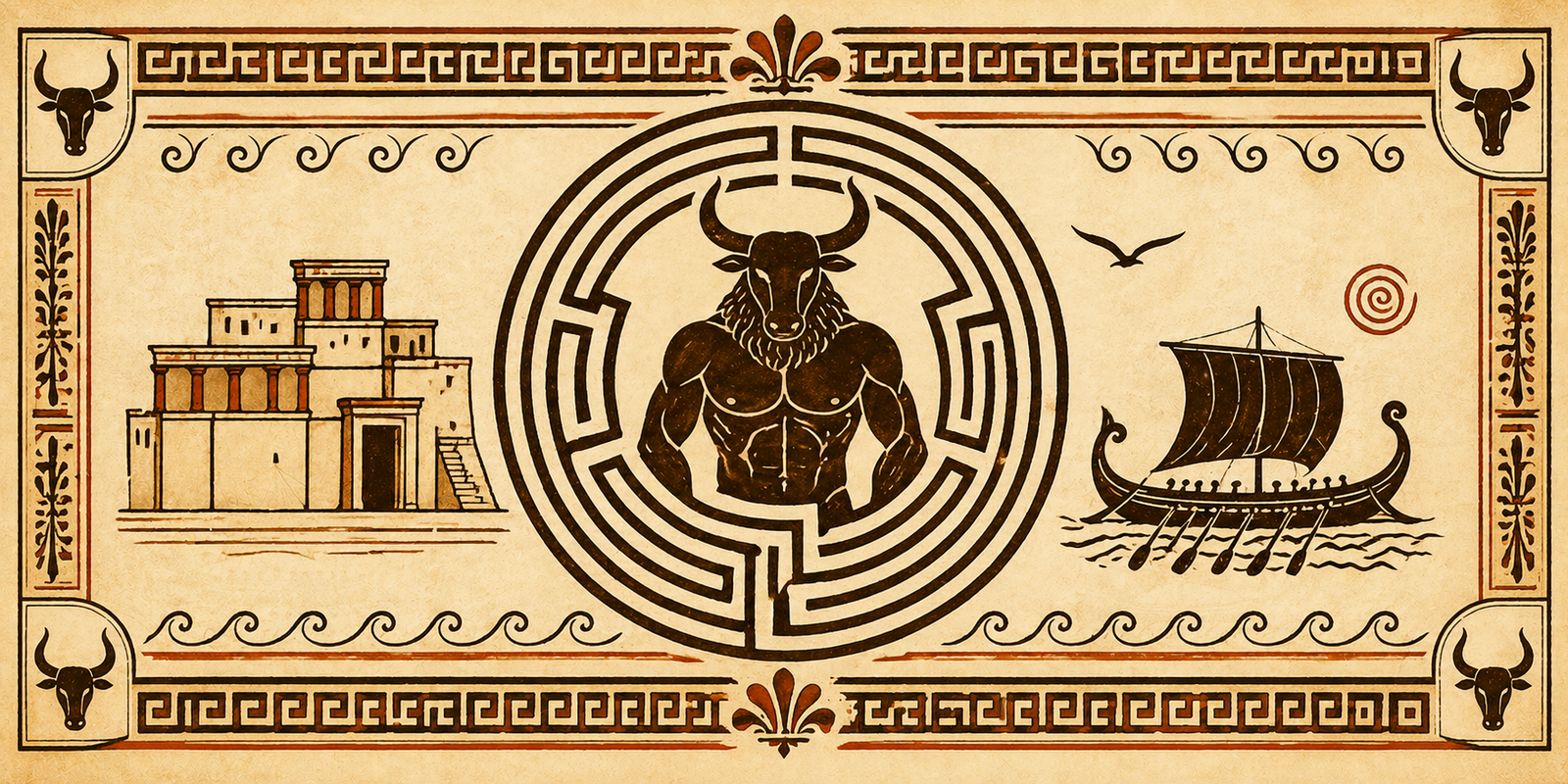

The Minotaur: The Monster at the Centre of the Labyrinth
Before Theseus enters the Labyrinth, meet the monster hidden beneath the palace of Crete.
Before the Tale
Before Theseus enters the Labyrinth, before Ariadne gives him the thread, before the dark begins to turn and twist around him, there is the Minotaur.
Not just a monster.
That is the first thing to understand.
Greek myths have many monsters. Some live in caves. Some rise from the sea. Some guard gates, haunt lonely places, or wait at the edge of the known world. But the Minotaur is stranger than many of them because he is not only a danger hiding in the dark.
He is a secret.
He belongs to a palace, a king, a queen, a craftsman, a god’s anger, and a family that tried to hide what had gone wrong.
That is why his story is frightening. Not because he has horns, though he does. Not because he waits in the Labyrinth, though he does. The Minotaur is frightening because grown-ups with crowns, servants, guards, and beautiful painted walls decided that something terrible could be shut away and fed.
In Greek myth, this almost never works.
The Short Answer
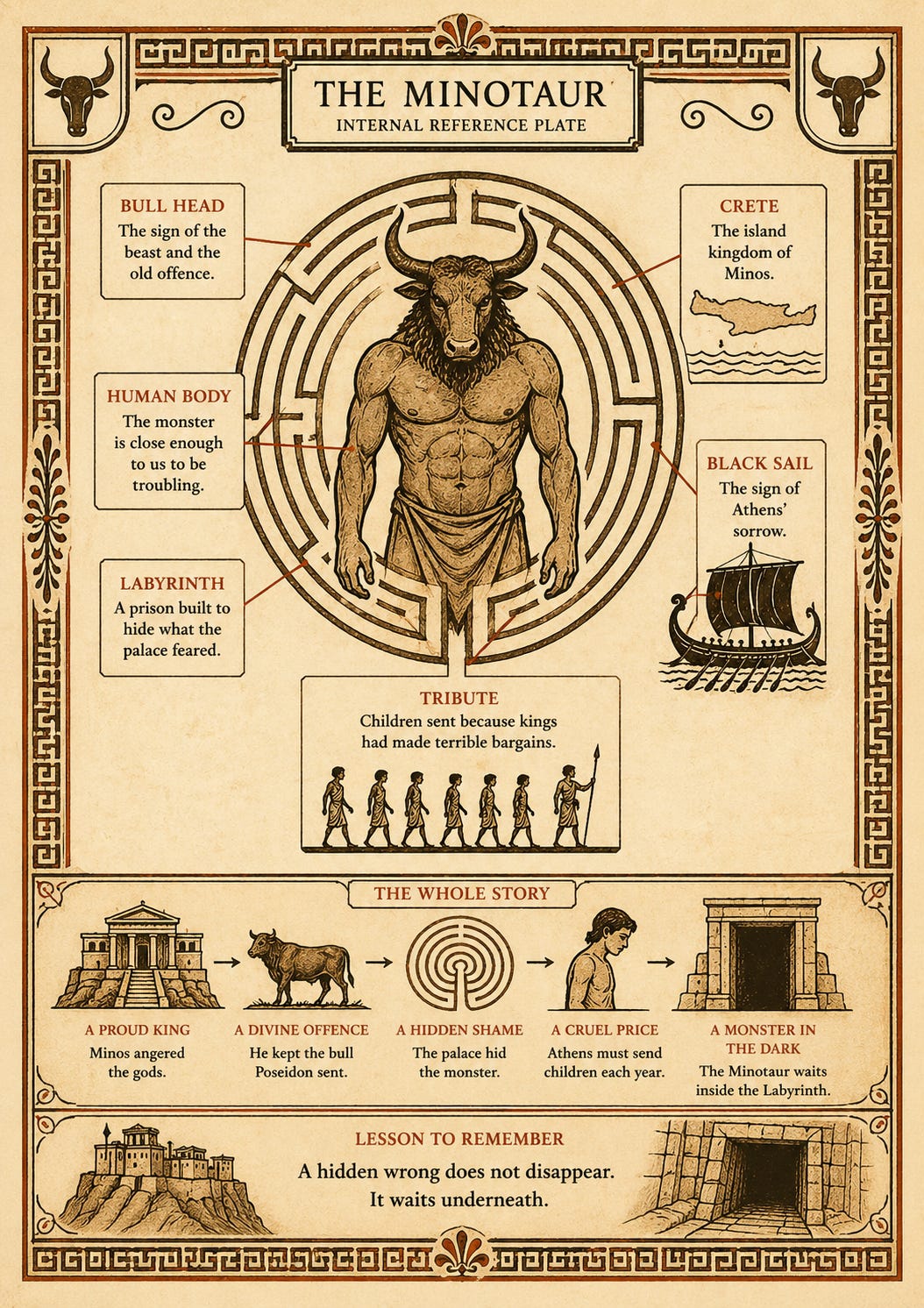
The Minotaur is a creature from the island of Crete: part man, part bull, and kept hidden inside the Labyrinth beneath or beside the palace of King Minos.
His name means “the bull of Minos.”
He is at the centre of the story of Theseus because Athens must send young people to Crete as tribute, and those young people are given to the Labyrinth.
No one sent into the Labyrinth is expected to come out again.
What You Need to Know Before the Story
Crete was a powerful island kingdom. Its king was Minos, who wanted everyone to know that he had the favour of the gods.
This was often a dangerous thing for a king to want.
One story says that Minos asked Poseidon, god of the sea, to send him a marvellous bull from the waves as a sign that he should be king. Poseidon sent the bull. It was magnificent — strong, bright, impossible to ignore.
Minos was supposed to sacrifice it back to the god.
He did not.
He kept it.
This was a very Minos sort of mistake: proud, greedy, royal, and extremely unwise. When gods give gifts in Greek myth, it is best to pay attention to the conditions attached.
Poseidon was not pleased.
After that, a strange punishment fell on the royal house of Crete. Queen Pasiphae gave birth to a child who was not fully human and not fully animal: the Minotaur.
The palace now had a problem it could not turn into a song of glory.
So Minos hid it.
He ordered Daedalus, the greatest craftsman of Crete, to build a prison so clever that no one placed inside it could find the way out. Daedalus built the Labyrinth — a maze of passages, turns, doors, chambers, and false ways, made not only to hold the Minotaur, but to confuse anyone who entered.
A monster can be dangerous.
A monster hidden by a king is worse.
What Kind of Trouble This Brings
The Minotaur brings the kind of trouble that grows when people refuse to face what they have made.
King Minos does not kill the creature. He does not heal the wrong. He does not confess it, mend it, or bring it into the light.
He hides it.
Then he makes other people pay for it.
That is why the Minotaur’s story is not only about a hero fighting a monster. It is about a whole house built around concealment. The palace above may be bright, painted, royal, and full of ceremony. Below, or deep within it, the Labyrinth waits.
Children should notice this.
In Greek myth, beautiful houses are not always safe houses. Kings are not always wise. A secret placed at the centre of a kingdom does not stay asleep forever.
It begins to breathe in the dark.
Signs to Watch For
When you meet the Minotaur in a story, watch for these signs:
The bull
Bulls in Greek myth are powerful, dangerous, sacred, and often connected to gods, kingship, sacrifice, and the sea. A bull is never merely a farm animal in these stories. It may be a sign of strength, pride, or divine anger.
The Labyrinth
The Labyrinth is not just a maze. It is a building made to defeat memory. It turns walking into confusion. It makes courage difficult because courage usually wants to go forward, while the Labyrinth keeps asking, “Are you sure this is the way?”
The locked secret
The Minotaur is hidden because his existence shames the royal house. When a myth places a monster inside a palace, it is asking us to look carefully at the people who built the walls.
The tribute
Athens must send young people to Crete. This is one of the cruelest parts of the story, and the tale does not need to make it loud. It is terrible enough as it is.
The thread
The Minotaur belongs to the dark centre of the story. The thread belongs to the way out. Remember both. A sword may help Theseus face the monster, but something much quieter will help him return.
When You Read the Tale
When you read Theseus and the Thread, do not think only about whether Theseus is brave enough to enter the Labyrinth.
Ask another question too.
Is courage enough, if you cannot find your way back?
That is what makes this tale different from many monster stories. The monster matters, of course. The Minotaur is real. The danger is real. The darkness is real.
But the Labyrinth is also part of the danger.
A hero who only knows how to strike may win the fight and still be lost.
Theseus will need courage. He will need strength. He will need a clear heart. But he will also need help from someone who understands the Labyrinth better than he does.
That help will not look like thunder.
It will look like a thread.
One Thing to Remember
The Minotaur is not only the monster at the centre of the Labyrinth; he is the secret a king tried to hide, until someone brave enough had to enter the dark and face it.
—
Receive the next work
Subscribe free to receive new work from the The Alexander Series Library by email.
More from the Library

See Also
A concise and impartial dictionary of absence, promises, quarrels, ordinary objects, and the troublesome instability of words.

The City of Service
The temple we inherit is a building from which almost all necessity has been removed. Nothing must be brought for it to continue being what we call a temple. The sanctuary asks nothing of us. Stone is good at this kind of independence.
A living temple was otherwise.
Water had to come in. So did grain, cloth, oil, aromatic substances, fuel. The things required for worship arrived because someone carried them across a threshold.

Houses of Wood, Light, and Smoke
Some of Angkor’s most intimate ruins do not rise above the ground at all. They are postholes, low mounds, hearths and ponds: durable traces of a domestic city built largely from things that decay. To restore that city is to see Angkor not only as stone, but as wood, smoke, water, repair, and people living within calling distance.