

Yama — The Weight That Balances
Death at Angkor is not a rupture.
It is an accounting.
Where fire transforms and water sustains, there remains a final power whose task is neither to burn nor to nourish, but to weigh. Yama stands at that threshold. He is the guardian of the southern territories, the sovereign of the departed, and the one who ensures that nothing—neither virtue nor transgression—passes without measure.
In the Vedic world, Yama is the first to die. From that death, time itself begins. Grief demanded sequence; sequence demanded night; and night made room for return. Death did not end the world—it organised it. Yama’s domain is therefore not annihilation but order: the invisible structure that allows consequence to follow action.
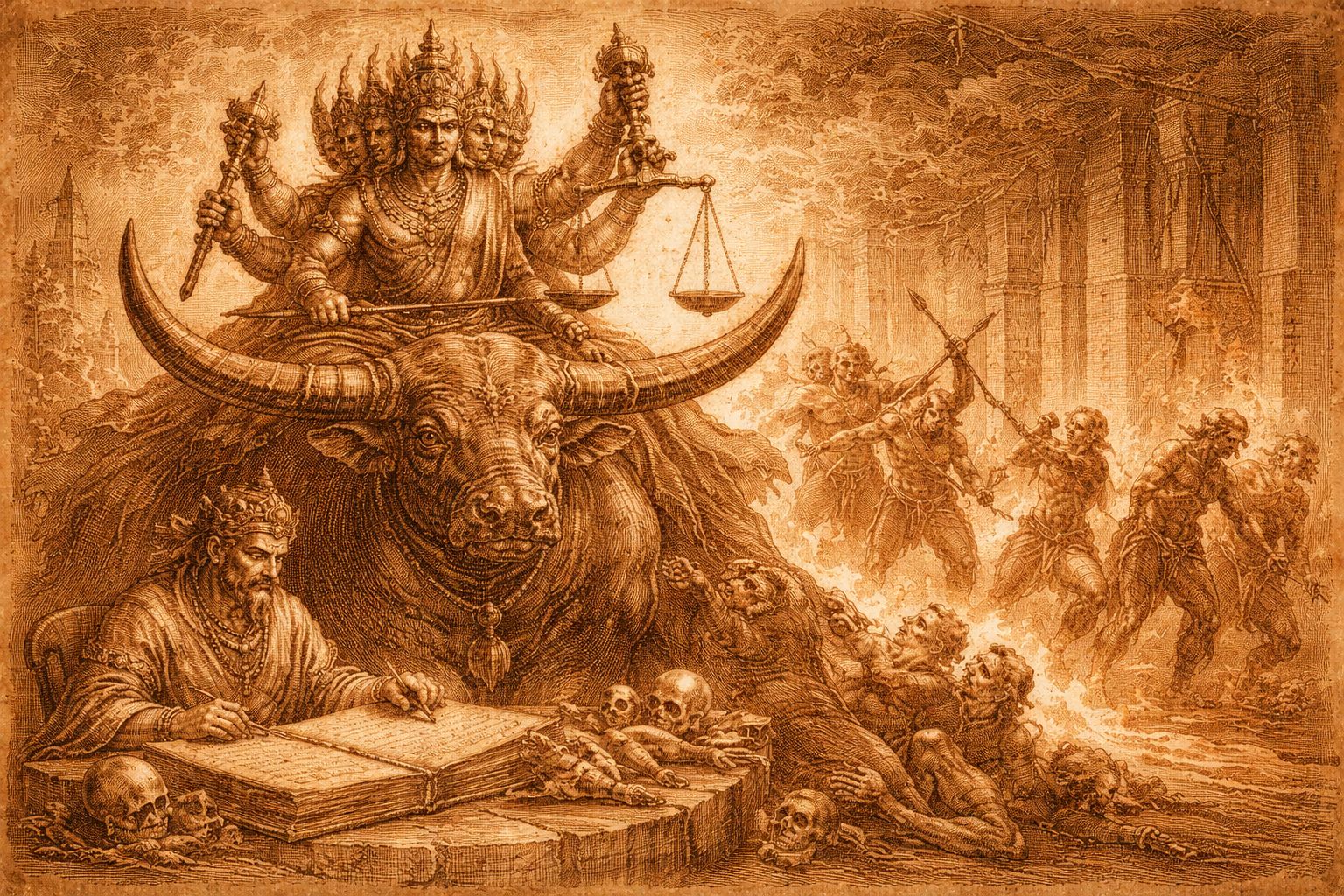
As Dharmaraja, Lord of Justice, Yama presides as supreme arbitrator. Souls are brought before him not to be accused, but to be read. Their lives are opened like ledgers, every intention inscribed, every deed tallied. The judgement is exacting, yet impersonal. Yama does not invent punishments; he assigns destinations. The Heavens and the Hells are not rewards or cruelties, but outcomes—spaces where imbalance is corrected.
This vision reaches its most formidable expression at Angkor Wat, where the great bas-relief of the Heavens and Hells unfolds along the southern gallery. Here, Yama appears enthroned, many-armed, seated upon his black water-buffalo—his vahana—holding sixteen swords. The image is not theatrical. It is administrative. Multiplicity of arms is not rage; it is capacity. Justice requires reach.
At his side stands Citragupta, the recorder of deeds, whose task is to read aloud what has already been written by life itself. In this court there is no persuasion. Speech is redundant. The record suffices.
Yet Khmer thought did not fix Yama solely in darkness. Though anciently bound to the South—the direction of the dead—his symbolism later turns toward the northeast, a quarter associated with return and rebirth. Justice, here, is not terminal. It is transitional. To be judged is not to be erased, but to be placed correctly within the cycle.
This alignment of royal and cosmic authority is deliberate. The earthly king guarantees dharma among the living; Yama guarantees it beyond the last breath. In Angkorian ideology, the two mirror one another. The throne and the judgement seat differ only by altitude.
That continuity persists into lived ritual. During Pchum Ben, the Fortnight of the Dead, Yama is not invoked as a terror but as a merciful sovereign—one capable of easing the suffering of wandering spirits and allowing them to move onward. Even the hungry dead are not abandoned. They are delayed.
Justice, in the Khmer imagination, also descended into the everyday. When human evidence failed, truth was entrusted to the gods through the judgement of heaven, enacted at Prasat Suor Prat. There, disputants were confined in stone towers and left to the verdict of the unseen. Illness or health became testimony. The body, once again, was read as a ledger.
Yama presides over this entire architecture of consequence. He does not delight in suffering. He does not hunt souls. He waits. His buffalo does not charge; it endures. His weapons are not swung; they are counted. The terror he inspires is not fear of death, but fear of imbalance—of a life left unweighed.
To walk Angkor attentively is to feel this presence beneath the splendour. Stone teaches proportion; water teaches patience; fire teaches restraint. Yama teaches that nothing escapes meaning. Every action casts a shadow. Every shadow returns to its source.
Death, here, is not the end of the path.
It is the place where the path is finally measured.
—
Receive the next work
Subscribe free to receive new work from the Lucas Varro Library by email.
More from the Library


See Also
A concise and impartial dictionary of absence, promises, quarrels, ordinary objects, and the troublesome instability of words.

The City of Service
The temple we inherit is a building from which almost all necessity has been removed. Nothing must be brought for it to continue being what we call a temple. The sanctuary asks nothing of us. Stone is good at this kind of independence.
A living temple was otherwise.
Water had to come in. So did grain, cloth, oil, aromatic substances, fuel. The things required for worship arrived because someone carried them across a threshold.

Houses of Wood, Light, and Smoke
Some of Angkor’s most intimate ruins do not rise above the ground at all. They are postholes, low mounds, hearths and ponds: durable traces of a domestic city built largely from things that decay. To restore that city is to see Angkor not only as stone, but as wood, smoke, water, repair, and people living within calling distance.