
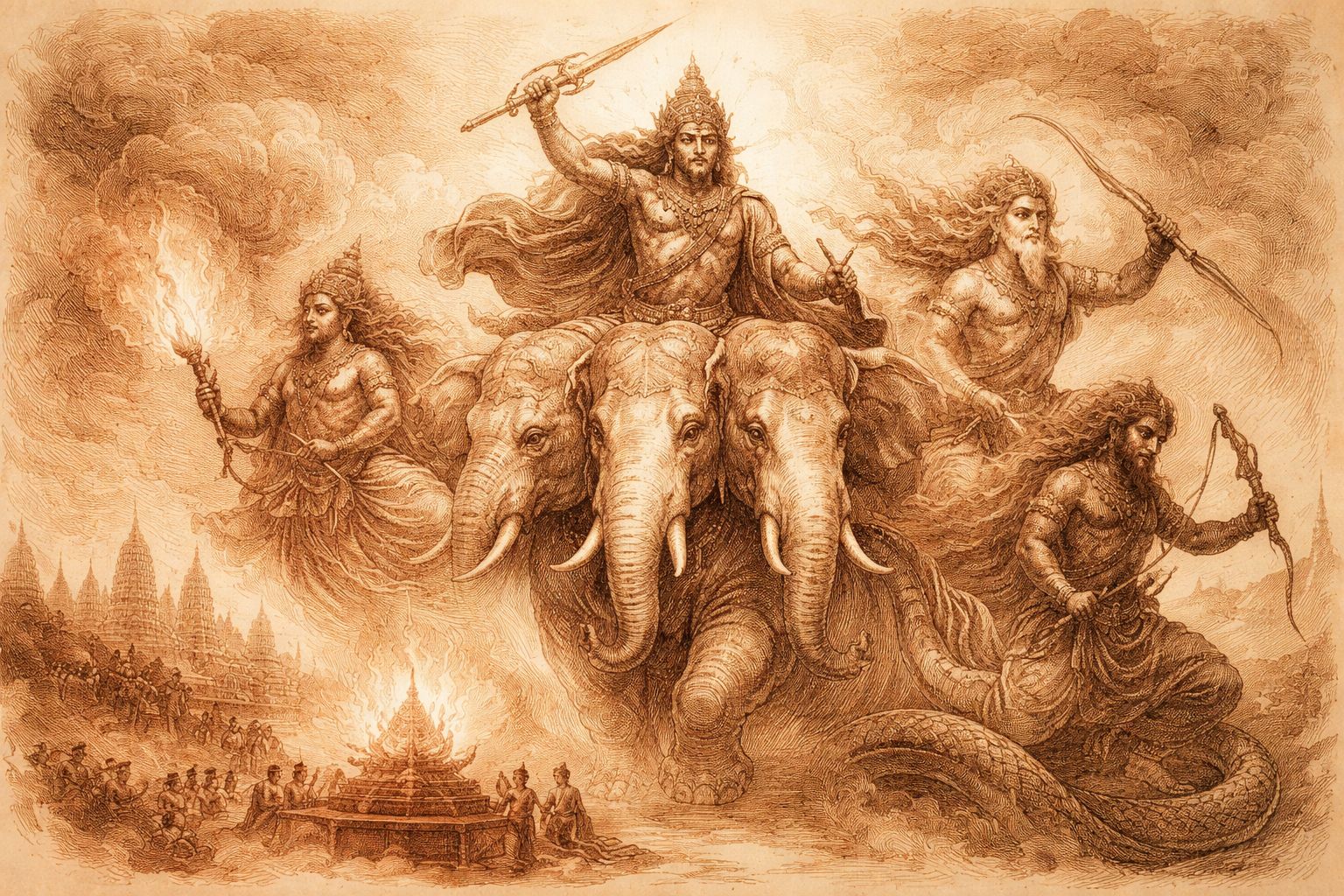

The Vedic Gods — Voices Before Stone
Before temples learned to hold silence, the gods arrived as weather.
They came without walls or enclosures, without threshold or tower. They came in wind and fire, in rain striking dust, in the blinding lift of the sun and the long withdrawal of the moon. The earliest gods of India did not inhabit sanctuaries; they moved across open ground, spoken into being by voice alone. They belonged to a people who travelled, who carried their world in breath and memory rather than stone.
These were the Vedic gods, preserved in the hymns of the Vedas, most vividly in the Rig Veda—a literature not of images but of invocation. Reality, in these texts, does not appear as a single face but as a manifold presence, endlessly named, endlessly addressed. Fire is not merely fire; it is Agni, mouth of the gods. Wind is Vayu, breath made visible. Rain is the action of Indra, victory falling from the sky.
The people who carried these hymns—the early Indo-Aryan pastoral communities—were not builders of cities but travellers between them. Their gods reflect this condition. They are mobile, restless, elemental. They govern skies rather than soil, forces rather than places. Unlike the land-bound spirits of older agricultural cultures, the Vedic deities rule what cannot be owned: storm, flame, light, moral order, time itself.
At the centre of this pantheon stands Indra, king of the gods, wielder of the thunderbolt, destroyer of fortresses. He is not a distant metaphysical principle but an active presence—drinking soma, riding into battle, breaking open the clouds to release rain. In him, sovereignty is inseparable from action. Power proves itself by effect.
Between gods and humans stands Agni, the fire that receives offerings and carries them upward. Without Agni, there is no communication. Sacrifice is not symbolic; it is logistical. The world is sustained through exchange. Humans feed the gods; the gods return order—seasonal rains, fertility, protection. The cosmos remains upright because ritual keeps it so.
Over this system presides Varuna, guardian of moral law and cosmic truth. His authority is quieter than Indra’s, but deeper. Varuna binds through oath rather than force, ensnaring falsehood with an invisible noose. He represents an early intuition that order is ethical before it is architectural.
At the margins howls Rudra, god of storms, disease, and wild places. Feared and propitiated rather than embraced, Rudra dwells beyond settlement, in forests and thresholds. From this dangerous, untamed figure will later emerge Shiva, transformed but never fully domesticated.
Yet this early world does not remain fixed. As centuries pass, attention turns inward. The external drama of sacrifice yields to the inward search for the Self. In the Upanishadic vision, the many gods begin to thin into principle. The supreme reality is no longer Indra’s storm or Agni’s flame, but Brahman, the unchanging ground beneath all names. The gods do not disappear; they are relativised.
By the time Hindu thought crystallises around the Trimurti—Brahma, Vishnu, and Shiva—the old Vedic gods have ceded primacy. Indra’s fall is especially telling. Once unrivalled, he becomes vulnerable, humbled in myth after myth, reminded that his kingship is temporary, cyclical, and ultimately illusory. Even Krishna assumes his worship, sheltering humans from Indra’s unruly storms.
And yet—when Indian cosmology travels east, crossing forests and seas into Cambodia, these gods find new work.
In the Khmer world, the Vedic deities are reorganised rather than erased. They become Dikpalas, guardians of the directions, anchoring space itself. Indra takes his place in the east, the direction of sunrise and royal approach. Varuna guards the west, lord of waters and setting light. Their authority is no longer supreme, but it is structural.
Khmer kings, adopting the ideal of the universal monarch, mirror Indra not as a rival but as an analogue. Through the Indrabhiseka, the king is momentarily aligned with the god, not to claim divinity outright, but to situate his rule within a cosmic order older than stone. Even under Mahayana Buddhism, this grammar persists. At Angkor Thom, Indra stands watch not as ruler, but as guardian—thunderbolt lowered, power disciplined into service.
The Vedic gods endure precisely because they consent to transformation. They begin as weather and become architecture. They arrive as voice and remain as orientation. They teach that sacred order does not begin in stone, but in attention—in the human attempt to live correctly beneath forces larger than itself.
Long before Angkor rose, the directions were already guarded.
—
Receive the next work
Subscribe free to receive new work from the Lucas Varro Library by email.
More from the Library


See Also
A concise and impartial dictionary of absence, promises, quarrels, ordinary objects, and the troublesome instability of words.

The City of Service
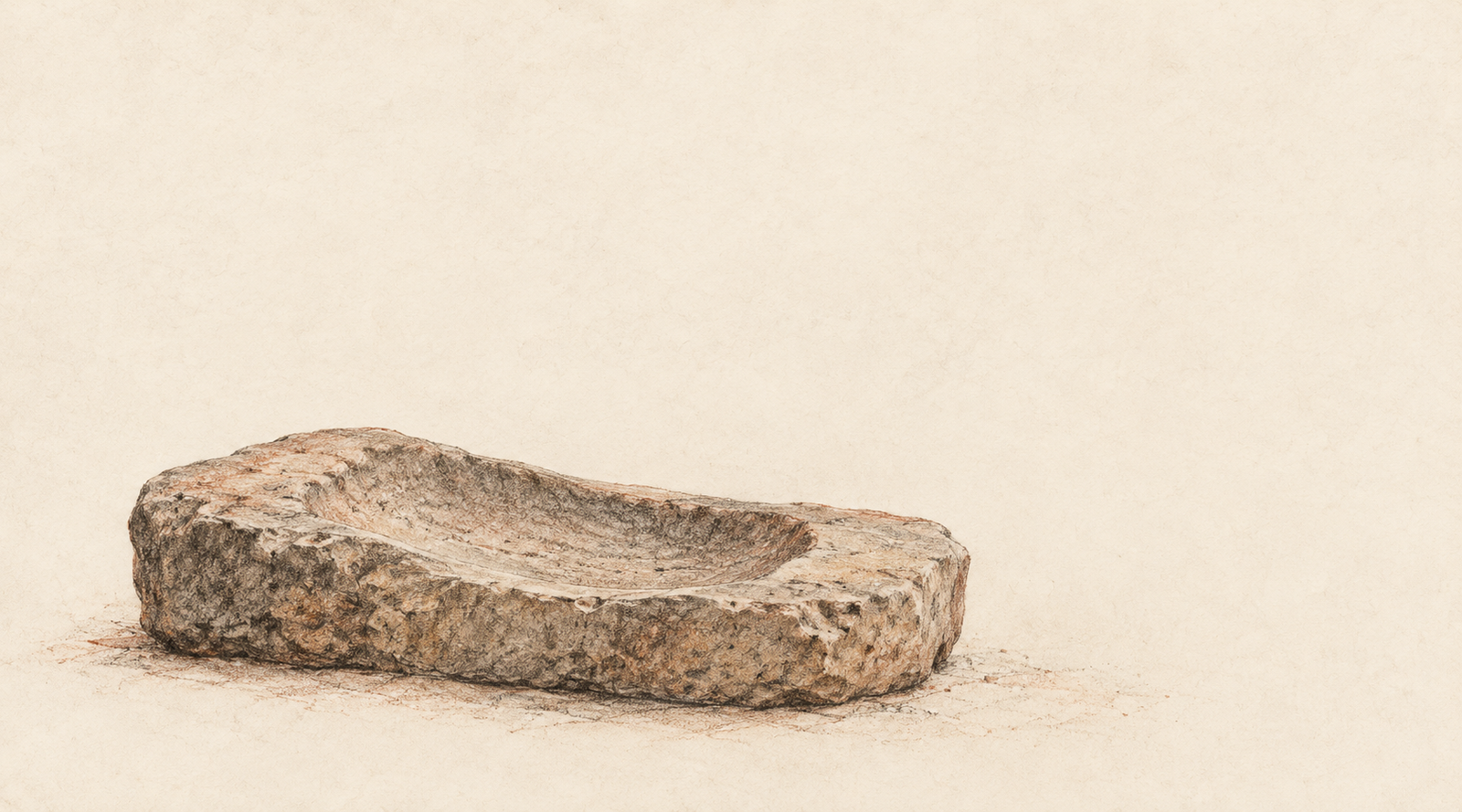
The temple we inherit is a building from which almost all necessity has been removed. Nothing must be brought for it to continue being what we call a temple. The sanctuary asks nothing of us. Stone is good at this kind of independence.
A living temple was otherwise.
Water had to come in. So did grain, cloth, oil, aromatic substances, fuel. The things required for worship arrived because someone carried them across a threshold.


Houses of Wood, Light, and Smoke
Some of Angkor’s most intimate ruins do not rise above the ground at all. They are postholes, low mounds, hearths and ponds: durable traces of a domestic city built largely from things that decay. To restore that city is to see Angkor not only as stone, but as wood, smoke, water, repair, and people living within calling distance.