

Fires of the Old World VI — The Mountain Under His Hand
In this tale from Fires of the Old World, Ravana comes to Kailasa with a measuring cord, a crown, and the terrible confidence of one who has mistaken force for mastery. What begins as a king’s act of defiance before the mountain becomes a story of weight, humiliation, song, and the strange mercy hidden inside stillness.
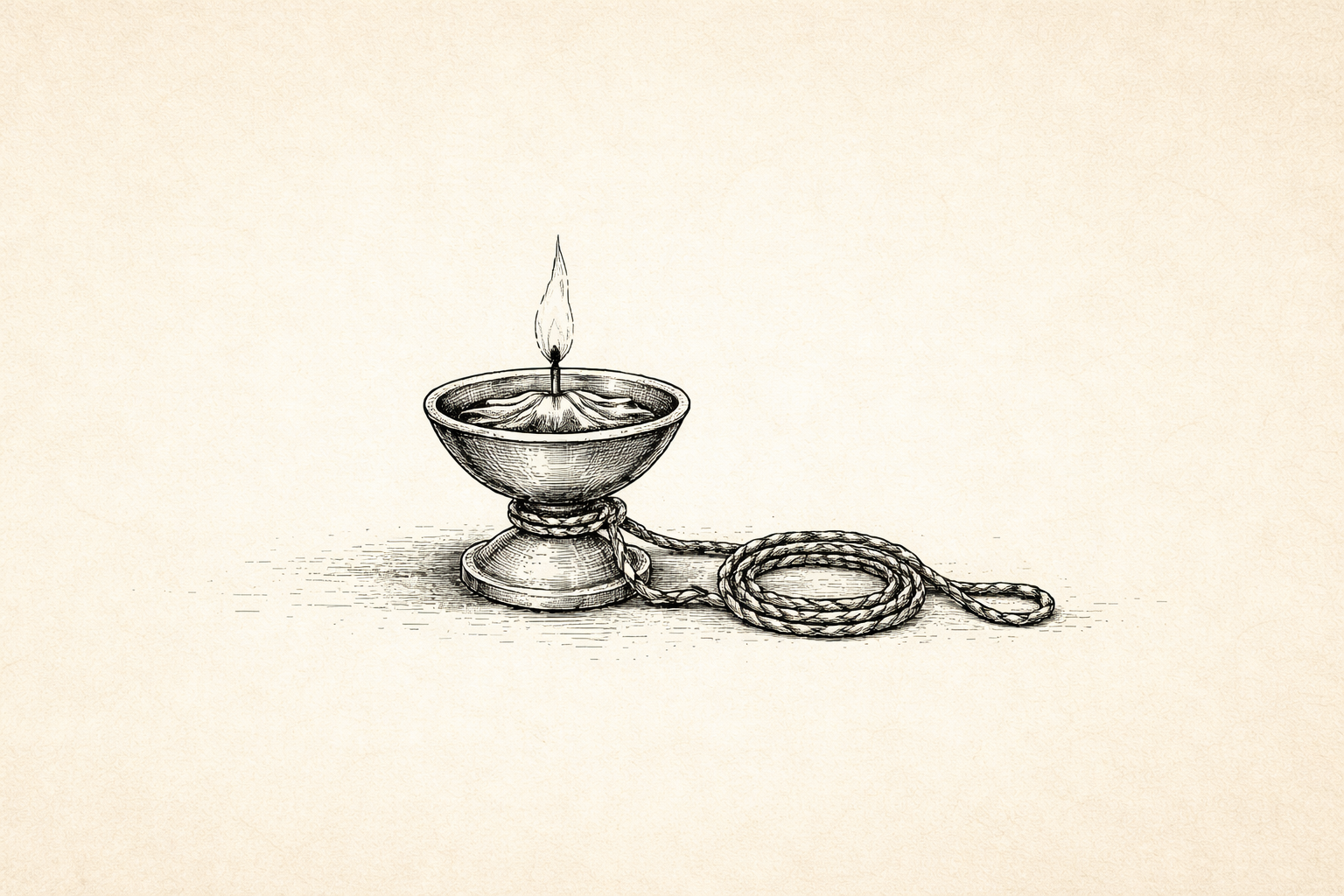
The lamp at the ledge burned low, and the oil held its own small hush. Cold stone sweated in the night air. A few lotus petals lay curled in a brass bowl, faintly sweet, already browning. Wind worried the shrine-ash, then fell quiet again, as if listening too. There was a thread tied round the lamp’s stem to keep it steady, and beside it a length of measuring cord, knotted with care.
Listen.
Some deeds begin with thunder. Their price comes later, soft-footed, when the proud heart has no witness.
Ravana was not a small king.
His crown carried ten victories. His hair was bound with a clasp of scaled bone, taken from something that fought to the end. His arms were thick with oath-bands. His chest bore old scratches where gods had refused him. He liked the world to answer to his hand, so he carried a measuring cord—braided fibre, knots at set lengths—because measure felt like mastery.
He had lifted towers by decree.
He had lifted men by fear.
He had lifted his own name.
The mountain was next.
Kailasa rose where clouds learned patience. Snow lay on its shoulders like undisturbed ash. Stones there did not speak to hurry. They spoke to weight.
Ravana came with storm in him.
His men brought torches and drums, because silence felt like insult. Yet the higher air took their fire. Flames guttered. Sound thinned. There is a height where noise loses its teeth.
Ravana went on alone.
He returned to the ledge-shrine as if it were his own gate, and laughed at the lamp’s small flame. He turned the cup in his hand and watched the soot. He lifted the thread, then the measuring cord, as if both were toys.
“Even your fire needs binding,” he said.
He could have stepped past.
He could have left it.
He could have gone on clean.
Instead, he made a bargain with the threshold.
He tied his measuring cord to the lamp’s stem, knotting his pride to that small steadiness, and spoke as if speaking to a servant.
“If I lift this mountain,” he said, “let the one who sits upon it know my strength. Let him taste it in his stillness.”
The wind moved, then did not.
The flame held.
The lamp watched.
He did not touch the lotus petals.
He did not touch the ash.
He did not bow.
Above, Kailasa waited.
Continue reading: Fires of the Old World VI — The Mountain Under His Hand at The Lantern Chronicles on Substack.
Also in The Lantern Chronicles

The Mirror, the Ledger, and the Box
Three ordinary acts—tending a mirror, keeping a ledger, reading a page—draw three voices into the same unseen machinery. In this original flash-fiction triptych by Lucas Varro, hunger becomes debt, witness becomes participation, and attention itself acquires a price. Enter through Mirror Hunger, where one rule has always been enough: do not lean close.

What the Hand Knows
When does effort become interference? This contemplative essay from The Living Way explores wu wei, attention and the human compulsion to force—whether in work, conversation, ambition or the private demand that reality unfold according to plan.

The Beauty Time Is Allowed to Make
A literary-philosophical essay on wabi-sabi, handmade kozo paper, and the modern demand for seamlessness. Beginning with red chalk meeting a resistant surface, Lucas Varro asks whether value must arrive untouched—and whether care becomes destructive when it begins erasing the visible history of objects and human lives.
Continue Reading
If this piece found something in you, you may wish to continue the journey elsewhere.
On The Lantern Chronicles, I gather writings from Angkor, myth and legend, contemplative essays, and poetry — works shaped by silence, beauty, wonder, memory, and the deeper questions that follow us through the world.
It is a place for stone and story, reflection and vow, shadow and revelation.
You would be most welcome there.