

The Beggar God: A Bhikshatana Retelling
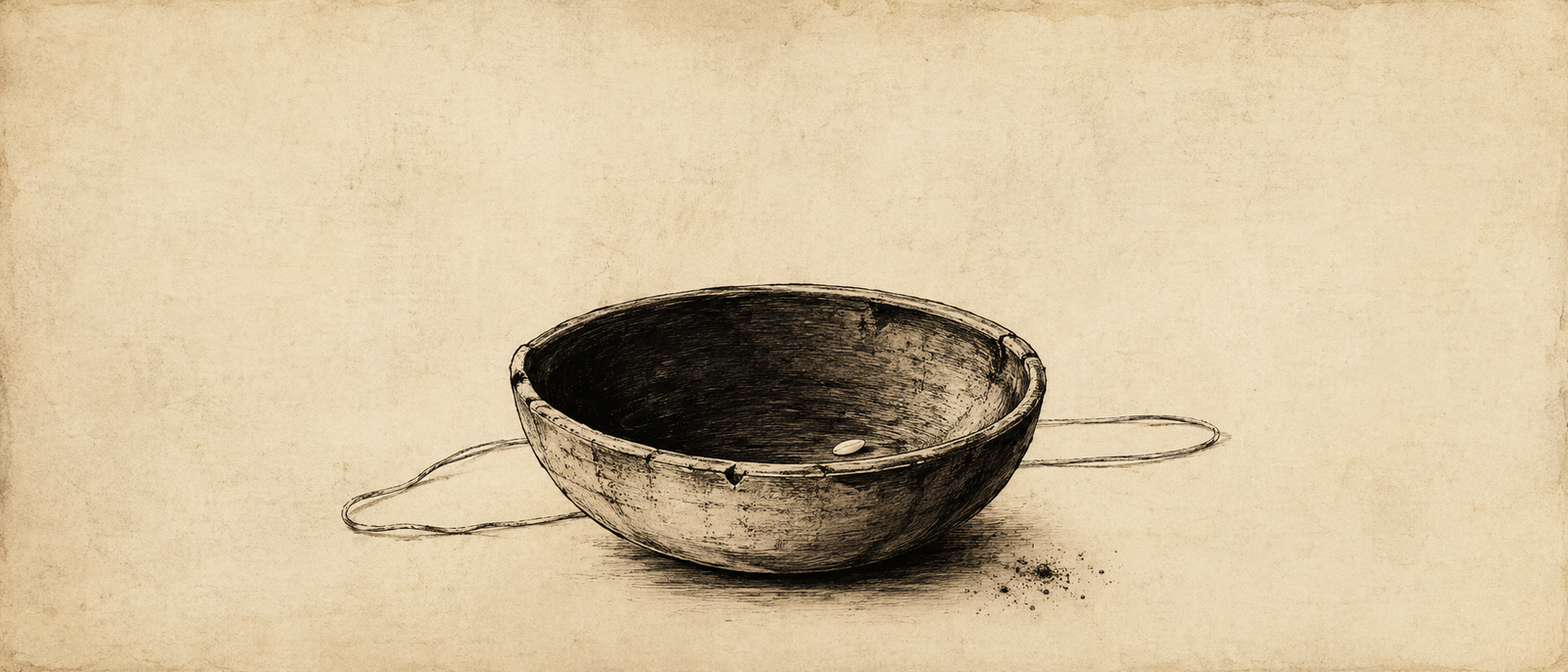
In Fires of the Old World XIX — The Beggar God, Lucas Varro retells the story of Bhikshatana: Shiva entering the forest not in splendour, but as a barefoot beggar with ash on his skin and an empty bowl in his hand.
This is a tale of spiritual pride, sacred dispossession, and the strange mercy of an object that refuses to fill until the hand finally opens.
When the lamp had burned low, and the house smelled of oil, warm milk, and cool stone, the grandmother drew the child closer beneath the cotton sheet.
Outside, the night insects clicked in the dark grass. A bowl stood beside the lamp, empty after supper, with one grain of rice still clinging to its side.
The child touched it with one finger.
“Why do beggars carry bowls?” he asked.
The grandmother smiled, but only a little.
“Because some bowls are made to receive,” she said. “And some are made to reveal.”
Then she turned the lamp wick down, and told him this.
—
In the old forest, where the trees stood so straight they seemed to be listening, there lived a circle of holy men.
They had built their hermitages from bark, clay, and patient hands. They had gathered dry wood. They had tied the measuring cord between posts and altar-stones. They had planted lotuses in a little pond, and swept the ash from the sacred fires each dawn.
Their chants rose at sunrise.
Their fires smoked at dusk.
Their bowls were clean, their mats were straight, their rules were counted, and their names were spoken with respect in villages far away.
People brought them fruit.
Kings sent them cloth.
Travellers bowed before the forest and said, “There, surely, wisdom lives.”
So the holy men began to believe it too.
At first, the belief was no larger than a seed.
Then it grew roots.
Then it rose in them like a tree.
They thought the fire burned because they fed it. They thought the gods listened because they called. They thought the forest was holy because they lived there.
Even their silence became something they owned.
One evening, when the sun had gone red among the branches and the deer were moving softly through the grass, a stranger came down the forest path.
He had no sandals.
His feet were dusted white.
Ash lay across his skin as though the wind had touched him with the end of a burned branch. His hair was matted and lifted like a dark river caught in storm. Around one arm, a serpent lay coiled as quietly as a bracelet.
He wore nothing.
He was unclothed as fire is unclothed.
In one hand he held a begging bowl, dark and hollow, shaped like something that had once belonged to death and now waited for food.
He came without shame.
He came without apology.
He came as wind comes through a torn curtain.
The full tale continues with the forest, the sages, the bowl that will not fill, and the god who reveals what pride has mistaken for possession.
Continue reading: Fires of the Old World XIX — The Beggar God at The Lantern Chronicles on Substack.
Also in The Lantern Chronicles

The Stranger Is Where Inheritance Is Weighed
A Living Way essay on faith, inheritance, empire, and moral humility. The Stranger Is Where Inheritance Is Weighed asks how the stories that form us can become either mercy or contempt — and why the true test of any tradition is whether it can still see the stranger.

At the Lip — A Poem from The Vow
A poem from The Vow on a waterfall, a river reaching the edge, and the stillness that gives falling its shape. At the Lip stays with one overwhelming natural image until movement, constraint, and scale become almost unbearable in their precision.

The Story Is Not Finished Yet
A Living Way essay on the old parable of fortune and misfortune: the lost horse, the returned horse, the injured son, and the wisdom of refusing to give the present a final name. This is not consolation, but a meditation on judgement, uncertainty, and the discipline of not closing life too soon.
Continue Reading
If this piece found something in you, you may wish to continue the journey elsewhere.
On The Lantern Chronicles, I gather writings from Angkor, myth and legend, contemplative essays, and poetry — works shaped by silence, beauty, wonder, memory, and the deeper questions that follow us through the world.
It is a place for stone and story, reflection and vow, shadow and revelation.
You would be most welcome there.