

Fires of the Old World X — The Neckless Hunger
In this tale from Fires of the Old World, Rama and Lakshmana come to a place the birds will not cross. The road has narrowed into mud, sour leaves, old ash, and a hunger that has forgotten its own name. The Neckless Hunger retells the encounter with Kabandha: not as a monster episode, but as a tale of appetite, mutilation, release, and the strange mercy by which the road opens south.
At the edge of evening, where the road ran low through tamarind shade and the last heat held in the stones, the brothers came upon a place the birds would not cross.
The smell reached them first: leaves gone sour in still water, something rank beneath, and the dry bitterness of old ash. Then the air changed. It grew cooler without mercy. Their feet sank a little in the black earth, and the hush there was not the hush of sleep or prayer. It was the hush of things that had drawn back.
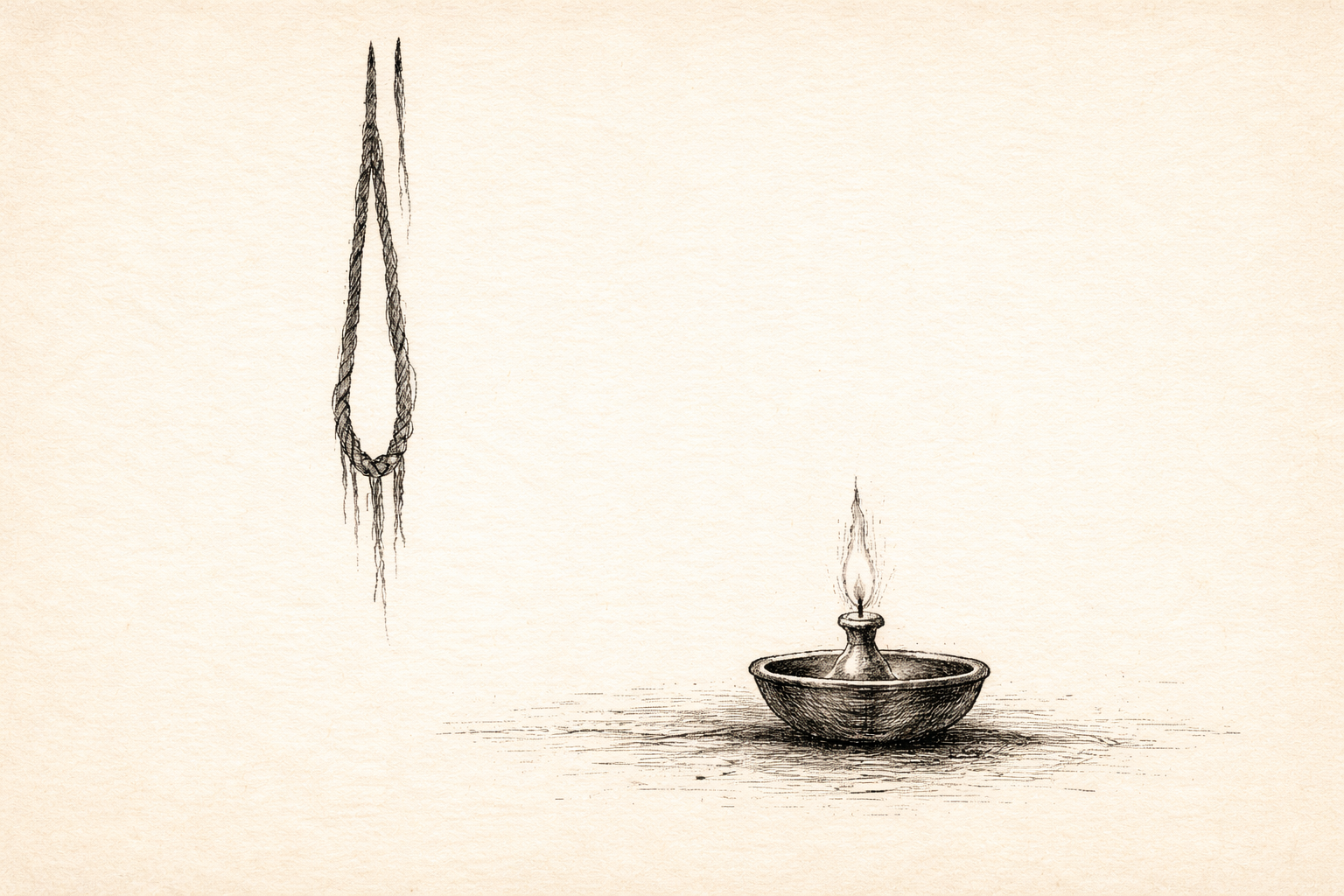
Rama lifted the lamp they had carried since noon, its flame small and steady. Lakshmana walked beside him with one hand near the bowstring. Somewhere beyond the trunks, something dragged itself once across the ground and stopped.
The trees there had learned a crooked patience. Roots broke from the soil like old fingers. From a low branch hung a measuring cord, snapped and weather-blackened, moving slightly though no wind touched it.
Then the cry came.
Not beast. Not bird. A voice, thick with hunger, yet shaped by speech.
“Who walks,” it said, “with light in his hand?”
Rama raised the lamp.
In its poor circle they saw first the arms.
They came out of the dark too long for any living frame, vast and rope-veined, one hand crushing bark from a trunk, the other groping low over the ground. Then the rest of it gathered: a hulking body sunk in mud, chest heaving, shoulders driven inward as if by some old blow that had never ended.
And where the head should have been, there was none.
An eye stared from the middle of the chest.
Below it a mouth split the belly, wide and wet, the teeth set in a ring.
Lakshmana drew breath through his teeth.
The thing laughed once.
“Two men,” it said. “Travel-worn. One steady. One quick to anger. I can smell both.”
Its searching hand swept across the clearing and closed on a stone as large as a jar. The fingers tightened. The stone broke. Rama saw then how it fed. It did not need to pursue. It only reached.
Lakshmana set an arrow to the string.
“Brother.”
“I see it.”
The eye narrowed against the lamp.
“You have looked and not run,” the creature said. “That is rare.”
Its left arm moved.
It struck across the clearing and wrapped Lakshmana round the waist.
Continue reading: Fires of the Old World X — The Neckless Hunger at The Lantern Chronicles on Substack.
Also in The Lantern Chronicles

The Mirror, the Ledger, and the Box
Three ordinary acts—tending a mirror, keeping a ledger, reading a page—draw three voices into the same unseen machinery. In this original flash-fiction triptych by Lucas Varro, hunger becomes debt, witness becomes participation, and attention itself acquires a price. Enter through Mirror Hunger, where one rule has always been enough: do not lean close.

What the Hand Knows
When does effort become interference? This contemplative essay from The Living Way explores wu wei, attention and the human compulsion to force—whether in work, conversation, ambition or the private demand that reality unfold according to plan.

The Beauty Time Is Allowed to Make
A literary-philosophical essay on wabi-sabi, handmade kozo paper, and the modern demand for seamlessness. Beginning with red chalk meeting a resistant surface, Lucas Varro asks whether value must arrive untouched—and whether care becomes destructive when it begins erasing the visible history of objects and human lives.
Continue Reading
If this piece found something in you, you may wish to continue the journey elsewhere.
On The Lantern Chronicles, I gather writings from Angkor, myth and legend, contemplative essays, and poetry — works shaped by silence, beauty, wonder, memory, and the deeper questions that follow us through the world.
It is a place for stone and story, reflection and vow, shadow and revelation.
You would be most welcome there.