
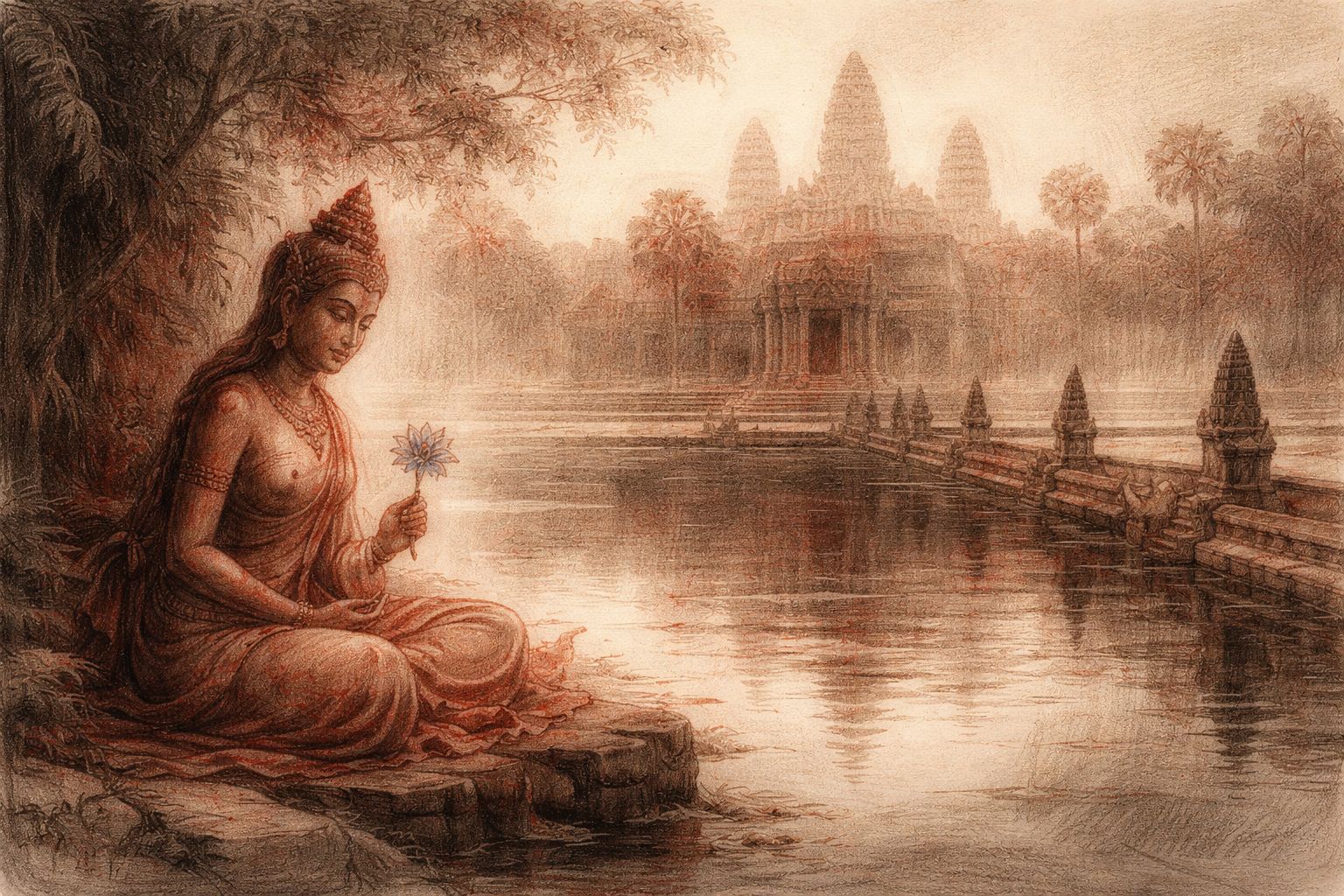

Bhumidevi
She is felt before she is named. In Angkor, the ground speaks first: laterite breathing heat, sandstone holding last night’s rain, roots lifting pavements by a patient fraction. This is where attention begins—not in the tower or the face, but in the earth that receives weight and remembers it. Bhumidevi does not announce herself. She receives.
The temples were never placed upon neutral ground. They are set into soil already thick with story, water, and obligation. To step across a causeway is to enter an agreement older than the stone: that the land bears, and is borne. Here the earth is not background. It is witness. It keeps account of every footfall, every offering, every king who claimed protection and asked to be believed.
Bhumidevi belongs to Vishnu not as ornament but as condition. Preservation requires substance. Order cannot float. In the old telling, when the earth was dragged beneath the waters, it was not merely a goddess lost but the ground of life itself submerged. Vishnu’s descent as Varaha is remembered in Angkor less through narrative relief than through posture and mass—the sense that weight has been lifted and set back into balance. The myth lingers as pressure rather than picture. The land here feels raised, not conquered.
In Khmer stone, Vishnu’s attributes adjust to place. The lotus recedes; the globe appears. A small sphere held lightly yet firmly, a reminder that the earth is not abstract but held, entrusted. The globe is not the world as possession but the world as responsibility. It rests in the god’s hand as something alive, vulnerable, answerable. To carry it is to answer for it.
Within the temple triads, the Earth Goddess stands slightly aside—often to the left—close enough to the threshold to be felt as one enters. She does not dominate the axis; she flanks it. Her power is lateral, not vertical. She confirms rather than commands. In the Bayon, under the name Dharani, she occupies a place that steadies the whole: earth answering to centre, ground answering to sky. The arrangement teaches quietly. Authority must be grounded or it fractures.
In Cambodia, the earth speaks most clearly through water. The basins, moats, and barays are not simply feats of engineering; they are acts of listening. Rain is gathered, slowed, released. Soil is asked what it needs. In the Buddhist retelling, the Earth Goddess becomes Preah Thorani, rising to wring from her hair the waters of accumulated merit. The gesture is not violent. It is inevitable. What has been given returns with force. The land remembers generosity as surely as it remembers harm.
This image—hair heavy with water, hands patient—has endured because it names a truth the body already knows. To live upon land is to borrow. To rule is to borrow publicly. The earth will testify. It does not argue. It releases.
Angkor’s kings understood this, even when they failed to honour it. The temples insist on relationship: king to god, god to land, land to people. The ground beneath the sanctuaries was never inert. It was a participant. To build was to ask permission. To neglect was to invite consequence. When the inscriptions speak of merit and protection, the earth is always implied as the final arbiter.
There is a deeper lineage here, older than imported gods and Sanskrit titles. The naga stirs beneath everything. Water coils through the land as ancestry. The story of Soma, the serpent princess, is not an embellishment but a memory of matrilineal authority, of land held through kinship and water rather than conquest. Bhumidevi absorbs this seamlessly. She is mother without sentiment, sovereign without throne.
Walking through Angkor, one senses her not in icons but in intervals: the pause where a root splits stone; the hush before rain; the coolness held under galleries at noon. The earth is teaching patience. It does not hurry the pilgrim. It asks for weight, for stillness, for acknowledgment. This is her pedagogy.
Even destruction passes through her. When images were broken, when names were erased, the ground received the fragments and kept them. Later, it returned them to sight. Nothing here is finally lost. The earth archives without judgment.
Bhumidevi’s presence reframes devotion. To kneel is not to abase oneself but to align. The body lowers because the ground is trustworthy. This is not submission; it is confidence. The land will hold.
In Angkor, spirituality is not lifted away from matter. It is pressed into it. The earth is not a metaphor but a contract. To stand here is to be counted, measured, and—if one is attentive—quietly forgiven.
The goddess does not ask to be seen. She asks to be borne in mind with every step. Long after towers crack and names thin, she remains, patient and exact. The final sanctuary is not the stone chamber but the ground that receives us all.
—
Receive the next work
Subscribe free to receive new work from the Lucas Varro Library by email.
More from the Library


See Also
A concise and impartial dictionary of absence, promises, quarrels, ordinary objects, and the troublesome instability of words.

The City of Service
The temple we inherit is a building from which almost all necessity has been removed. Nothing must be brought for it to continue being what we call a temple. The sanctuary asks nothing of us. Stone is good at this kind of independence.
A living temple was otherwise.
Water had to come in. So did grain, cloth, oil, aromatic substances, fuel. The things required for worship arrived because someone carried them across a threshold.


Houses of Wood, Light, and Smoke
Some of Angkor’s most intimate ruins do not rise above the ground at all. They are postholes, low mounds, hearths and ponds: durable traces of a domestic city built largely from things that decay. To restore that city is to see Angkor not only as stone, but as wood, smoke, water, repair, and people living within calling distance.