
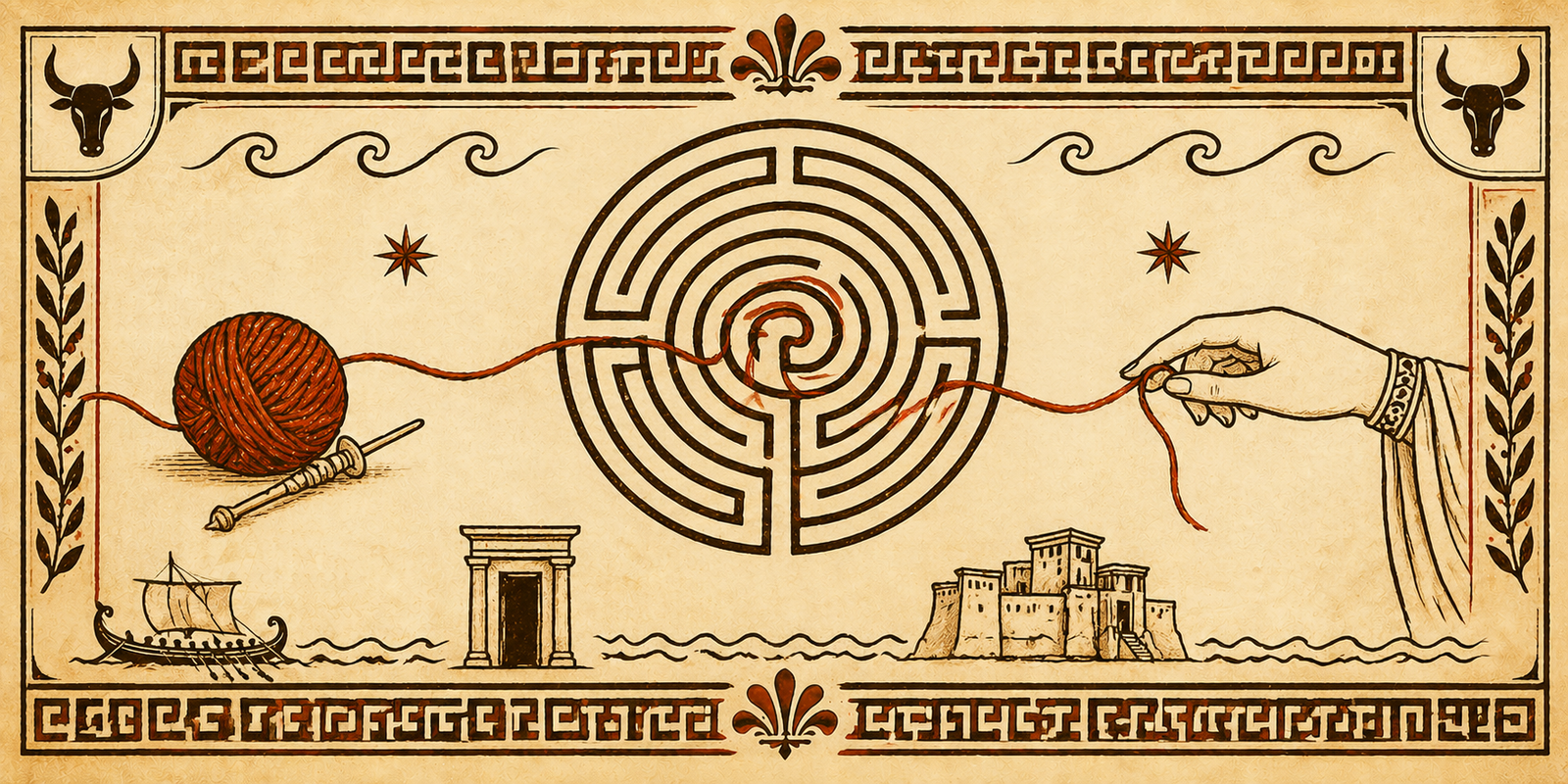

Ariadne’s Thread: The Small Thing That Leads Courage Home
After Theseus leaves the Labyrinth, we can ask why the smallest thing in the story mattered most.
After the Tale
Now that Theseus has entered the Labyrinth and come out again, we can look more closely at the smallest thing in the story.
Not the ship.
Not the sword.
Not the horns of the Minotaur.
The thread.
At first, Ariadne’s thread does not look like much. That is one of the reasons it matters. Greek myth is full of marvellous objects: winged sandals, shining shields, golden apples, thunderbolts, bows that only one man can string, helmets that make the wearer unseen. Beside such things, a ball of thread seems almost too ordinary to belong in a great adventure.
But Theseus does not come back from the Labyrinth because of something large, bright, and god-made.
He comes back because of a line.
Ariadne gives him the sword too, in many tellings. The sword matters. Without it, Theseus could not face the Minotaur.
But the sword only answers one part of the danger.
The thread answers the other.
The Short Answer
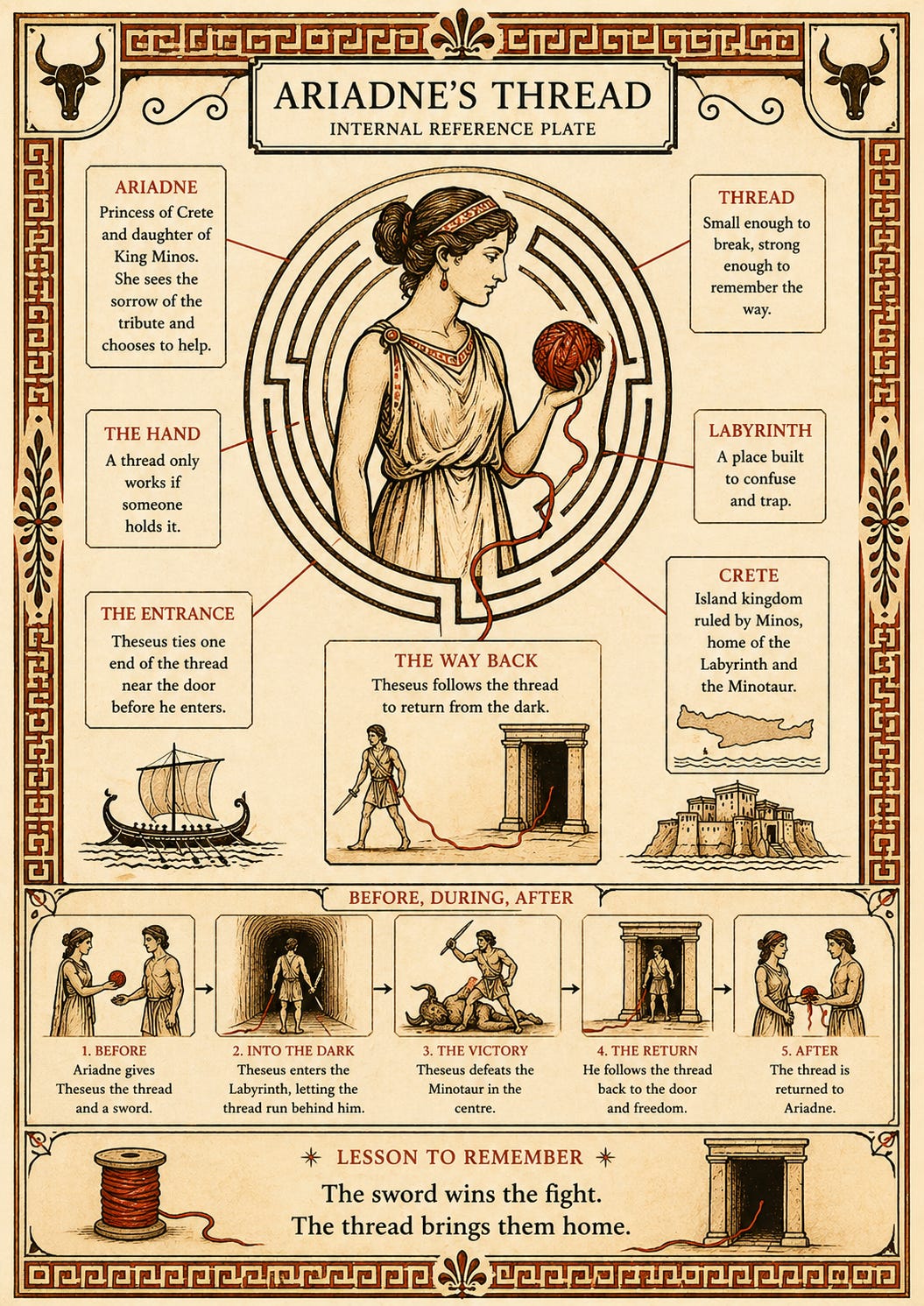
Ariadne’s thread is the line Theseus uses to find his way back out of the Labyrinth after facing the Minotaur.
Ariadne, daughter of King Minos of Crete, gives it to him before he enters the maze. Theseus ties one end near the entrance and lets the thread run through his hands as he walks deeper and deeper into the dark.
Then, after the Minotaur is dead, he follows the thread back.
That is the important part.
The thread does not defeat the monster.
It defeats being lost.
What the Tale Showed You
In Theseus and the Thread, the danger does not end when the Minotaur falls.
That is easy to forget.
A great monster makes a great noise. It has horns, breath, weight, hunger, and a body that can be seen by lamp-light. When it charges, everyone knows the danger has arrived.
The Labyrinth is quieter.
It has no teeth. It does not roar. It does not chase Theseus through the passages. It simply waits for him to forget, boast, hurry, panic, or trust himself too much.
That is why Ariadne understands the story better than almost anyone else.
Theseus thinks first of the Minotaur.
Ariadne thinks of the way back.
She knows that courage can carry a person into danger, but courage alone does not always bring them home. Heroes often know how to begin. Fewer know how to return.
The thread is Ariadne’s answer to the part of the adventure that looks small from outside and becomes enormous from within.
It says:
You may enter the dark.
You may face what waits there.
But do not pretend you can remember every turn alone.
Ariadne
Ariadne is the daughter of King Minos.
That means she belongs to the palace that hides the Minotaur. She lives among the painted walls, the guarded doors, the servants, the courtyards, and the silence around the Labyrinth.
She knows more than a stranger knows.
She has seen the tribute arrive.
She knows what her father calls justice.
She knows what the palace prefers not to say.
This matters because Ariadne does not help Theseus by accident. She is not merely standing nearby with a useful object. She sees the shape of the wrong and chooses not to obey it.
In this way, Ariadne is one of the bravest figures in the tale.
Her courage is different from Theseus’s courage. She does not walk into the Labyrinth with a sword. She does not stand before the Minotaur. But she does something that may be just as dangerous inside a palace: she disobeys a cruel order and gives the trapped a way out.
Some stories remember heroes by the monsters they defeated.
Ariadne should be remembered by the way she understood the dark.
Why a Thread?
A thread is a strange kind of heroic object.
It is easy to break.
It can tangle.
It can catch on stone.
It can be dropped.
It does not protect the body. It does not frighten enemies. It does not make anyone stronger. It does not blaze with magic.
That is exactly why it is beautiful.
The thread must be trusted.
It only works if Theseus keeps hold of it. It only works if he refuses the false way, even when another passage looks brighter. It only works if he slows down when it catches, untangles it carefully, and remembers that coming back is part of the task.
A sword can be swung in a moment.
A thread must be followed patiently.
That patience is part of its power.
The thread does not make the Labyrinth less dark. It does not make the Minotaur less dreadful. It does not make Theseus less afraid.
It gives fear a path.
Not a Weapon
Many famous objects in Greek myth are weapons or armour.
Perseus has a shield. Zeus has the thunderbolt. Athena has the spear. Apollo has the bow. Heracles has his club.
Ariadne’s thread belongs to a different family of objects.
It does not strike.
It guides.
It does not dazzle.
It remembers.
It does not win glory.
It brings people home.
That is why it is one of the great objects of Greek myth, even though it is small enough to fit in a hand.
In some stories, the most important thing is the thing everyone notices immediately. In this story, the most important thing is almost humble. It can be wound into a ball, hidden under a cloak, carried through a door, and trusted in the dark.
Ariadne’s thread teaches the reader to look carefully at small things.
Greek myth often does this. The large, shining object is not always the truest one. Sometimes the object that saves the story is quiet, practical, and easily overlooked.
Signs and Symbols
The red thread
Ariadne’s gift to Theseus. It marks the way back through the Labyrinth.
The ball of thread
The thread before the danger begins: neat, held, possible, waiting.
The frayed thread
The thread after the return: dusty, stretched, and changed by what it has passed through.
The hand holding the line
A reminder that help must be accepted. A thread cannot save anyone who refuses to hold it.
The Labyrinth
The dark place where memory fails and pride becomes dangerous.
The doorway
The place where the thread begins, and where it must lead again.
Ariadne at the harbour
The one who gave courage a way home.
What Else the Myths Say
Ariadne’s story does not end with the thread.
The old myths follow her beyond the harbour, beyond Crete, and into other strange and beautiful stories. Some tell of sorrow. Some tell of a god. Some lift her into the stars.
Those stories matter, but they belong elsewhere.
Here, in the tale of Theseus and the Labyrinth, Ariadne stands at the crucial point between darkness and return. She gives the object that changes the adventure from a brave death into a possible homecoming.
That is enough for one story to hold.
When You Remember the Tale
When you remember Theseus and the Thread, it is easy to picture the Minotaur first.
That is natural.
Monsters are made to be remembered.
But try to remember the thread too.
Remember it moving through Theseus’s fingers as he walks into the dark. Remember it lying across the dusty floor after the Minotaur falls. Remember it catching on stone and being freed slowly. Remember it leading the children back to the bronze door. Remember it returned to Ariadne, no longer neat, but faithful.
The thread is not impressive in the way a sword is impressive.
It is better than impressive.
It is true.
One Thing to Remember
Ariadne’s thread is the small faithful thing that leads courage home.
—
Receive the next work
Subscribe free to receive new work from the The Alexander Series Library by email.
More from the Library

See Also
A concise and impartial dictionary of absence, promises, quarrels, ordinary objects, and the troublesome instability of words.

The City of Service
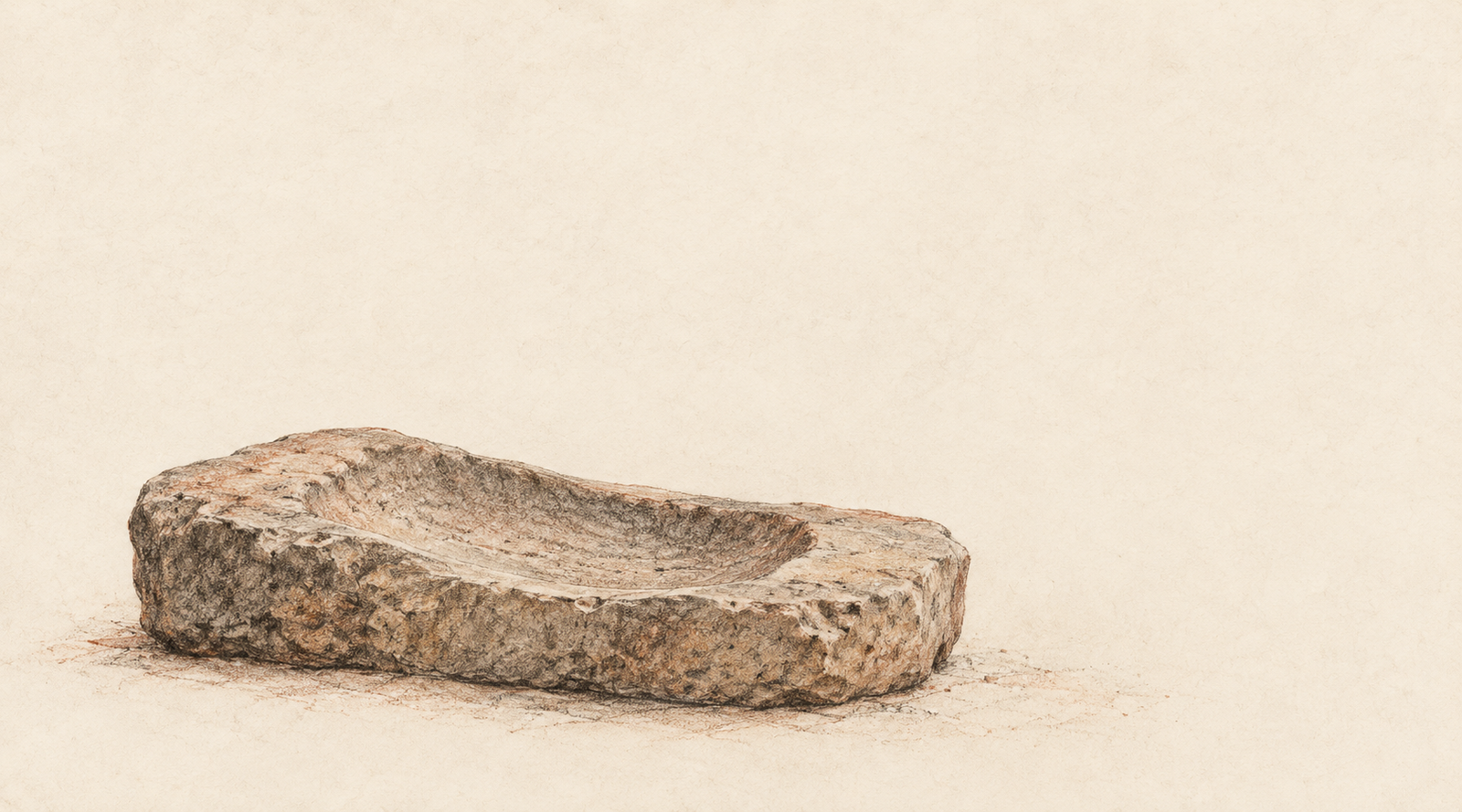
The temple we inherit is a building from which almost all necessity has been removed. Nothing must be brought for it to continue being what we call a temple. The sanctuary asks nothing of us. Stone is good at this kind of independence.
A living temple was otherwise.
Water had to come in. So did grain, cloth, oil, aromatic substances, fuel. The things required for worship arrived because someone carried them across a threshold.

Houses of Wood, Light, and Smoke
Some of Angkor’s most intimate ruins do not rise above the ground at all. They are postholes, low mounds, hearths and ponds: durable traces of a domestic city built largely from things that decay. To restore that city is to see Angkor not only as stone, but as wood, smoke, water, repair, and people living within calling distance.