
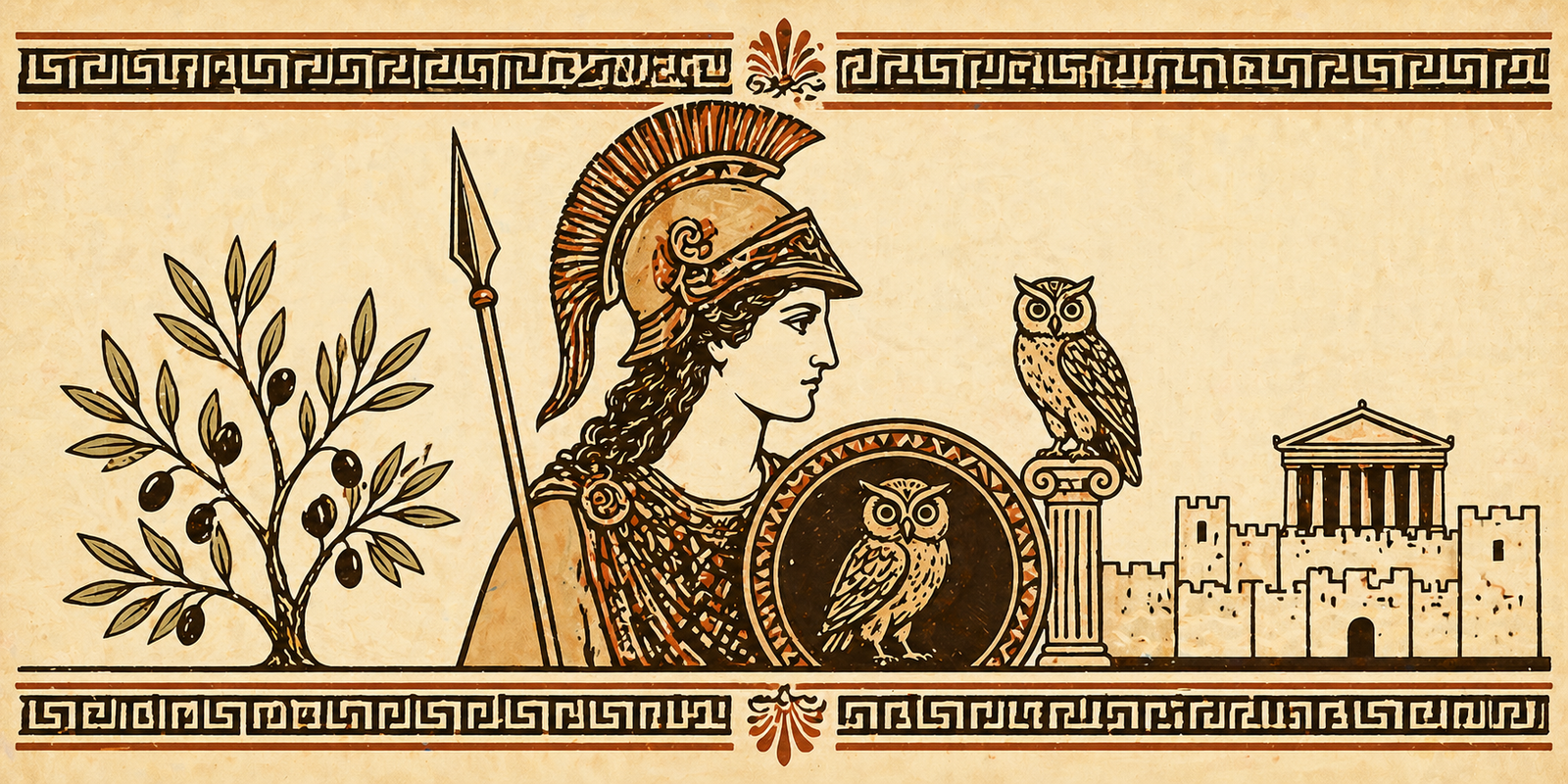

Athena: The Shield, the Owl, and the Courage to Think
Before Perseus meets the Gorgon, he must first receive help from the goddess of wisdom, shields, and difficult good sense.
Before the Tale
Before Perseus lifts the polished shield, before he hears the snakes move in the dark, before he learns how not to look at the thing he fears most, there is Athena.
This is worth noticing.
In Greek myth, heroes do not usually survive because they are simply brave. Bravery helps, of course. So do strong arms, quick feet, sharp swords, and not making foolish boasts in front of gods. But very often, the hero who survives is the one who receives the right kind of help — and understands how to use it.
Athena’s help is not soft help. She does not usually make the danger go away. She does not pat the hero on the shoulder and say that everything will be easy.
Athena gives clearer help than that.
She gives a plan.
She gives a warning.
She gives a tool.
She gives the kind of courage that can think.
The Short Answer
Athena is the goddess of wisdom, war-craft, weaving, cities, shields, strategy, and difficult good sense.
She is one of the great Olympian gods, the daughter of Zeus, and one of the most important divine helpers in Greek myth.
She is not the goddess of wild battle-rage. That is Ares, and Ares is often much less careful. Athena belongs to a different kind of fighting: the kind that uses thought before force, discipline before shouting, and a shield before a reckless charge.
She is the goddess who knows that courage without judgement can get a person killed.
What You Need to Know Before the Story
Athena is often called grey-eyed Athena. This does not mean she is dull or pale. It means she sees clearly. Her gaze is bright, steady, and difficult to fool.
She was born in a very strange way, even by Greek standards, which are already quite strange. In many tellings, Zeus swallowed Metis, a goddess of wisdom, and later suffered a terrible pain in his head. When his head was opened, Athena sprang out fully grown, armed for battle.
This is not the sort of birth most families expect.
The Greeks used the story to show that Athena belonged to wisdom, power, and the mind of Zeus himself. She was not a helpless child among the gods. She arrived ready.
Athena is also connected with cities, especially Athens, which was named for her. She gave the people the olive tree: useful, patient, long-lived, and valuable. Poseidon struck the ground and offered a salt spring or a horse, depending on the telling. Athena offered the olive, and the city chose her.
That tells you something about Athena. She is not only interested in winning a quarrel. She is interested in what can last.
What Kind of Help She Brings
Athena often appears when a hero needs more than strength.
She helps Perseus face Medusa.
She helps Odysseus use cunning on his long journey home.
She helps Heracles in some of his impossible labours.
She stands near heroes when the task is too dangerous for ordinary courage.
But Athena’s favour is not the same as being rescued.
If Athena helps you, you may still have to walk into the dark. You may still have to fight. You may still have to keep your hands steady when your fear wants to shake them.
Athena does not make heroes useless by doing everything for them. She makes them more able to do what must be done.
That is why she matters so much before the story of Perseus. Perseus is sent against a monster no one can look at and live. A sword alone will not be enough. A brave shout will not be enough. Running straight at the danger will be the worst possible idea.
He will need Athena’s kind of courage.
The thoughtful kind.
Signs to Watch For
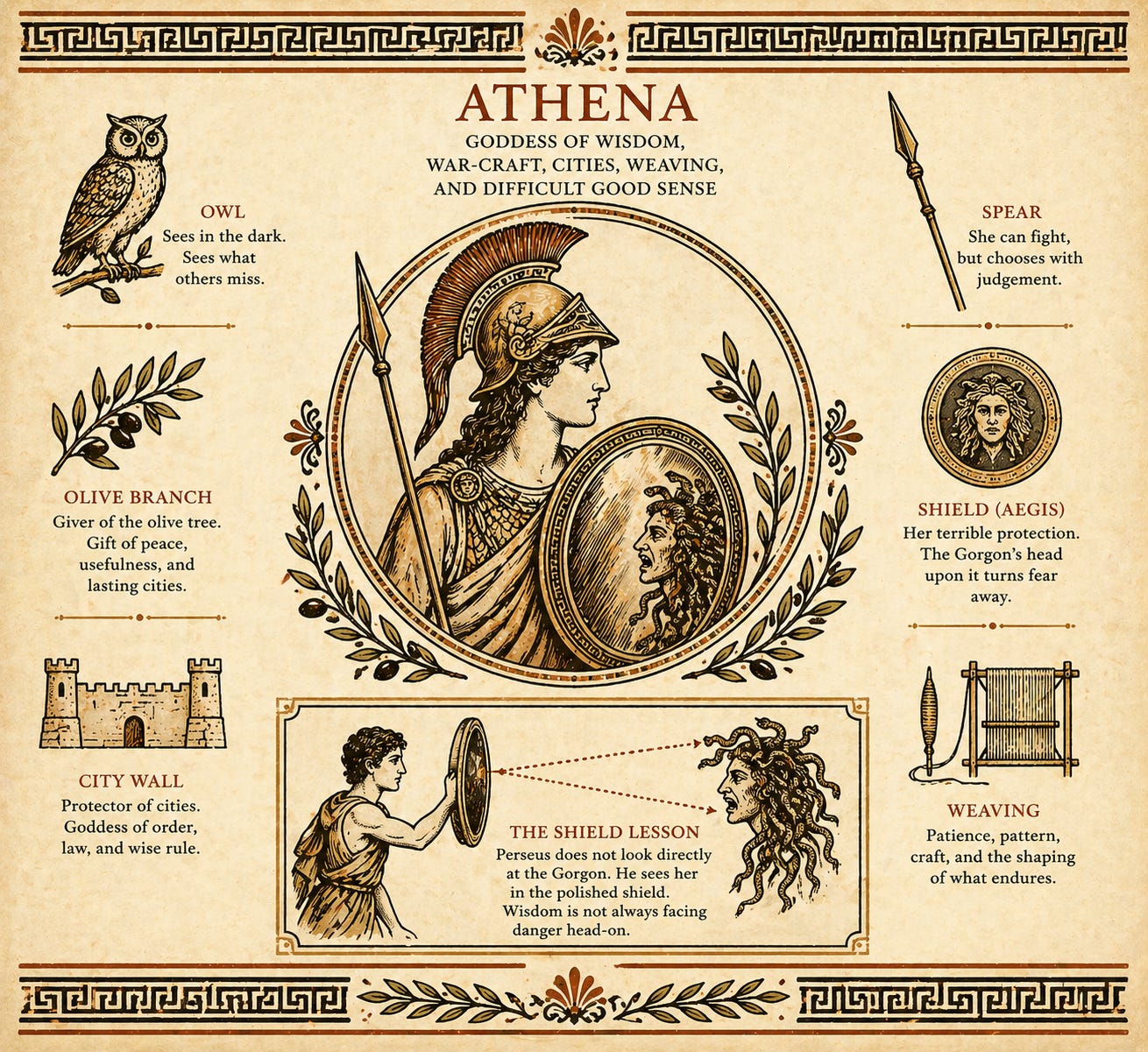
Athena is often shown with:
A helmet — because she is a goddess of war-craft and protection.
A spear — because she can fight when fighting is necessary.
A shield — because defence, patience, and guarded attention matter.
An owl — because owls see in darkness, and Athena is linked with wisdom and clear sight.
An olive tree or branch — because she is a goddess of useful gifts, cities, and lasting order.
The aegis — a frightening divine shield or cloak, sometimes shown with the head of Medusa upon it.
These signs are not decorations. In Greek myth, objects remember things. A shield may be more than a shield. A bird may be more than a bird. A tree may be a city’s whole future, quietly growing in silver leaves.
When You Read the Tale
When Athena appears in Perseus and the Shield of Athena, watch how she helps.
She does not simply hand Perseus safety.
She gives him the means to face danger indirectly. That matters. Some dangers cannot be met by staring straight at them. Some fears become more dangerous when we rush at them without thought.
Athena understands this.
Her shield is not only armour. It becomes a way of seeing without being destroyed by sight. It teaches Perseus that intelligence is not cowardice. Caution is not weakness. A hero may need to turn aside in order to survive.
That is one of Athena’s great lessons.
Not every brave person charges forward.
Some brave people stop, think, listen, and hold the shield at exactly the right angle.
One Thing to Remember
Athena does not make heroes safe; she teaches them how to stand inside danger without losing their minds.
—
Receive the next work
Subscribe free to receive new work from the The Alexander Series Library by email.
More from the Library


See Also
A concise and impartial dictionary of absence, promises, quarrels, ordinary objects, and the troublesome instability of words.

The City of Service
The temple we inherit is a building from which almost all necessity has been removed. Nothing must be brought for it to continue being what we call a temple. The sanctuary asks nothing of us. Stone is good at this kind of independence.
A living temple was otherwise.
Water had to come in. So did grain, cloth, oil, aromatic substances, fuel. The things required for worship arrived because someone carried them across a threshold.

Houses of Wood, Light, and Smoke
Some of Angkor’s most intimate ruins do not rise above the ground at all. They are postholes, low mounds, hearths and ponds: durable traces of a domestic city built largely from things that decay. To restore that city is to see Angkor not only as stone, but as wood, smoke, water, repair, and people living within calling distance.