
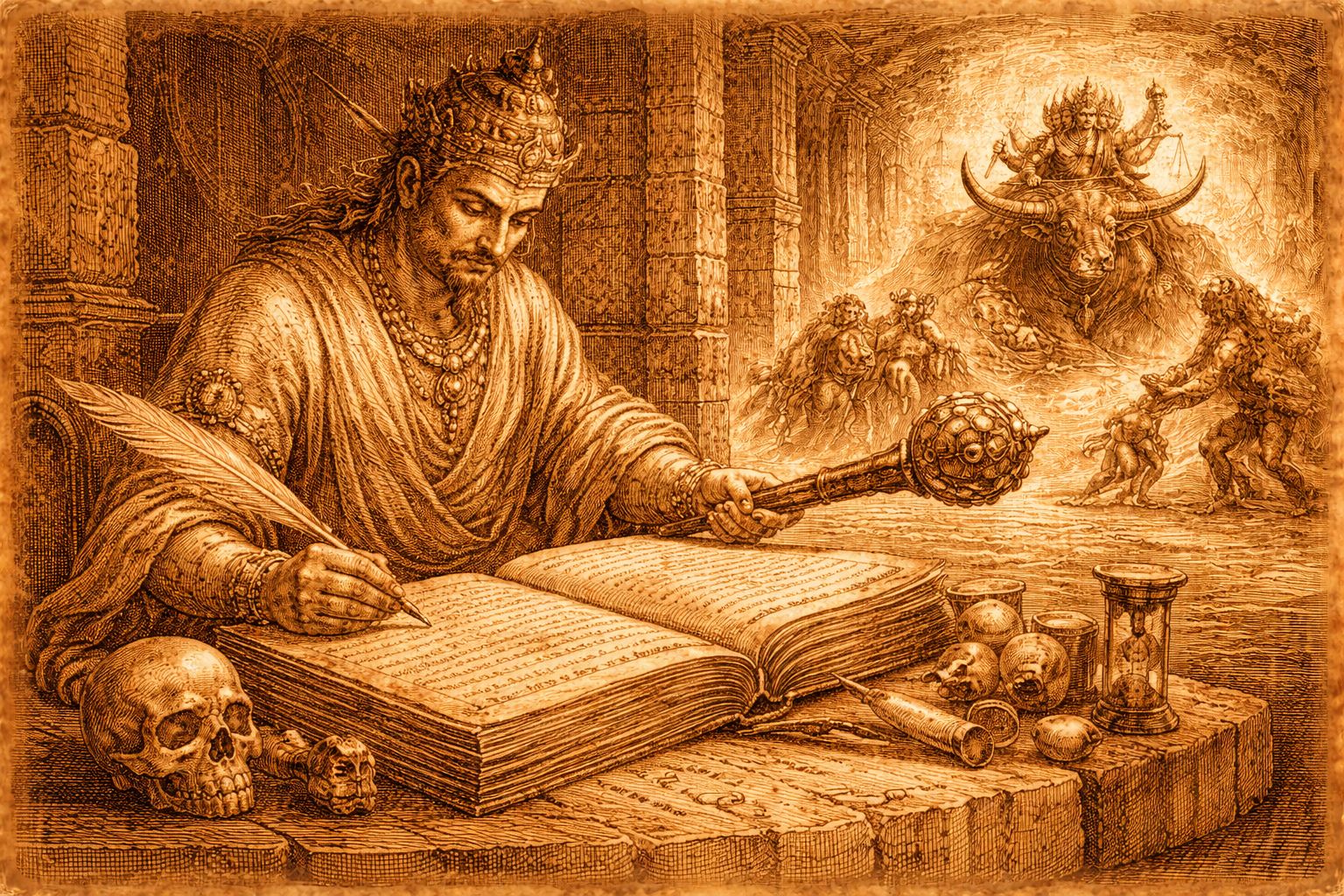

Citragupta — The Ledger That Does Not Forget
Before judgement is spoken, it is read.
At the threshold of the afterlife, before the throne of Yama, there stands no accuser and no defender. There is only a record. The one who holds it is Citragupta—the divine clerk, the keeper of duration, and the custodian of consequence.
Citragupta is not feared because he punishes. He is feared because he remembers.
In the cosmology shared by Vedic and Khmer traditions, the universe is governed not merely by power, but by accounting. Actions do not dissolve when they are completed; they persist as entries. Every life is a ledger. Every intention is a line item. When the body falls silent, the book is closed and carried forward intact.
Citragupta’s office is exacting and impersonal. He records the full span of a life—its allotted duration, its deeds of merit and demerit, its excesses and omissions. Nothing is too small to enter the register. Nothing is too hidden to escape inscription. This is not surveillance; it is structure. The cosmos, here, is not moral because it judges, but because it remembers.
In the court of the dead, Citragupta reads. He does not argue. He does not interpret. He does not soften. The pleas of the soul are heard, but the record speaks more clearly. Justice, in this system, does not depend on persuasion. It depends on balance.
This vision is carved with unsettling clarity at Angkor Wat, in the southern gallery of the Heavens and Hells. There, Citragupta appears seated low, crowned, holding a mace or club of command—not as a weapon, but as an instrument of direction. He points. The damned are not struck; they are assigned.
The relief places him with exactitude. Alongside Dharma, he occupies interpillar space twenty, precisely one hundred and eight cubits from the eastern end of the panel. Measure governs even representation. The number is not decorative. It signals that judgement is an extension of cosmic order, not an interruption of it.
Historically defaced, like many figures in this gallery, Citragupta’s damaged face does not weaken his authority. If anything, it sharpens it. The erasure of features only reinforces the idea that he is not an individual personality, but a function. He is the mechanism by which karma becomes legible.
In this system, punishment is not revenge. The thirty-two hells (Naraka) are not expressions of divine anger, but zones of correction. Each is tailored, each finite, each proportionate. Citragupta does not consign souls out of cruelty; he directs them according to what the record requires. When the account is settled, movement resumes.
This is why he listens without mercy. Mercy would introduce distortion. Compassion, here, belongs elsewhere—in ritual, in intercession, in the living world. Citragupta’s task is clarity. Without him, judgement would drift. With him, consequence remains precise.
In the Khmer imagination, this precision extended into daily life. Moral disputes unresolved by human testimony were entrusted to divine ordeal. Truth was expected to manifest physically because the universe itself was assumed to be in balance. The ledger was already written; the body would reveal it.
Citragupta stands as the quiet guarantee of this order. He does not create fate. He confirms it. He does not invent justice. He tallies it. His power lies not in command, but in completeness.
To walk Angkor attentively is to sense this presence beneath the stones. Proportion, repetition, axial alignment—all are forms of record-keeping. The temples themselves behave like ledgers, tracking light, shadow, season, and return.
When death arrives, nothing is improvised.
The book is opened to the final page.
—
Receive the next work
Subscribe free to receive new work from the Lucas Varro Library by email.
More from the Library


See Also
A concise and impartial dictionary of absence, promises, quarrels, ordinary objects, and the troublesome instability of words.

The City of Service
The temple we inherit is a building from which almost all necessity has been removed. Nothing must be brought for it to continue being what we call a temple. The sanctuary asks nothing of us. Stone is good at this kind of independence.
A living temple was otherwise.
Water had to come in. So did grain, cloth, oil, aromatic substances, fuel. The things required for worship arrived because someone carried them across a threshold.

Houses of Wood, Light, and Smoke
Some of Angkor’s most intimate ruins do not rise above the ground at all. They are postholes, low mounds, hearths and ponds: durable traces of a domestic city built largely from things that decay. To restore that city is to see Angkor not only as stone, but as wood, smoke, water, repair, and people living within calling distance.