
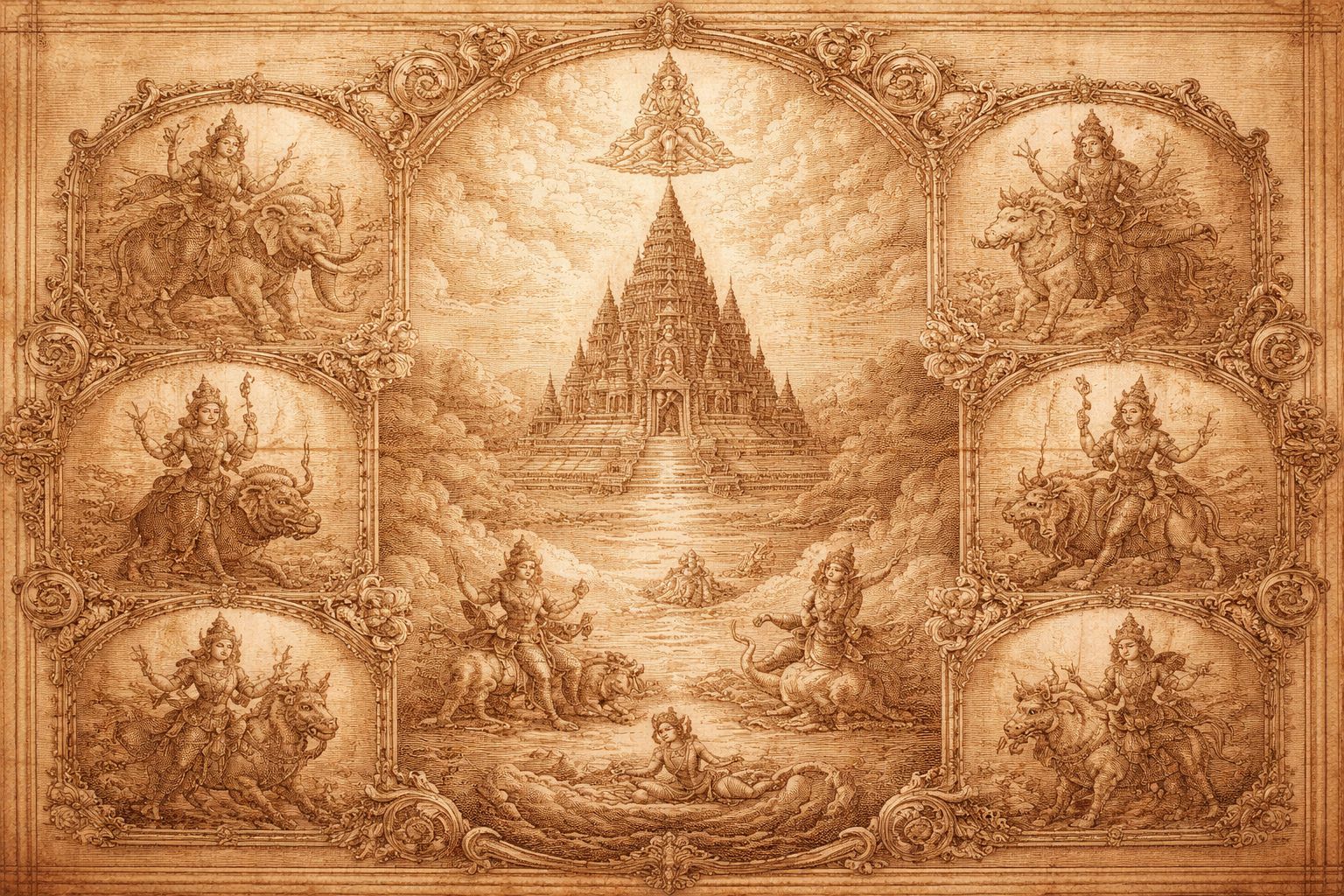

The Dikpalas — Holding the World in Place
A temple does not begin at its doorway. It begins earlier—at the moment the body senses direction. East is felt before it is named. West gathers weight in the afternoon light. North cools the breath; south presses warmth into the stone. Long before doctrine or inscription, the world announces itself through orientation. The Dikpalas arise from this awareness. They are not inventions of myth so much as recognitions of a condition already present: that space itself must be held.
The Dikpalas—also called Lokapalas—are the Guardians of the Directions. They rule not over stories but over territories. Each god governs a sector of space: the four cardinal points, the four intercardinal intervals, and, in expanded cosmologies, the zenith above and the nadir below. Together they form a complete enclosure, a divine perimeter within which order can exist. Without them, space would be open, unbounded, and therefore unsafe.
In the earliest Vedic imagination, the world is not neutral. Directions carry ethical charge. To move eastward is not the same as turning south. Each direction has consequence. Indra presides over the east, where kingship, sky, and authority rise with the sun. Agni governs the south-east, the threshold of fire and transformation. Yama stands in the south, judge and regulator of death, ensuring that endings remain measured. Nirriti occupies the south-west, the most precarious quarter, where dissolution, sorrow, and hidden realms collect. Varuna rules the west, keeper of waters and vows, the god of moral restraint as much as oceans. Vayu moves through the north-west, animating the world with wind and breath. Kubera holds the north, storing wealth, fertility, and accumulation. Ishana presides over the north-east, where knowledge and sovereignty converge.
Above them, Brahma crowns the zenith, and beneath them Vishnu anchors the nadir. The cosmos is sealed from every side.
In the Khmer world, these deities are not abstract. They are installed. Their images appear on lintels, pillars, pediments, and thresholds—not as decoration, but as structural necessity. A temple without directional guardians would be cosmologically unfinished. By carving the Dikpalas into stone, Khmer architects fixed the building into the grid of the universe. The temple became not a shelter for worship, but a working model of the world.
This is why the temple-mountain matters. Its form does not merely symbolise Mount Meru; it activates it. The central tower establishes the vertical axis. The terraces articulate hierarchies of being. The moat draws the primordial ocean close and still. But it is the Dikpalas who hold this structure in equilibrium. They prevent drift. They ensure that power does not leak from one direction into another, that water does not overwhelm fire, that death does not wander north, that wealth does not accumulate without limit.
In Khmer adaptation, these guardians change subtly. Mounts are altered. Vayu rides a lion instead of an antelope. Agni appears on a rhinoceros, a distinctly local intervention. Varuna may sit upon a naga or a hamsa rather than a makara. These are not errors or deviations. They are acts of translation. The cosmology remains intact, but it is spoken in a Khmer accent.
Over time, the balance shifts. Vishnu comes to dominate the west. Shiva advances into the north-east, sometimes even the east itself. The old Vedic order is not discarded, but re-weighted. In the temples associated with Jayavarman VII, Shiva’s presence is often felt along the northern axis—a quiet but decisive reorientation of the cosmic map. Direction is never static. It responds to theology, kingship, and historical moment.
Yet the underlying principle holds. A temple must be oriented, guarded, and sealed.
The Dikpalas are therefore not warriors in the ordinary sense. They do not defend against invasion. They defend against confusion. They ensure that thresholds remain thresholds, that transitions occur in the correct order. Their authority is ethical rather than martial. Varuna governs vows. Yama judges fairness. Kubera regulates excess. Even Nirriti, feared and avoided, has her place—holding the realms that must not bleed into the living world.
Seen this way, the Dikpalas are less like soldiers than surveyors. They mark limits. They say: this far, and no further. In a civilisation built on water management, seasonal rhythm, and architectural precision, this role is not symbolic—it is existential.
To walk through an Angkor temple attentively is to feel these forces at work. One turns a corner and senses a change in gravity. A causeway aligns the body east-west with unmistakable insistence. A doorway compresses space, and the dvārapālas stand ready—not to threaten, but to confirm that one has arrived at a point of transition. Beyond them, devatas inhabit the walls, no longer guarding but sanctifying, turning structure into dwelling.
The Dikpalas operate at a deeper register. They do not welcome. They do not bless. They hold.
In an age inclined toward boundlessness, their lesson is severe and necessary. Order is not imposed through dominance, but through placement. Power is not amplified by expansion, but by restraint. To know where one stands—north, south, east, or west—is to know how to act.
The temples of Angkor endure not because they are monumental, but because they are correctly aligned. Stone survives when it knows its direction.
—
Receive the next work
Subscribe free to receive new work from the Lucas Varro Library by email.
More from the Library


See Also
A concise and impartial dictionary of absence, promises, quarrels, ordinary objects, and the troublesome instability of words.

The City of Service
The temple we inherit is a building from which almost all necessity has been removed. Nothing must be brought for it to continue being what we call a temple. The sanctuary asks nothing of us. Stone is good at this kind of independence.
A living temple was otherwise.
Water had to come in. So did grain, cloth, oil, aromatic substances, fuel. The things required for worship arrived because someone carried them across a threshold.


Houses of Wood, Light, and Smoke
Some of Angkor’s most intimate ruins do not rise above the ground at all. They are postholes, low mounds, hearths and ponds: durable traces of a domestic city built largely from things that decay. To restore that city is to see Angkor not only as stone, but as wood, smoke, water, repair, and people living within calling distance.