
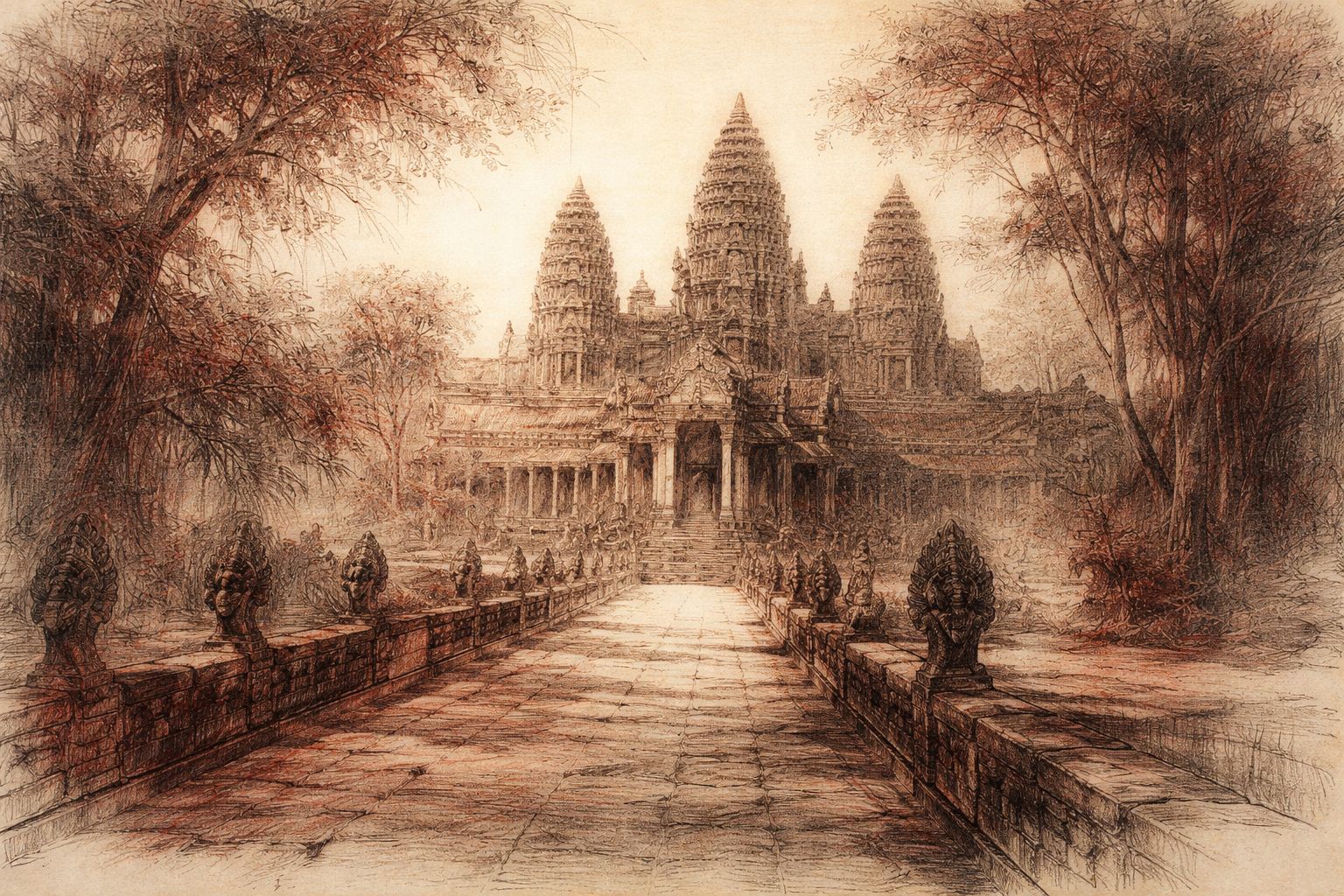

Dharma — What Holds
Dharma is not announced in Angkor. It is carried. It passes through stone as weight passes through a column: unseen, assumed, decisive. The word itself begins with bearing—with what holds, supports, keeps from collapse. In this landscape of reservoirs and causeways, of towers raised and sustained by patient masonry, dharma is not a concept set apart from form. It is the condition that allows form to endure.
The temples do not explain it. They enact it. Orientation teaches restraint before belief does. Thresholds slow the body into measure. Processional routes insist on sequence, return, and proportion. One learns dharma here not by instruction, but by compliance—by allowing the body to be guided into alignment with something larger than preference. The stone does not persuade. It disciplines.
In its earliest sense, dharma names the law that binds without coercion. It is the rule by which the world keeps faith with itself. In Angkor, this rule is architectural before it is moral. Water must be held at the correct level. Foundations must meet laterite with exactness. Towers rise only if weight is carried correctly from course to course. Failure is not punished; it simply fails. Collapse is the consequence of misalignment, not transgression.
Human life enters this order as obligation rather than aspiration. To live within dharma is not to choose freely, but to inhabit one’s given place with accuracy. The role does not ask to be loved. It asks to be borne. Whether priest or cultivator, king or labourer, each position carries a shape, a load, a duration. To perform it imperfectly but faithfully is considered nearer to truth than to imitate another’s calling with brilliance. The error lies not in weakness, but in displacement.
Kingship, in this understanding, is not exemption but exposure. The ruler stands where dharma is most visible and most fragile. Authority is legitimate only insofar as it holds the order together—protecting soil, water, labour, and law from fracture. The king does not invent justice; he carries it. When he fails, the failure is not merely political. It is cosmic. Disorder enters as imbalance, not rebellion.
Time itself participates in this logic. Dharma is said to wane across the great ages, losing stability as the world moves farther from its origin. Yet Angkor does not dramatise this decline. It responds with endurance. If the age weakens, the stone compensates. If certainty thins, structure thickens. The temples are not nostalgic for a golden past; they are efforts to hold what remains with greater care.
Truth, here, is not rhetorical. It is structural. A life aligned with dharma acquires a quiet force—not the power to dominate, but the power to remain coherent under strain. Falsehood eventually collapses because it cannot carry weight indefinitely. What is borne honestly endures longer than what is proclaimed loudly.
To encounter dharma in Angkor is to feel the cost of order. It asks for attention, patience, and the acceptance of limits. It offers no consolation beyond stability. Yet in a world shaped by monsoon and time, that stability is not small. It is what allows the stone to stand, the water to rest, and the pilgrim—moving slowly, adjusting posture—to sense that something larger is being held, and that for a moment, they are helping to carry it.
—
Receive the next work
Subscribe free to receive new work from the Lucas Varro Library by email.
More from the Library


See Also
A concise and impartial dictionary of absence, promises, quarrels, ordinary objects, and the troublesome instability of words.
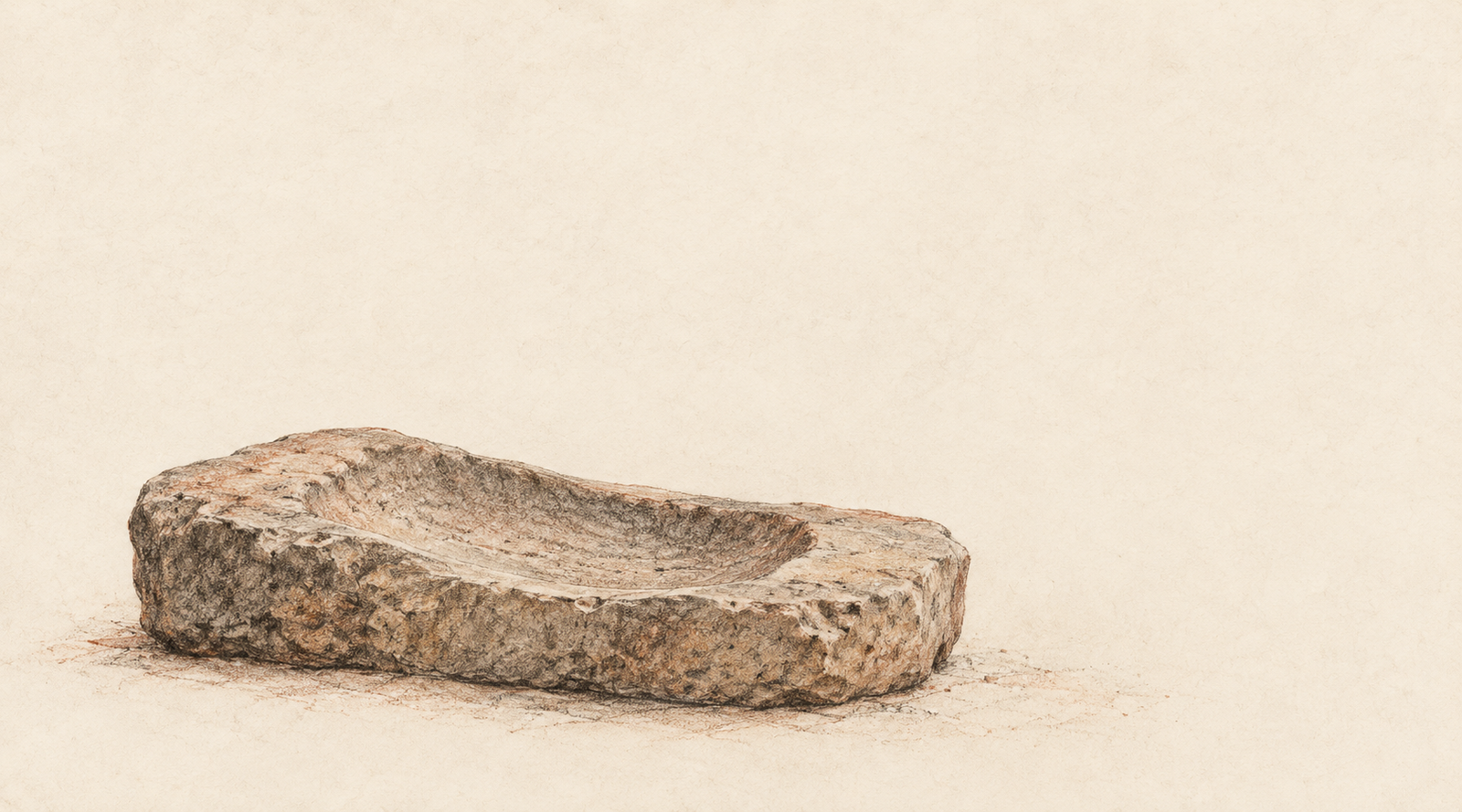

The City of Service
The temple we inherit is a building from which almost all necessity has been removed. Nothing must be brought for it to continue being what we call a temple. The sanctuary asks nothing of us. Stone is good at this kind of independence.
A living temple was otherwise.
Water had to come in. So did grain, cloth, oil, aromatic substances, fuel. The things required for worship arrived because someone carried them across a threshold.


Houses of Wood, Light, and Smoke
Some of Angkor’s most intimate ruins do not rise above the ground at all. They are postholes, low mounds, hearths and ponds: durable traces of a domestic city built largely from things that decay. To restore that city is to see Angkor not only as stone, but as wood, smoke, water, repair, and people living within calling distance.