
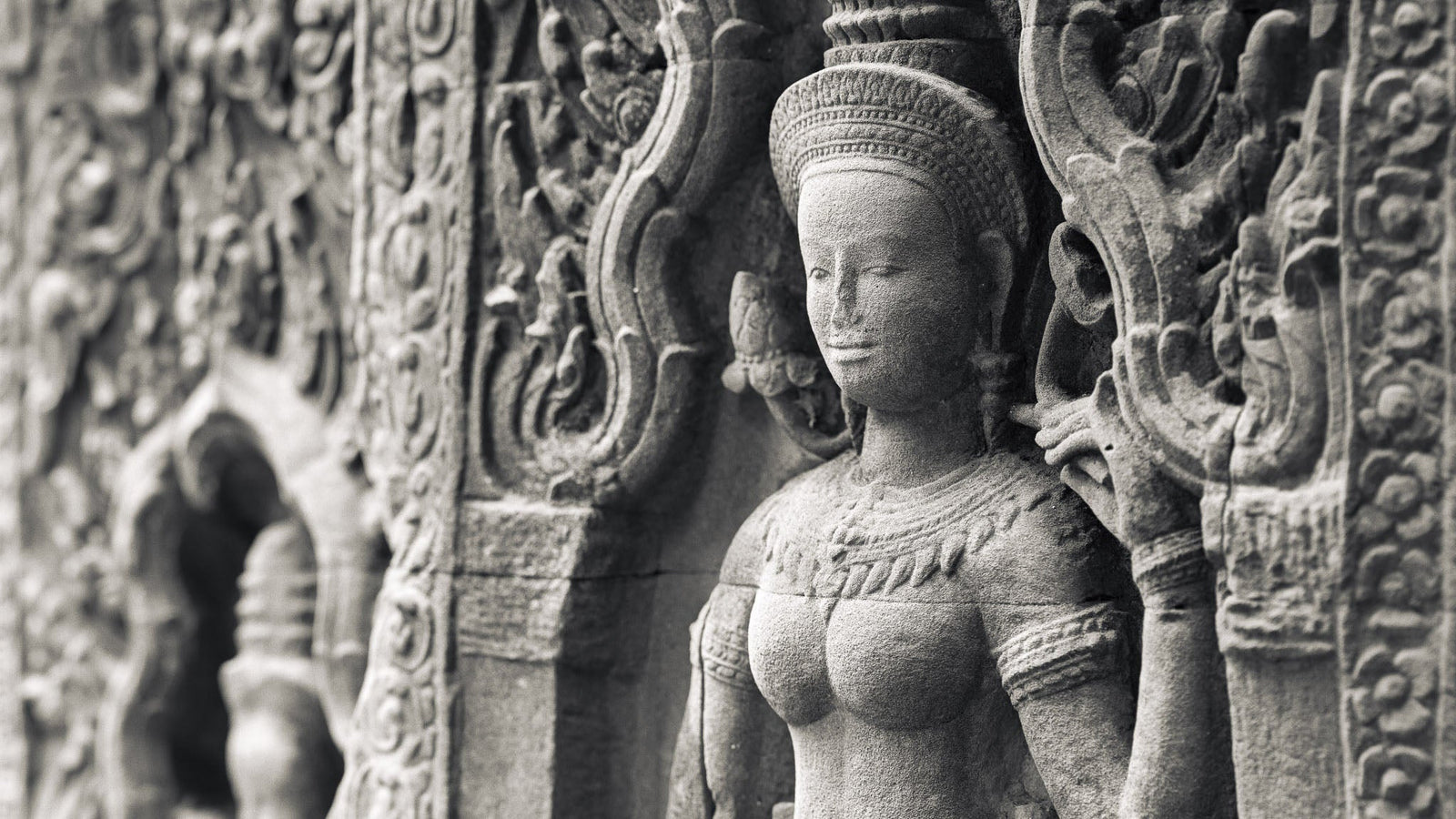

Devatas of Angkor: The Guardians Who Remain
Those Who Remain Standing
They are encountered not as figures to be sought, but as presences already waiting. Along the walls, at the angles of galleries, beside thresholds worn smooth by centuries of passage, they stand—unmoving, unannounced, intact. The devatas do not call attention to themselves. They do not narrate, dance, or intervene. They remain, and in remaining they quietly alter the space around them.
To walk the temples of Angkor is to feel how thoroughly they are woven into the architecture. Stone alone would be weight and enclosure. Reliefs alone would be story. But the devatas establish something else: a populated stillness. They give the impression that the temple is not empty between rituals, not abandoned between kings, not inert between prayers. Even now, when incense no longer burns and chants no longer echo, they maintain a sense of habitation. The sanctuary feels kept.
Their posture is essential. They stand upright, frontal, composed. Their feet may turn slightly in profile, their hips settle into a gentle curve, but there is no suggestion of movement. This is not hesitation; it is resolution. They do not arrive and they do not depart. Their role is to hold position—at doorways, on piers, in recesses where stone meets shadow. They do not block entry, yet the threshold feels marked. One passes in their presence, not beyond it.
In earlier temples, their placement is selective. They guard sanctuaries devoted to goddesses, as if assigned to watch over spaces already feminine in orientation. Later, they proliferate. By the twelfth century they appear everywhere—no longer confined to inner sanctums but spread across the full skin of the monument. The temple becomes crowded with witnesses. Walls are no longer neutral surfaces; they are occupied.
What they hold is modest: a lotus bud, a flower stem, a fly-whisk, sometimes a mirror or a small vessel. These objects do not read as tools. They function more like affirmations. Growth, purity, order, attention. Nothing sharp. Nothing violent. Their power is not forceful. It is cumulative, transferred slowly through repetition and presence. The stone receives it. The building is made auspicious by being so consistently accompanied.
They are youthful, but not girlish. Their bodies are fully formed, adorned, composed. Jewellery is elaborate—necklaces heavy, armlets tight, belts precise. Hair is arranged with care beneath tiered crowns. These are not abstractions. They record the court: its fashions, its ideals of beauty, its understanding of refinement. To stand before them is to sense how the sacred and the royal were never far apart. The divine was imagined wearing the same ornaments as queens and princesses. Heaven dressed like the palace.
And yet, despite their finery, there is restraint. The face is calm. The mouth neither smiles broadly nor frowns. Eyes are often lowered, or half-open, or directed forward without challenge. They do not seduce. They do not distract. Their beauty does not pull the viewer outward; it gathers attention inward. One feels observed, but not judged. A quiet exchange takes place, without gesture or speech.
The distinction between devatas and apsaras clarifies their function. Where apsaras move—flying, dancing, celebrating—devatas remain. Where apsaras animate the heavens with rhythm and delight, devatas stabilise the earthbound palace of the god. One brings energy; the other ensures continuity. Together they complete the cosmology of the temple, but it is the devatas who define its moral temperature. Without them, the building would feel impressive but vacant. With them, it feels inhabited by care.
At Angkor Wat, their number becomes overwhelming. Nearly two thousand, each distinct. No repetition of jewellery, no identical arrangement of hair or posture. The labour involved is staggering, but the effect is subtle. One does not notice difference immediately; one notices abundance. Only later does individuality emerge. This is not decoration for spectacle. It is a declaration: prosperity made visible through attention to detail. The kingdom had the means, the time, and the devotion to ensure that even divine guardians were never copied.
Some appear in pairs or trios, arms lightly touching, bodies angled toward one another. The strict isolation of the sentinel softens. A hint of intimacy enters the stone. These figures remain still, but they are no longer solitary. They suggest companionship, shared duty, perhaps shared origin. The temple wall becomes less like a barrier and more like a gathering.
In later styles, the faces change. The features soften. The gaze becomes more direct, more human. The faint smile appears—not exuberant, not theatrical, but present. Compassion replaces distance. One feels less watched over and more accompanied. The devata becomes not only guardian but guide. The stone no longer merely holds; it meets the viewer halfway.
Their purpose is often explained as protection, fertility, prosperity. These are accurate, but insufficient. What they truly establish is legitimacy. The temple claims its place as a celestial residence because it is appropriately staffed. No god would dwell alone in bare stone. The devatas ensure hospitality. They make the monument socially complete. In this sense, they function as diplomats between worlds—assuring the divine that honour has been properly observed, and assuring the human that presence has been acknowledged.
There is also an echo of memory. Some devatas may bear the names of real women, elevated after death, fixed into stone as enduring attendants of the sacred. The boundary between human and divine blurs. Grief, devotion, and political continuity intersect. The wall becomes an archive of transformed lives. The temple remembers through bodies that do not age.
To stand among them for long enough is to feel how little they require from the viewer. They do not ask to be admired closely. They do not reward analysis with revelation. Their effect accumulates through duration. The longer one remains, the more the space steadies. Sound softens. Movement slows. The body aligns itself with the stillness already present.
They do not move because they do not need to. Their task is not action, but assurance. They guarantee that the space remains worthy, even when empty. Long after kings have gone, rituals ceased, and meanings shifted, they continue to stand. Not as remnants, but as residents.
—
Receive the next work
Subscribe free to receive new work from the Lucas Varro Library by email.
More from the Library


See Also
A concise and impartial dictionary of absence, promises, quarrels, ordinary objects, and the troublesome instability of words.

The City of Service
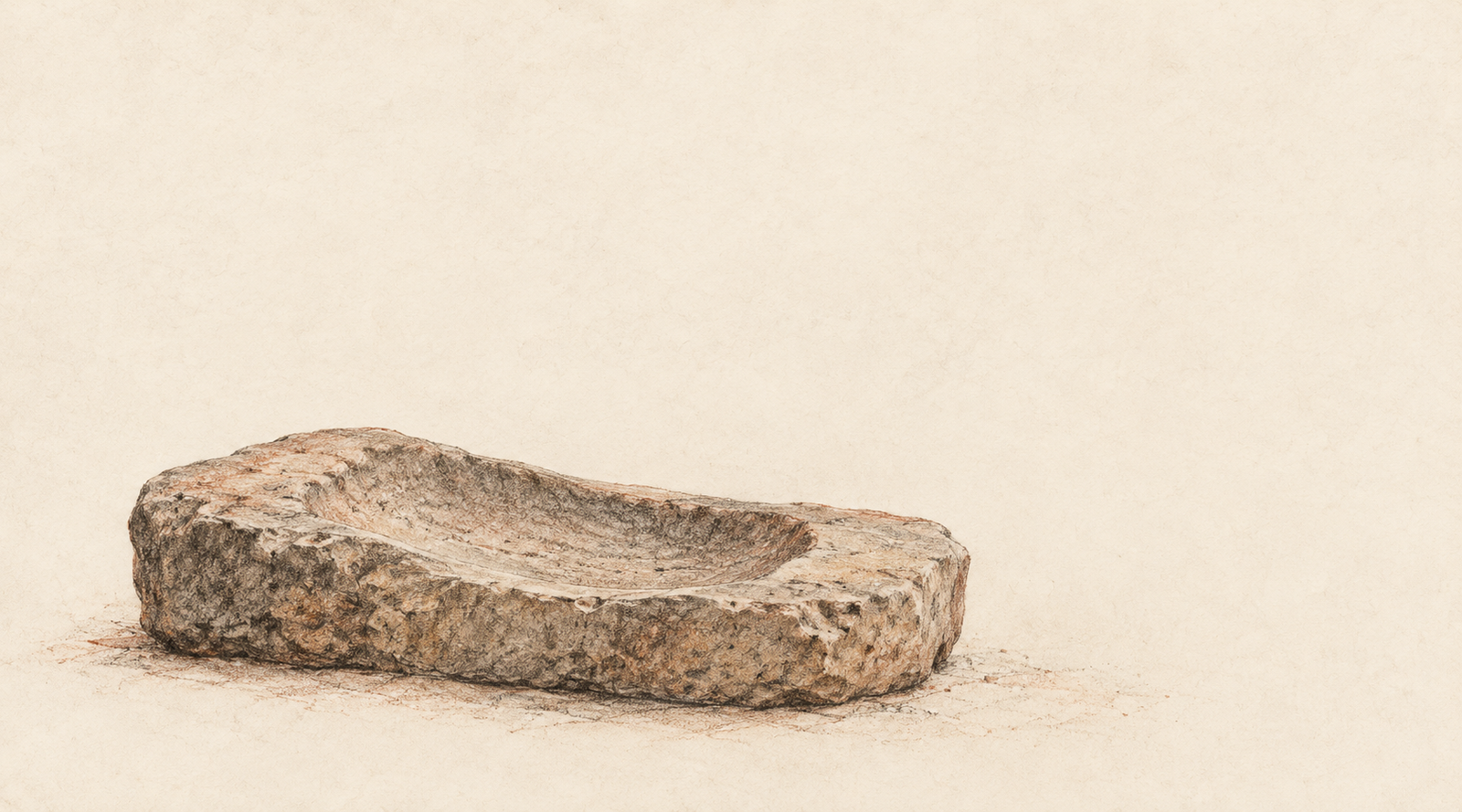
The temple we inherit is a building from which almost all necessity has been removed. Nothing must be brought for it to continue being what we call a temple. The sanctuary asks nothing of us. Stone is good at this kind of independence.
A living temple was otherwise.
Water had to come in. So did grain, cloth, oil, aromatic substances, fuel. The things required for worship arrived because someone carried them across a threshold.

Houses of Wood, Light, and Smoke
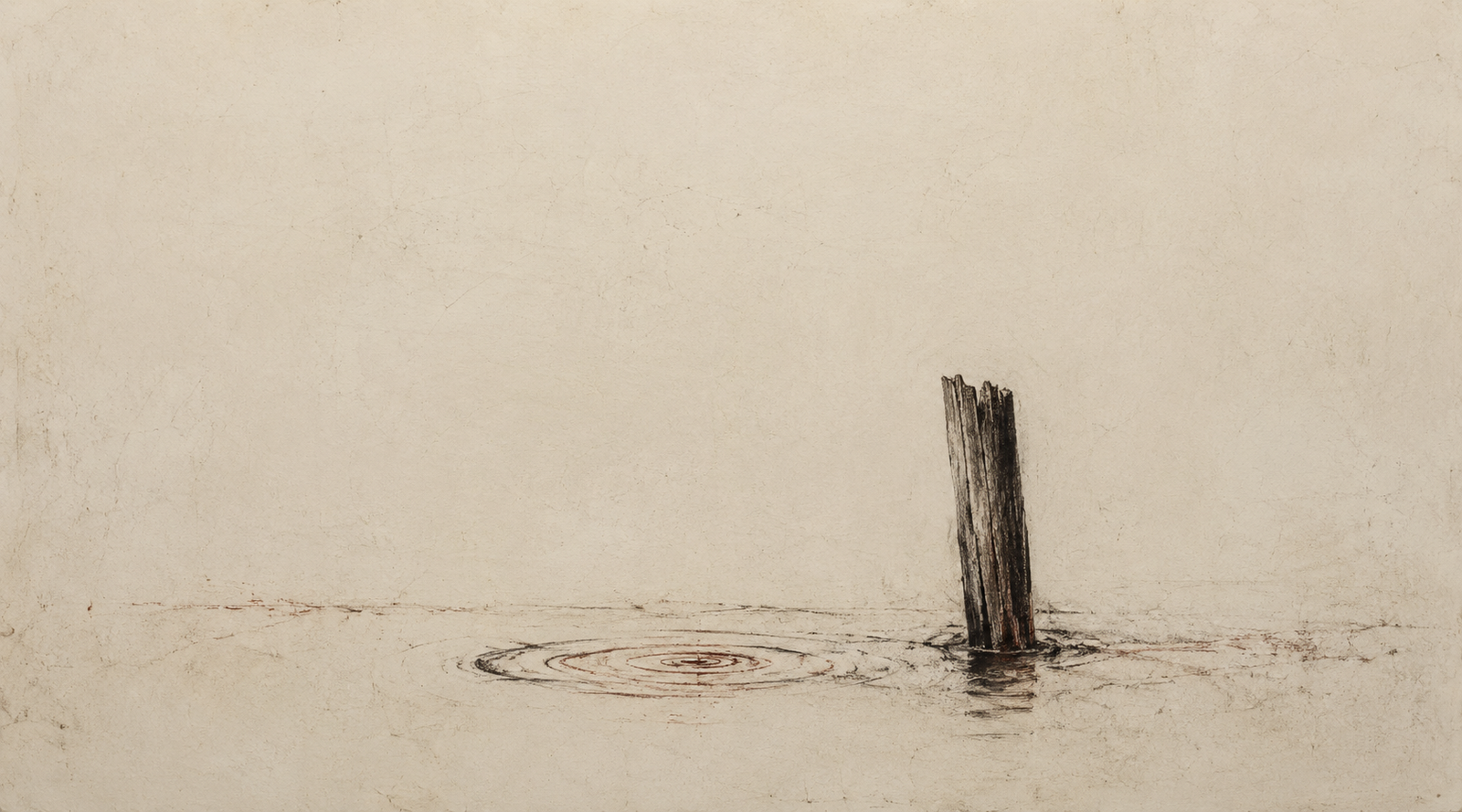
Some of Angkor’s most intimate ruins do not rise above the ground at all. They are postholes, low mounds, hearths and ponds: durable traces of a domestic city built largely from things that decay. To restore that city is to see Angkor not only as stone, but as wood, smoke, water, repair, and people living within calling distance.