

Angada — The Strength That Carries Forward
In the great epic of the Ramayana, power often arrives disguised as devotion. Not thunder, not kingship, not divine weaponry—but a young vanara who carries the weight of a broken lineage forward without bitterness. Angada stands at the hinge where grief becomes service, where inheritance is not claimed but entrusted.
Angada is born into fracture. He is the son of Valin, the fallen monkey-king, and Tara, whose wisdom exceeds the violence of her world. His uncle Sugriva inherits the throne after Valin’s death, but the boy inherits something heavier: memory, loyalty, and the burden of reconciliation. On his deathbed, Valin places Angada under the protection of Rama—not as hostage, not as symbol, but as promise. The past is not erased; it is carried.
This is Angada’s first lesson. He does not rebel. He does not retreat. He becomes present.
When Sita is abducted by Ravana, Angada joins the vanara host not as heir-in-waiting but as anchor. The campaign to Lanka is not merely a march of arms; it is a test of cohesion—between species, dynasties, and wounded loyalties. Angada holds that cohesion without speech.
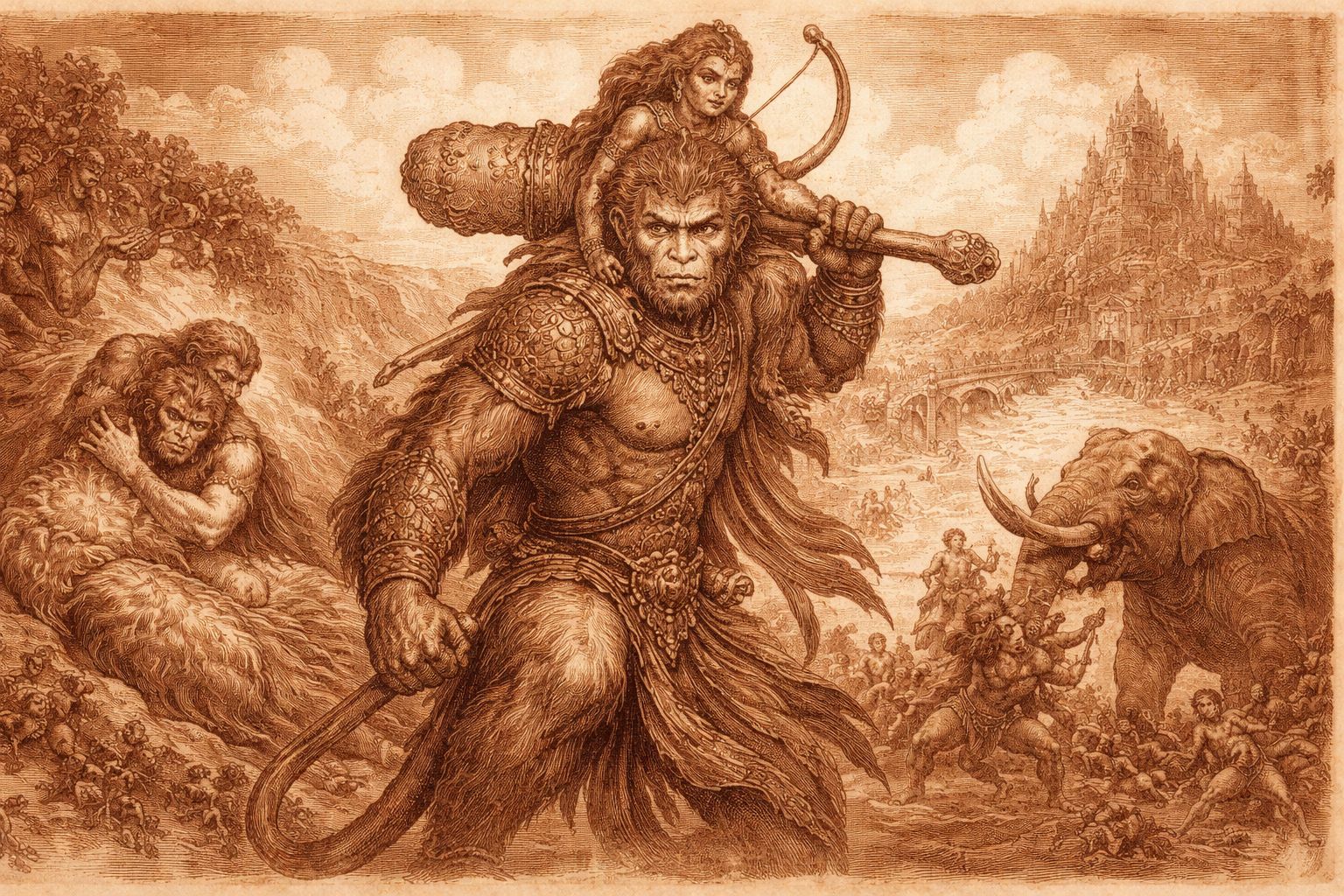
At the threshold of the sea, when the causeway to Lanka is completed, it is Angada who inaugurates the crossing. Lakshmana, bearer of royal blood and martial fire, rides upon Angada’s shoulders as they step onto the bridge. The image is precise and deliberate: strength bearing duty, youth carrying lineage, the vanara body becoming a living pier between worlds. Stone follows later. First comes trust.
In the Battle of Lanka, Angada’s restraint gives way to ferocity—but never to chaos. He fights in single combat against Ravana’s champions, not as spectacle but as necessity. He topples the elephant of Mahodara. He overcomes Narantaka. He slays Vajradamshtra and presses on. These are not acts of cruelty but of clearing—removing obstacles so the path remains open. Even in violence, Angada remains architectural. He creates passage.
Khmer sculptors understood this. In the west gallery of Angkor Wat, Angada appears amid the formal duels of the Battle of Lanka, his body compact, coiled, resolved. He is not exaggerated. He does not dominate the frame. He belongs to the rhythm of the narrative—an embodiment of continuity rather than climax. Elsewhere, in the Bayon style of Banteay Chhmar and Bayon, his presence sharpens: a warrior formed by loyalty rather than ambition.
Angada’s deeper symbolism lies here. He is the figure who proves that inheritance need not reproduce conflict. Though his father died in opposition to Rama, Angada becomes one of Rama’s most steadfast allies. Though born of a contested throne, he does not contest. He bridges reigns, factions, and moral wounds. He is the living causeway—flesh where stone will follow.
In a world intoxicated by conquest, Angada offers a quieter strength: the capacity to carry forward what is unfinished without demanding recompense. He teaches that continuity is not passive. It requires muscle, patience, and the willingness to bear weight so others may cross.
This is why he endures in stone. Not because he ruled. Not because he spoke. But because, at the moment when the future needed a body strong enough to hold it, Angada stepped forward—and did not step aside.
—
Receive the next work
Subscribe free to receive new work from the Lucas Varro Library by email.
More from the Library


See Also
A concise and impartial dictionary of absence, promises, quarrels, ordinary objects, and the troublesome instability of words.

The City of Service
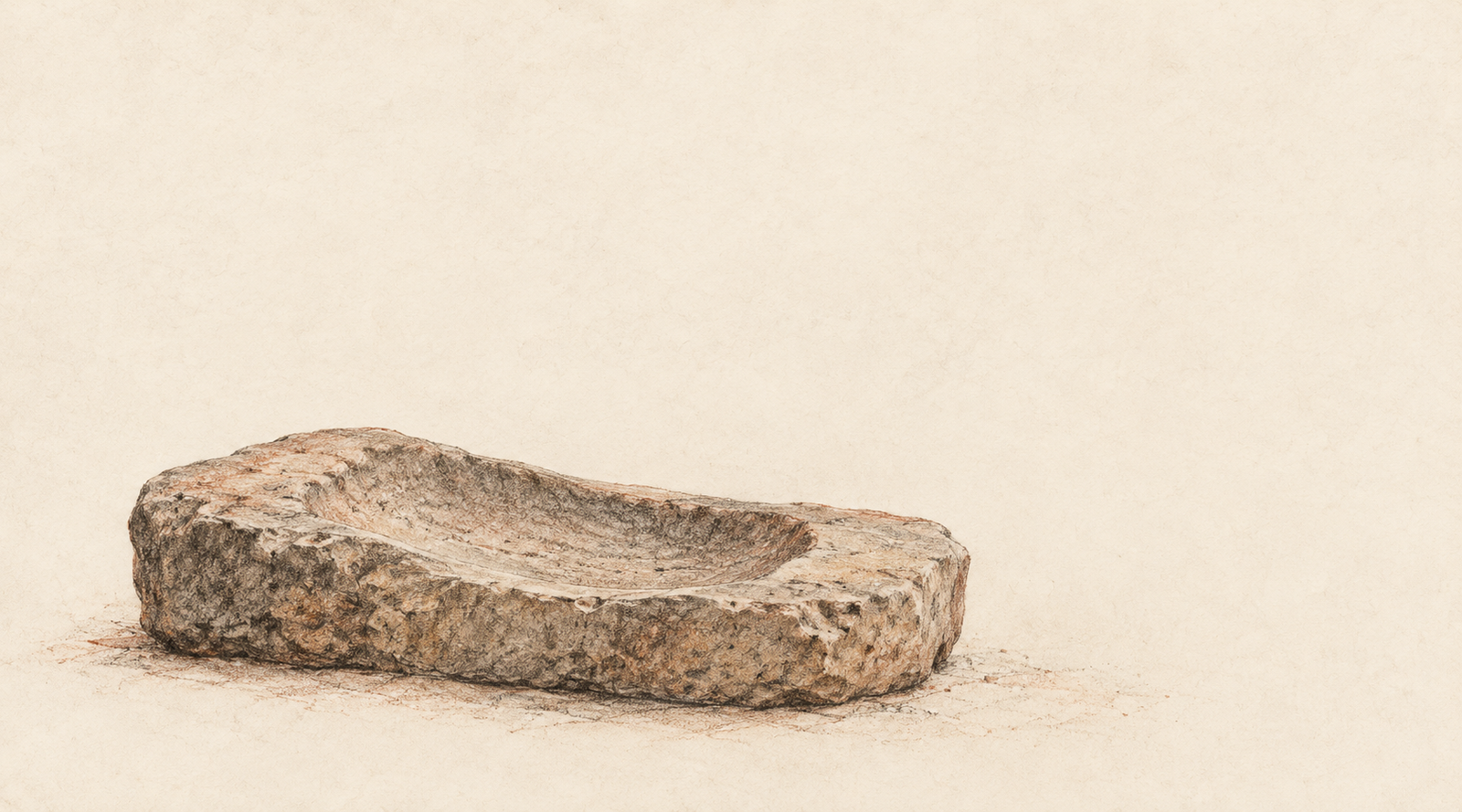
The temple we inherit is a building from which almost all necessity has been removed. Nothing must be brought for it to continue being what we call a temple. The sanctuary asks nothing of us. Stone is good at this kind of independence.
A living temple was otherwise.
Water had to come in. So did grain, cloth, oil, aromatic substances, fuel. The things required for worship arrived because someone carried them across a threshold.


Houses of Wood, Light, and Smoke
Some of Angkor’s most intimate ruins do not rise above the ground at all. They are postholes, low mounds, hearths and ponds: durable traces of a domestic city built largely from things that decay. To restore that city is to see Angkor not only as stone, but as wood, smoke, water, repair, and people living within calling distance.