
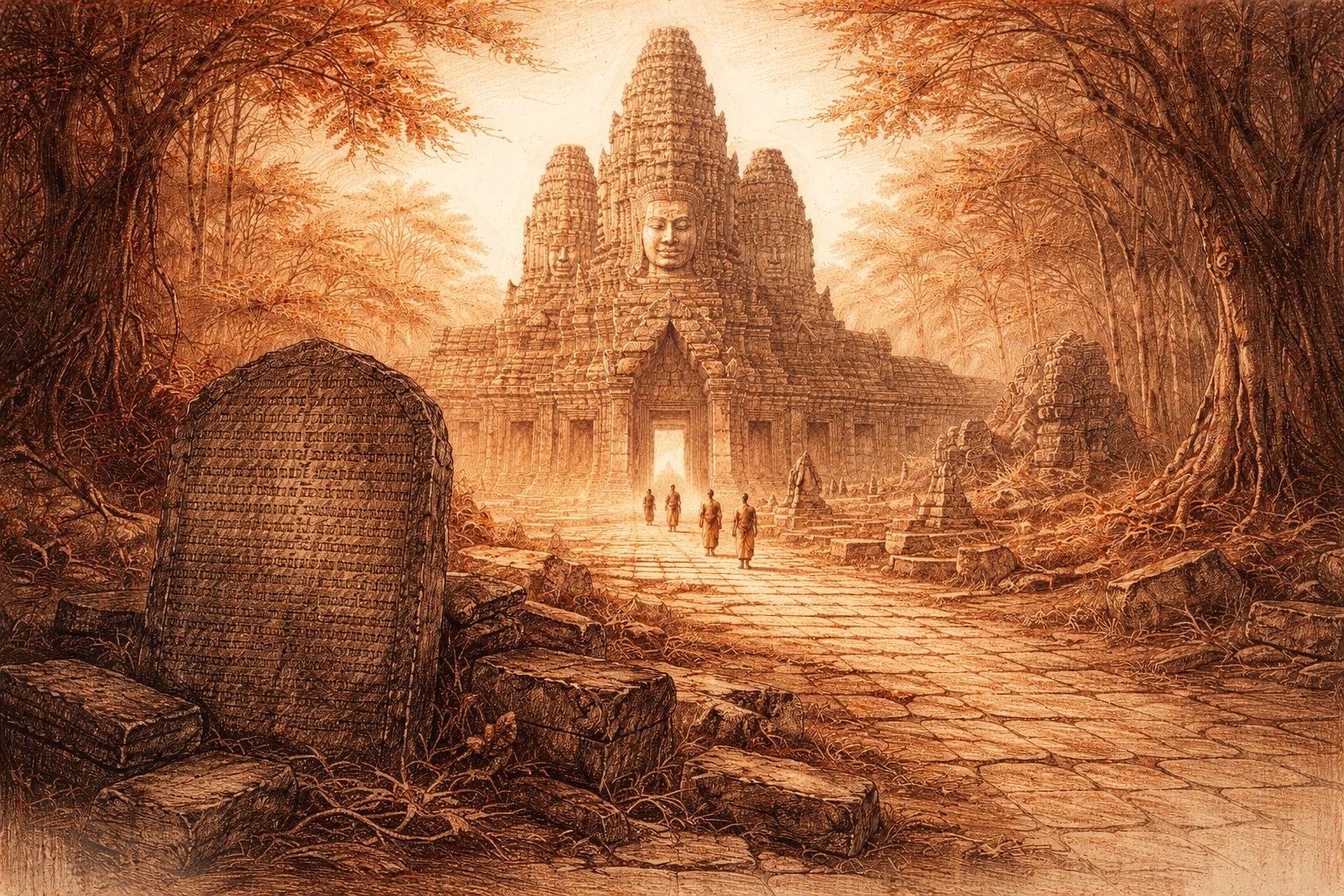

Jayavarman IX — The Last Inscription
Angkor did not end with fire.
It ended with silence.
Jayavarman IX stands at the edge of that silence—the last king whose name was cut into stone, the final voice to speak in Sanskrit upon the walls of the empire. After him, the monuments fall quiet. Not ruined, not erased, but no longer speaking in the old language of divine kingship.
He came to power in 1327, inheriting not a rising civilisation but a structure already hollowed by time. The great mandala of Angkor had fractured long before his reign. The hydraulic system was failing. The population had thinned. The centre no longer held with conviction. What remained was habit, memory, and stone.
Like his father, Indravarman IV, Jayavarman IX was a Shaivite. But this was no longer the militant Shaivism of Jayavarman VIII, no longer a campaign of chisels and erasures. The violence had already passed. The great Mahayana images had been defaced, re-carved, buried, or broken. The reaction had spent itself. Jayavarman IX inherited the aftermath, not the struggle.
His reign is notable precisely for what it lacks. There are no great temples bearing his name. No new capitals. No monumental declarations of cosmic order. Instead, there is consolidation—ritual continuity without architectural ambition. The king maintained Shaivite orthodoxy, but without the ideological urgency of restoration. Shiva remained, but no longer demanded proclamation.
This restraint is not weakness. It is realism.
By the fourteenth century, Angkor was no longer the unquestioned centre of the world. Power had begun to drift—southward, toward the Mekong; inward, toward Theravada monastic communities; outward, into regional polities less dependent on stone and spectacle. The old model of kingship—divine, centralised, mandalic—had lost its economic and spiritual leverage.
Jayavarman IX ruled a kingdom that had outgrown its cosmology.
And yet, he still inscribed.
His inscriptions are the last Sanskrit texts of Cambodia. They close a literary and metaphysical epoch that began with the early Angkorian kings—when the ruler was written as god, the temple as universe, the city as cosmic diagram. After Jayavarman IX, inscriptions would continue, but in Khmer, and in a different register: administrative, local, human.
This shift matters. It marks the end of Angkor as a civilisation that spoke primarily to the gods.
The Cambodian Royal Chronicle records that Jayavarman IX was assassinated in 1336 by the head of the royal gardens, Neay Trasac Paem Chay, who then seized the throne through marriage. The story is almost certainly legendary—too neat, too symbolic, echoing similar myths elsewhere in Southeast Asia. Whether or not it is true, its persistence is revealing.
The king is overthrown not by a rival prince or a conquering army, but by a caretaker of cultivated ground.
Garden replaces temple. Steward replaces god-king.
Even if the tale is fiction, it speaks a deeper truth. Power had shifted from the monumental to the managed, from cosmic display to earthly continuity. The empire no longer needed to prove itself to heaven. It needed to survive on the ground.
Jayavarman IX does not preside over collapse. He presides over transition.
He is the last figure of an old grammar, ruling long enough to close it properly. After him, Angkor does not fall—it dissolves, redistributing its meaning into monasteries, villages, rivers, and memory. The stones remain, but they are no longer commanded to speak.
With Jayavarman IX, Angkor finishes its sentence.
—
Receive the next work
Subscribe free to receive new work from the Lucas Varro Library by email.
More from the Library


See Also
A concise and impartial dictionary of absence, promises, quarrels, ordinary objects, and the troublesome instability of words.

The City of Service
The temple we inherit is a building from which almost all necessity has been removed. Nothing must be brought for it to continue being what we call a temple. The sanctuary asks nothing of us. Stone is good at this kind of independence.
A living temple was otherwise.
Water had to come in. So did grain, cloth, oil, aromatic substances, fuel. The things required for worship arrived because someone carried them across a threshold.

Houses of Wood, Light, and Smoke
Some of Angkor’s most intimate ruins do not rise above the ground at all. They are postholes, low mounds, hearths and ponds: durable traces of a domestic city built largely from things that decay. To restore that city is to see Angkor not only as stone, but as wood, smoke, water, repair, and people living within calling distance.