

Jayavarman IX — The Last Candle and the Morning Light
The end of Angkor was not announced by invasion or fire.
It arrived as a change in breath.
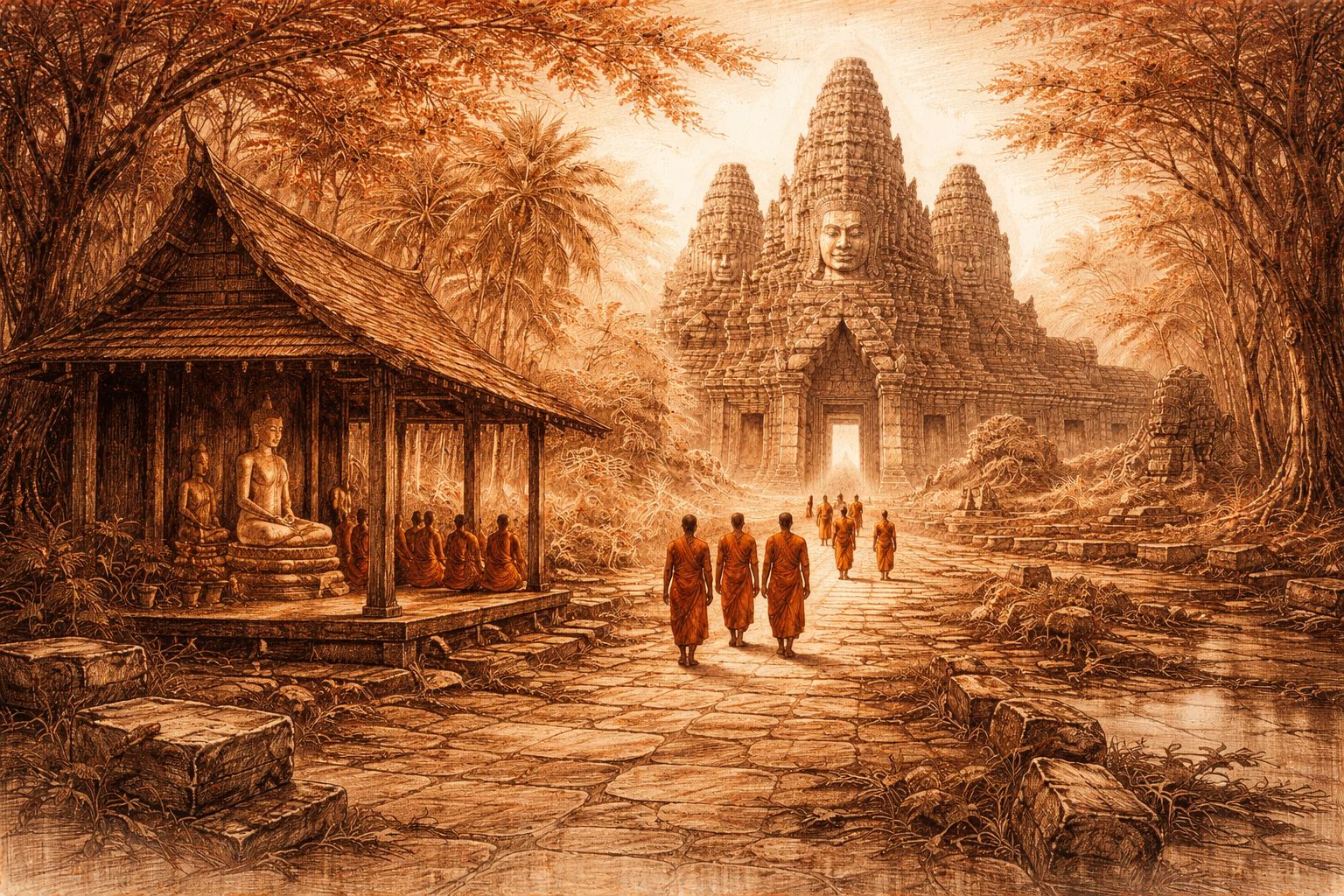
Jayavarman IX stands precisely at that moment—the last king named in stone, the final sovereign to speak in Sanskrit, ruling while the spiritual centre of Cambodia was already moving elsewhere. His reign does not oppose the rise of Theravada Buddhism. It quietly witnesses it.
The accession of Jayavarman IX in 1327 is recorded in the final Sanskrit inscription of Cambodia, discovered near the northeast corner of the Angkor Wat moat, at a site once called Kapilapura. Its language is formal, elevated, and Shaivite—dense with the metaphysical confidence of an older world. The king is still framed within the cosmology of divine kingship. Shiva still speaks. The court still listens.
But outside the walls, the grammar had already changed.
By the early fourteenth century, Theravada Buddhism had taken deep root among the Khmer population. Carried from Sri Lanka through Mon and Thai networks, it spread not by monument or decree, but by practice—monks walking barefoot between villages, sermons delivered beneath trees, ethics taught through daily conduct rather than cosmic myth. Where earlier religions had required kings, architects, and stone, Theravada required only attention, discipline, and memory.
This was not a religion of the court. It was a religion of the people.
Jayavarman IX inherited a kingdom where this transformation was already irreversible. His father, Indravarman IV, had ruled during the acceleration of the shift. Earlier still, Srindravarman had left the first Pali inscription in Cambodia in 1309, formally acknowledging the Doctrine of the Elders at royal level. Jayavarman IX did not reverse this movement. Nor did he fully join it. Instead, he held the old form long enough for it to end with dignity.
This matters.
His Shaivism is not reactionary. It is residual. Hinduism, by his reign, had retreated into the court as a final refuge—preserved through ritual, language, and inscription, even as its social authority dissolved. Jayavarman IX is not the architect of a new religious order. He is the custodian of a closing one.
The physical landscape reflects this shift with quiet clarity. Monumental temple construction ends. No new temple-mountains rise. The hydraulic ambition that once bound kingship to cosmic order falters. In its place emerge simpler forms: wooden viharas, brick assembly halls, reoccupied sanctuaries shaped for communal listening rather than divine display.
Even Angkor Wat—once a Vaiṣṇava temple of imperial scale—slowly becomes something else. Its galleries fill with monks. Its vast enclosures soften into spaces of recitation and meditation. Stone does not vanish, but it relinquishes command.
Theravada does not need monuments to endure. That is its strength.
Jayavarman IX also presides over the final anchoring of political authority at Angkor itself. After his reign, the demographic and administrative centre of Cambodia drifts southward toward the Quatre Bras region near Phnom Penh, drawn by river trade, maritime networks, and new economic realities. The stone city, once the heart of the world, becomes a remembered place.
The Cambodian Royal Chronicle records that Jayavarman IX was assassinated by a court gardener who seized the throne. The story is almost certainly legendary, echoing similar myths elsewhere. But legend, here, speaks accurately in symbol if not in fact. The king is replaced not by a conqueror, but by a caretaker. The garden supersedes the temple. Stewardship replaces cosmology.
Jayavarman IX is not the king who brought Theravada to Cambodia.
He is the king who allowed it to arrive fully.
By remaining the last voice of the old order—measured, formal, inscribed—he closes the Angkorian world cleanly. After him, Cambodian spirituality no longer needs to speak to heaven in Sanskrit. It speaks to the ground, in Khmer, in breath, in conduct.
The candle goes out.
Morning does not rush in.
It simply arrives.
—
Receive the next work
Subscribe free to receive new work from the Lucas Varro Library by email.
More from the Library

The Leaf and the Pencil
A leaf holds my attention. Then I remember that I can draw. The pencil reveals things I had never noticed, but introduces its own demands: proportion, shading, the desire to make something beautiful. When I try to describe the encounter, language presents another difficulty. An essay about the uncertain distance between looking at something, understanding it, and being present with it.

The Work We Return To
We have become very good at measuring persistence, and less good at asking what deserves it.
A musician begins the same passage again. A writer returns to an unfinished sentence. Someone stands before a familiar face carved in stone, with nothing new to photograph.
What brings us back when enthusiasm has gone? And how do we distinguish devotion from the demands that quietly consume the rest of our lives?

Under the Gallery
Rain, a carved hand, and the small movements of lives separated by centuries. A new literary piece from The Vow.