
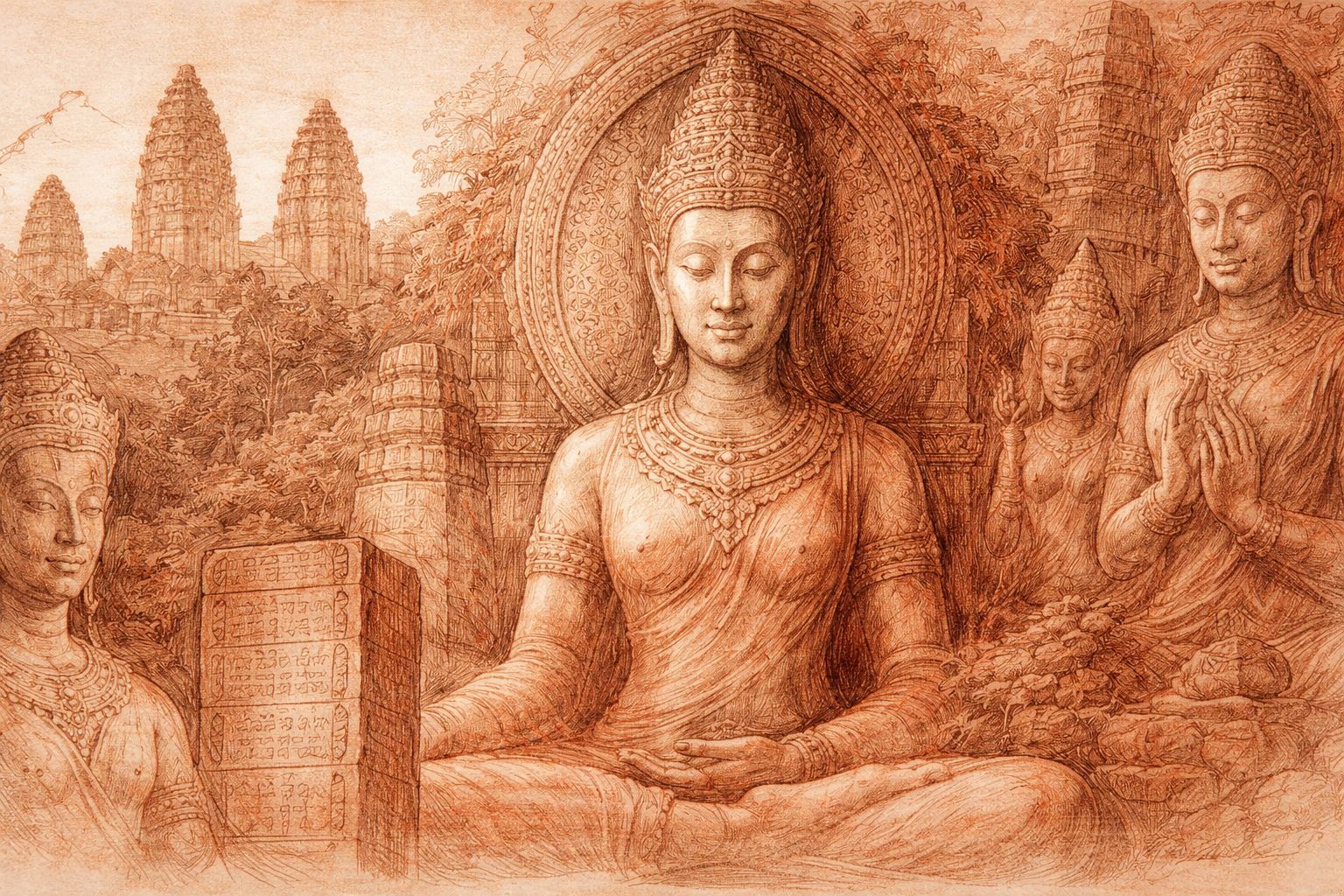

Vrah Rupa — Identity Without a Face
At Angkor, identity does not reside in likeness.
Stone faces repeat themselves with deliberate restraint: calm, symmetrical, impersonal. To modern eyes, this repetition can feel evasive, even anonymous. We search for portraits and do not find them. Yet this absence is not a failure of representation. It is a different understanding of what a person is—and what may remain of them after death.
The Khmer answer was the vrah rupa.
The term, drawn from Sanskrit and Old Khmer, means “sacred image,” but this translation is insufficient. A vrah rupa was not an image of a person. It was the conceptual body of their spiritual self, abstracted from flesh, preserved beyond mortality, and anchored within the divine order. Through the vrah rupa system, an individual—often deceased, sometimes living—was ritually identified with a god and thus granted a form of apotheosis.
This was not metaphorical. It was administrative, ritual, and enduring.
In this system, portraiture was irrelevant. What mattered was essence, not appearance. To create a vrah rupa, the Khmer did not sculpt a face remembered by the living. They borrowed a canonical divine form—Shiva, Vishnu, Lokeshvara, Prajnaparamita—and installed the individual’s spiritual identity within it. The god provided the structure. The human soul inhabited it.
This is why so many Angkorian statues appear interchangeable. They were never meant to distinguish individuals through features. Distinction occurred elsewhere—through names, ritual, and inscription.
Khmer inscriptions consistently record three separate levels of identity. First, the person as a social being: a king, a queen, a minister, a parent. Second, the vrah rupa: the abstract sacred identity of that person aligned with a deity. Third, the statue itself: the material vessel, the physical body through which the divine-human fusion could be approached, fed, honoured, and sustained.
Because the statues themselves were iconographically identical, inscriptions were indispensable. Doorway piers, thresholds, and sanctuary walls functioned as nameplates in stone. They told the informed visitor not only which god was present, but which person now existed within that god’s form.
Names were the hinge. The link between human and divine was formalised through composite nomenclature, binding an individual’s personal name to the identity of a deity. A suffix such as -ishvara or -deva aligned a person with Shiva; -narayana or -svamin bound them to Vishnu; -devi or -ishvari placed women within the body of a goddess. These were not honorifics. They were ontological statements.
Under Jayavarman VII, the system reached an extraordinary level of religious openness. Individuals whose sacred identities bore Hindu names were represented by Buddhist forms. Men were housed within Lokeshvara; women within Prajnaparamita. The statue’s iconography mattered less than the ritual intention and the name recorded beside it. Hindu ancestors could inhabit Buddhist hosts without contradiction.
What endured was not dogma, but continuity.
The vrah rupa was animated through ritual—most notably the eye-opening ceremony, in which the statue’s gaze was pierced or painted to allow the divine presence to enter. Once enlivened, the image became a yasahsariira: a “body of glory.” From that moment, the individual existed in a stable, recognisable form within the sacred economy of the temple.
This had consequences for the living. By maintaining the cult of their ancestors’ vrah rupas, descendants sustained a bridge of merit across generations. Care for the dead was inseparable from care for the future. Memory became an ethical act, and preservation a moral duty.
Seen this way, Angkor’s countless calm faces are not anonymous at all. They are precise, disciplined, and intentional. Identity here is not worn on the surface. It is spoken softly, recorded in stone at the threshold, and carried by ritual rather than resemblance.
The vrah rupa system asks us to see differently: to stop searching faces for personality, and to listen instead for names, placements, and acts of care. It reminds us that in this civilisation, a person did not survive by being remembered as they looked—but by being correctly placed within the order of the sacred.
—
Receive the next work
Subscribe free to receive new work from the Lucas Varro Library by email.
More from the Library


See Also
A concise and impartial dictionary of absence, promises, quarrels, ordinary objects, and the troublesome instability of words.

The City of Service
The temple we inherit is a building from which almost all necessity has been removed. Nothing must be brought for it to continue being what we call a temple. The sanctuary asks nothing of us. Stone is good at this kind of independence.
A living temple was otherwise.
Water had to come in. So did grain, cloth, oil, aromatic substances, fuel. The things required for worship arrived because someone carried them across a threshold.

Houses of Wood, Light, and Smoke
Some of Angkor’s most intimate ruins do not rise above the ground at all. They are postholes, low mounds, hearths and ponds: durable traces of a domestic city built largely from things that decay. To restore that city is to see Angkor not only as stone, but as wood, smoke, water, repair, and people living within calling distance.