
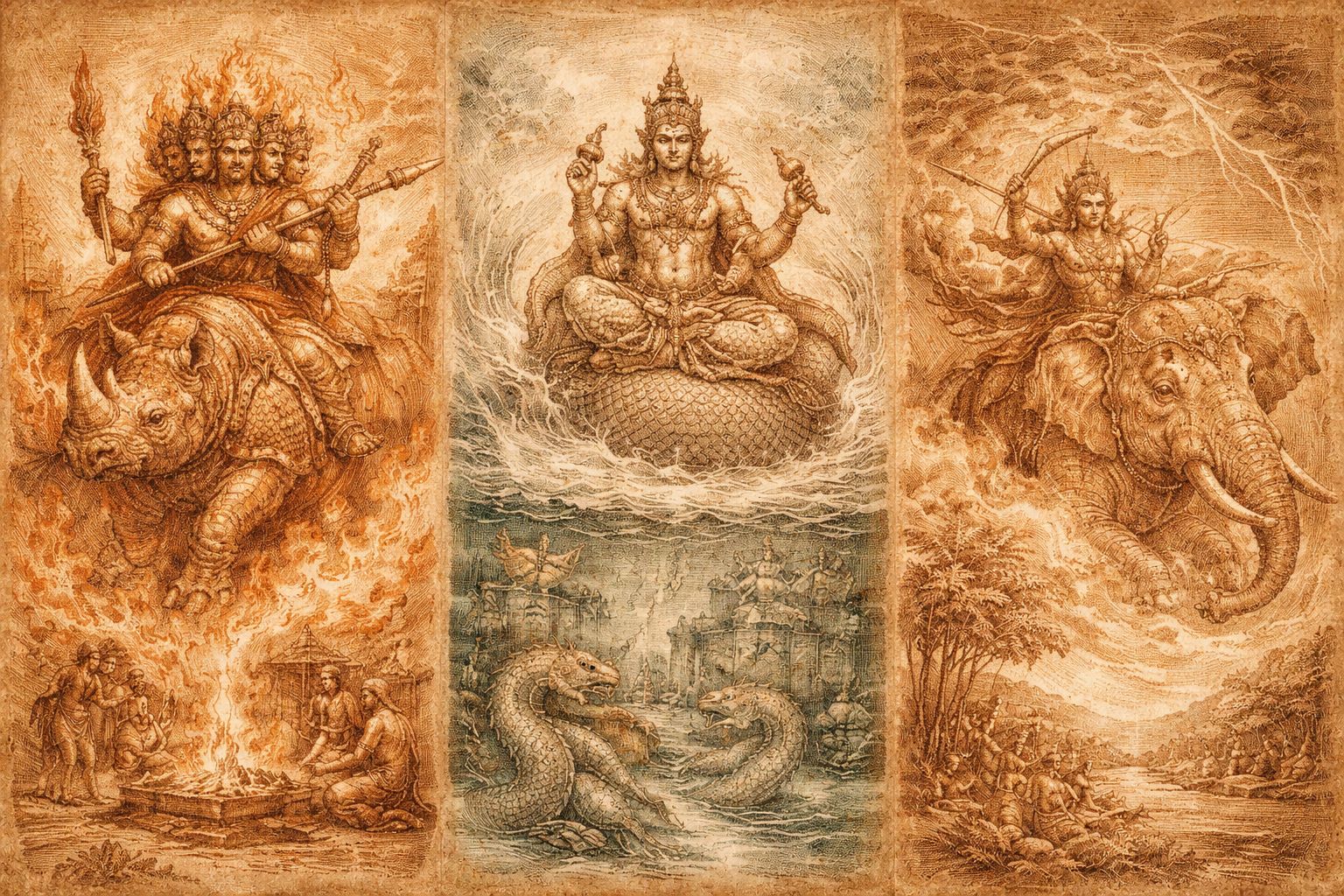

The Measured Powers — Agni, Varuna, and Indra
Angkor is held together not by stone alone, but by restraint.
Every tower rises only because something else is contained; every reservoir endures because something is released slowly. The Khmer did not imagine the cosmos as a theatre of excess, but as a system of forces held in tension—fire that must be kept, water that must be bounded, and storm that must arrive on time.
In this balance stand three ancient powers: Agni, Varuna, and Indra. Fire, water, and storm. Not rivals, not equals, but a triad whose task is restraint rather than domination. Together, they regulate the passage between worlds.
Agni belongs to the earth. He lives at the altar, in the hearth, in the kiln and cremation ground. He is the mouth through which offerings pass, translating substance into ascent. Fire consumes, but it does so lawfully. What enters Agni is not lost; it is prepared. Even destruction, under his governance, is a form of order. Ash is a state of readiness.
Varuna belongs beneath and beyond the visible world. Once the sovereign of cosmic law, he became the keeper of waters—the oceans, the subterranean currents, the naga realms coiled beneath the land. He binds by oath rather than force. Water under Varuna does not flood indiscriminately; it circulates, recedes, returns. Where Agni transforms through heat, Varuna sustains through measure.
Indra occupies the space between. He rules the atmosphere, the unsettled domain where energy becomes movement. Armed with the vajra, he is the god who breaks open what has been hoarded. His storms do not create water; they release it. Rain is not generosity—it is victory over stagnation. Without Indra, Varuna’s waters remain captive and Agni’s heat becomes barren.
These three are not elemental chaos. They are regulators of exchange.
Vedic ritual understood this with precision. In the ancient rite known as the “Dying Round the Holy Power,” fire, rain, sun, and moon are said to dissolve into the wind—the highest and most subtle force—only to be reborn from it. Even the gods must submit to concealment. Power is not constant visibility; it is the capacity to withdraw and return intact.
The body mirrors this order. Agni becomes speech—the fire of articulation in the mouth. Varuna becomes the vital fluids, the continuity of life itself. Indra is breath and circulation, the pulse that moves between them. Fire without water is destruction. Water without movement is decay. Storm without restraint is ruin. Only together do they sustain life.
Khmer architecture renders this cosmology in stone and void. The east, guarded by Indra, receives the first light and the seasonal rains. The west, under Varuna, holds moats and barays—vast bodies of stillness that cool the land and reflect the heavens. The southeast, governed by Agni, is the quarter of ignition and rite, where fire begins its disciplined work. These are not symbols; they are instructions.
Even myth preserves their mutual dependence. Indra’s greatest act is the slaying of the cloud-serpent to free the waters—an act of violence in service of flow. Agni, paradoxically, is called apam-napat, the “grandchild of the waters,” for fire is born from wood nourished by rain. Varuna binds, Indra breaks, Agni completes. None can act alone without becoming destructive.
This is why Angkor does not glorify firestorms, floods, or thunderous conquest. It honours the pause between them. The Khmer world was not built on elemental excess but on timing—when to burn, when to release, when to hold back. Fire was housed. Water was measured. Storm was awaited.
Together, Agni, Varuna, and Indra teach that civilisation is not the triumph over nature, but the disciplined participation in its cycles. Power is not the ability to unleash, but the wisdom to restrain. The temples endure because fire knew when to stop, water knew where to rest, and storms arrived neither too early nor too late.
At Angkor, the gods do not rage.
They keep watch.
—
Receive the next work
Subscribe free to receive new work from the Lucas Varro Library by email.
More from the Library


See Also
A concise and impartial dictionary of absence, promises, quarrels, ordinary objects, and the troublesome instability of words.

The City of Service
The temple we inherit is a building from which almost all necessity has been removed. Nothing must be brought for it to continue being what we call a temple. The sanctuary asks nothing of us. Stone is good at this kind of independence.
A living temple was otherwise.
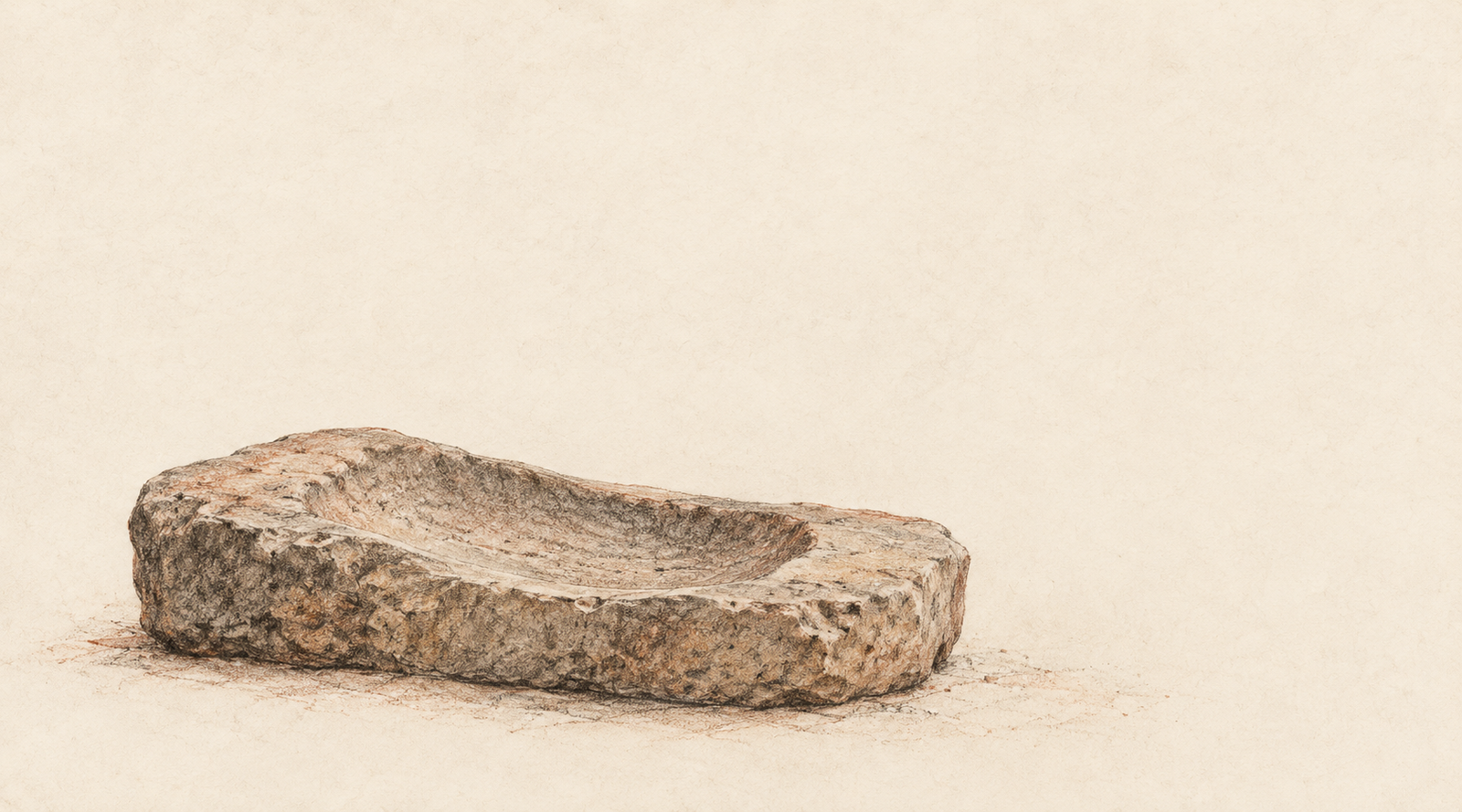
Water had to come in. So did grain, cloth, oil, aromatic substances, fuel. The things required for worship arrived because someone carried them across a threshold.


Houses of Wood, Light, and Smoke
Some of Angkor’s most intimate ruins do not rise above the ground at all. They are postholes, low mounds, hearths and ponds: durable traces of a domestic city built largely from things that decay. To restore that city is to see Angkor not only as stone, but as wood, smoke, water, repair, and people living within calling distance.