
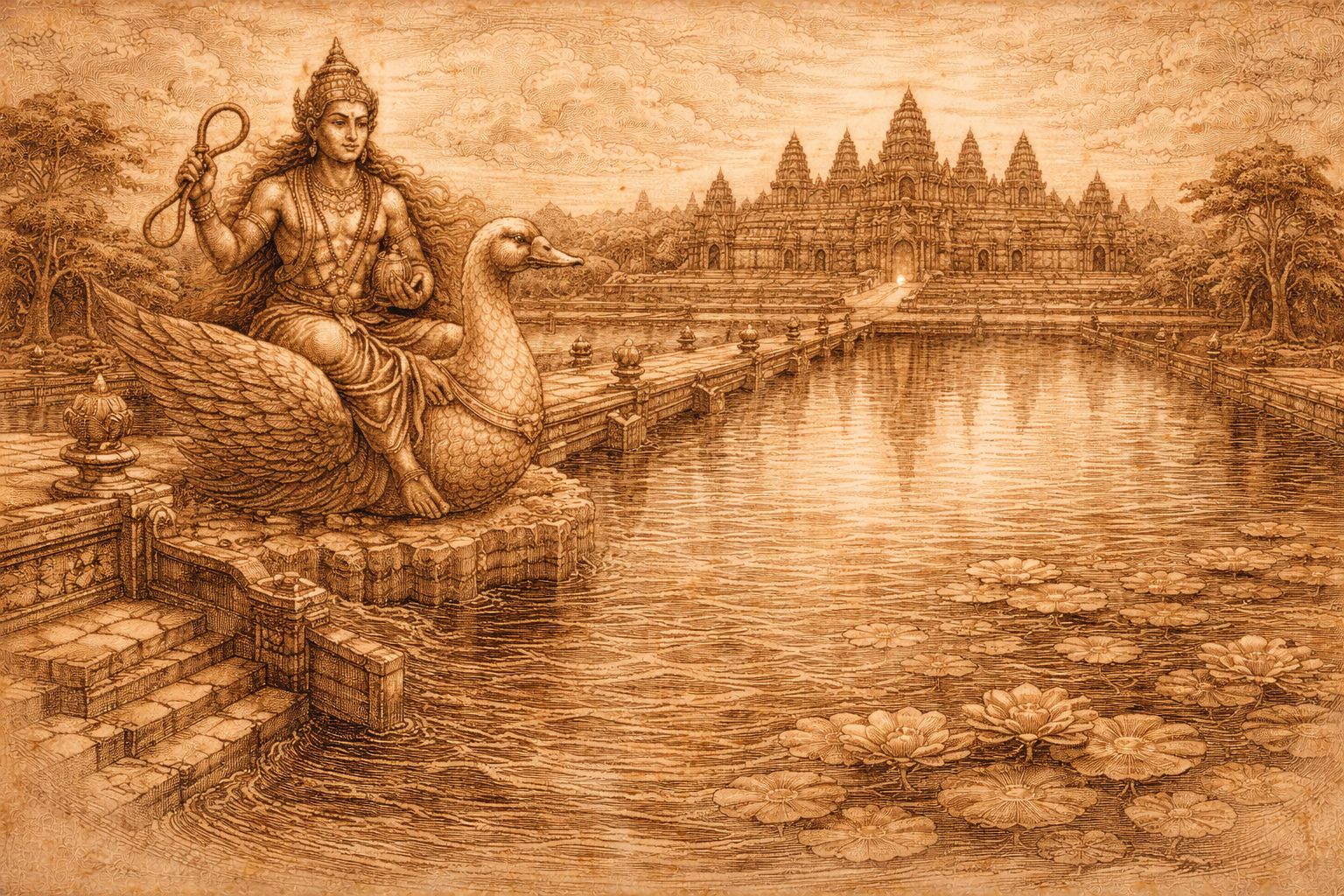

Water as Measure: Varuna and the Discipline of Flow
Angkor is often described as a civilisation built on water.
This is true, but incomplete.
Water here is not abundance. It is restraint.
Moats do not rush. Reservoirs do not spill. Causeways cross water that is held deliberately still. Even the vast barays—among the largest engineered bodies of water in the premodern world—are not expressions of excess, but of containment. Their success lies not in volume, but in balance.
This is where Varuna’s presence becomes legible.
In early cosmology, Varuna governs water not as force, but as law. He oversees the boundary between what flows and what must not. Rivers, under his watch, are not wild; they are accountable. Oceans are not chaos; they are limits. Water becomes a moral substance—capable of sustaining life only when held within measure.
Angkor’s hydraulic imagination follows this ethic closely. Moats define sacred precincts not to protect, but to separate worlds. They mark the passage from ordinary ground into ordered space. To cross water is to submit to regulation: of pace, of attention, of intention. One does not rush across a causeway. The body adjusts.
Reservoirs function similarly. The barays are often spoken of as engines of prosperity, but their deeper role is temporal rather than economic. They store not only water, but time. Rainfall is gathered, delayed, released. Excess is absorbed so that scarcity does not destroy continuity. Water becomes patience made visible.
Varuna’s custodianship operates precisely here—not in spectacle, but in calibration. He ensures that flow does not become flood, that abundance does not become hubris. His authority is present wherever restraint allows life to continue.
This is why water in Angkor is so often still. Reflections matter. Towers double themselves. The world is asked to look back at itself before proceeding. In these moments, water becomes a mirror of order rather than a conduit of force.
Later, Vishnu will inherit the western quarter and the logic of preservation. But Varuna remains embedded in the system—quietly shaping how water is handled, delayed, respected. His ethic persists not in myth alone, but in engineering decisions that favour balance over domination.
To understand Angkor’s water is to understand that mastery here was not conquest. It was listening. The builders did not command water to obey; they learned how much it could be trusted.
Water was not used to prove power.
It was used to maintain sense.
—
Receive the next work
Subscribe free to receive new work from the Lucas Varro Library by email.
More from the Library


See Also
A concise and impartial dictionary of absence, promises, quarrels, ordinary objects, and the troublesome instability of words.


The City of Service
The temple we inherit is a building from which almost all necessity has been removed. Nothing must be brought for it to continue being what we call a temple. The sanctuary asks nothing of us. Stone is good at this kind of independence.
A living temple was otherwise.
Water had to come in. So did grain, cloth, oil, aromatic substances, fuel. The things required for worship arrived because someone carried them across a threshold.


Houses of Wood, Light, and Smoke
Some of Angkor’s most intimate ruins do not rise above the ground at all. They are postholes, low mounds, hearths and ponds: durable traces of a domestic city built largely from things that decay. To restore that city is to see Angkor not only as stone, but as wood, smoke, water, repair, and people living within calling distance.