
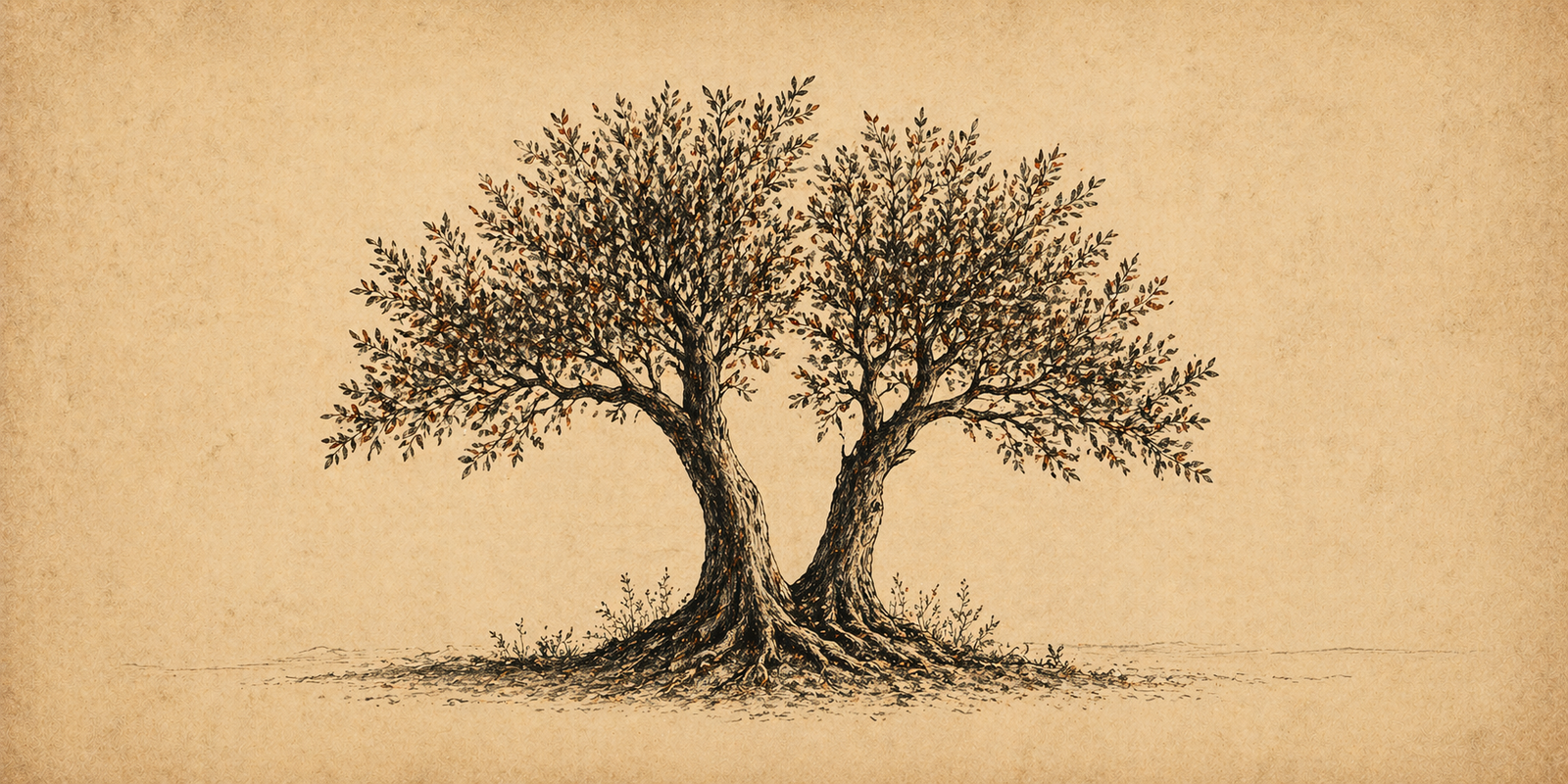

Philemon and Baucis — The Two Trees
Philemon and Baucis — The Two Trees is a literary myth retelling from The Hospitable Dark, returning the old tale of divine visitors, poverty, hospitality, and transformation to the small room where its holiness first begins. Before the temple, before the flood, before the two trees rise from one rooted life, there is only an old couple, a poor house, and strangers at the door.
By the time the strangers came to their door, Philemon and Baucis had been poor for so long that poverty had ceased to feel like an event in their lives and had become, instead, the shape of their attention.
They knew the worth of each thing in the house because each thing remained with them long enough to be known. The stool by the hearth had one leg that liked to wander if it was not set properly on the packed earth. The bronze pot had been mended twice, and held its heat better now than when it was new. The roof kept out the rain in most places if the thatch was laid right before the heavy weather. The olives in the jar had to last. The wine, which had long ago given up any claim to strength, was better for admitting it. Nothing in the room was grand enough to be taken for granted.
They lived in Phrygia, in a district where the land was neither generous nor wholly unkind, but answered a man in proportion to the patience he brought to it. Their cottage stood low and plain among other low and plain dwellings, with reeds in the roof and smoke that could never quite be persuaded to leave by the same route twice. They had not built it in youth; they had merely come to it young enough to think that the greater part of life still lay ahead, and then remained in it until the walls knew the shape of their days.
This is how many marriages become invisible to the world: not by lacking devotion, but by practising it so steadily that it ceases to look remarkable from the outside.
Philemon rose first most mornings, though not by much. Baucis would hear the slight disturbances by which a person who has reached old age negotiates with the day — the care not to knock the stool, the small sound of breath drawn differently when the joints objected, the low cough he thought too familiar to mention. By the time she sat up, he would have coaxed the embers into usefulness and set water to warm.
That morning was like the others in all the ways that matter most when one is about to lose it. The room held its poor order. Light came modestly to the threshold. Baucis cut cabbage on the board worn smooth at the centre by years of use. Philemon stood for a moment beneath the hanging scrap of smoked pork, judging by eye how much could be spared without becoming foolish. They spoke little, and what they said would not have seemed worth preserving to anyone who had not understood that most love is carried in remarks too small for memory.
By midday the road had become hot, and the district had already done what it would later be punished for. Again and again the strangers had come to doors and again and again those doors had remained closed, or opened only far enough to refuse.
A world does not collapse all at once into hardness.
It practises first, with smaller occasions.
Continue reading: Philemon and Baucis — The Two Trees at The Hospitable Dark on Substack.
Also in The Hospitable Dark

The Long Return VII — The Palace of Alcinous
Odysseus reaches the palace of Alcinous, but safety is not yet home. In this seventh instalment of The Long Return, hospitality becomes a moral test: a good house receives the stranger’s body before demanding his story.

When Favour Is Mistaken for Right — On Bellerophon
A companion essay to Bellerophon — The Bridle and the Fall, exploring Pegasus, divine favour, the bridle, heroic ascent, and the danger of mistaking help for permanent right. From The Hospitable Dark, this essay asks why Bellerophon’s tragedy is not false greatness exposed, but real help wrongly remembered.

Bellerophon — The Bridle and the Fall
A literary Greek myth retelling of Bellerophon, Pegasus, and the divine bridle: a tale of heroic ascent, misremembered grace, and the moment a true gift becomes proof in the wrong hands. From The Hospitable Dark, where old stories are retold in a warm, grave voice.
Continue Reading
If this piece found something in you, you may wish to continue the journey elsewhere.
On The Lantern Chronicles, I gather writings from Angkor, myth and legend, contemplative essays, and poetry — works shaped by silence, beauty, wonder, memory, and the deeper questions that follow us through the world.
It is a place for stone and story, reflection and vow, shadow and revelation.
You would be most welcome there.